
[General Election Special] Comparing the Floor Speeches of the Ruling and Opposition Parties’ Negotiating Bloc Leaders
-
Writer
CFE
-



 The Ruling Party Emphasizes Labor Reform and Deregulation, While the Opposition Has Grown Less Distinct
• The People Power Party argues that “labor market flexibility is urgently needed,” while the Democratic Party of Korea emphasizes “sufficient social consensus”
• The opposition criticizes the Yoon Suk Yeol administration for halting the nuclear phase-out while calling for expanded renewable energy… the People Power Party strongly backs the promotion of nuclear power
• A ruling party victory would raise the likelihood of regulatory innovation and structural reform, while an opposition victory would likely produce a climate similar to that of the 21st National Assembly
◈ This report compares and analyzes the pledges, policies, and values of major political parties and candidates ahead of the 22nd general election for members of the National Assembly, scheduled for April 2024, in order to help voters make informed judgments and choices.
■ Introduction
The speech that most clearly reveals a political party’s policy philosophy and direction is, without question, the floor leader’s speech on behalf of the parliamentary negotiating group. Usually delivered by the party leader or floor leader as a representative of the party, it is a relatively lengthy 30- to 40-minute speech covering overall state affairs, legislative activity, and the party’s key policy priorities going forward.
These speeches are given at symbolically important points in the National Assembly calendar. Each year, the regular session of the National Assembly begins in September with speeches by the leaders of the parliamentary negotiating groups. Such speeches are also commonly delivered during the extraordinary session in June or July immediately after the opening of a new National Assembly, as well as during the extraordinary session in February at the beginning of the year. In 2024 as well, with the February extraordinary session underway, Yoon Jaeok, floor leader of the People Power Party, and Hong Ikpyo, floor leader of the Democratic Party of Korea, each delivered a speech on behalf of their respective parliamentary negotiating groups.
As these speeches were delivered by the two major parties’ top parliamentary strategists ahead of the 22nd general election, they offer a highly condensed view of the policy direction and campaign pledges of both the ruling and opposition parties. This report compares and analyzes each party’s position and perspective on the economic order and discusses the implications.
■ (Issue 1) Positions on the Labor Market and Labor Reform
With labor reform consistently cited as a central task of economic and social reform, the two parties’ floor leaders showed sharply contrasting approaches. Yoon Jaeok, floor leader of the People Power Party, made labor reform the first of his five major livelihood reform tasks under the subheading “Labor Reform That Will Evolve Korea,” strongly arguing for both its necessity and the means to pursue it.
By contrast, Hong Ikpyo, floor leader of the Democratic Party of Korea, mentioned labor reform only briefly in about two sentences, and gave no clear indication of support or opposition, nor any detailed plan. The key points from the two speeches are as follows.
Yoon defined Korea’s labor regulations as “Galápagos regulations” and identified a rigid labor market as the most fundamental factor behind Korea’s lagging behind global standards. On that basis, he emphasized labor market flexibility grounded in the free market economic order. By referring to “frequent political strikes,” “large labor unions,” and “the rule of law in labor-management relations,” he also revealed a critical view of illegal and violent union disputes and of social vested interests concentrated in dominant unions.
At the same time, apparently mindful of criticism that this could be seen as excessively anti-union, he added that “the labor market must be supported by creating a social safety net.” He also proposed measures to prevent abuse and unfair practices, saying that “unfair transactions between large corporations and small and medium-sized enterprises must also be corrected more forcefully.”
Hong, meanwhile, effectively expressed opposition to bold labor reform by presenting stronger social safety nets and social consensus as preconditions. At the same time, his remarks suggest continuity with various labor policies pursued under the Moon Jae-in administration, such as guaranteeing the minimum wage, reducing working hours, and equalizing wages between non-regular and regular workers.
■ (Issue 2) Nuclear Power Generation and Renewable Energy Use
Another major issue on which the ruling and opposition parties show a stark difference in perspective is policy on nuclear power generation and the use of renewable energy. Criticizing the radical nuclear phase-out pursued under the Moon Jae-in administration, the People Power Party shifted course after taking office toward significantly increasing the share of nuclear power and reducing dependence on renewable energy. The Democratic Party of Korea, in turn, has pushed back, arguing that this amounts to abandoning the development of next-generation power sources.
In this speech, Yoon Jaeok did not directly criticize the nuclear phase-out, instead limiting himself to presenting the revival of the nuclear power industry as an achievement of the current administration. At the same time, apparently mindful of the risks and environmental burden associated with nuclear power, he pledged the safe disposal of spent nuclear fuel, suggesting concern for the anxieties of local residents in affected areas.
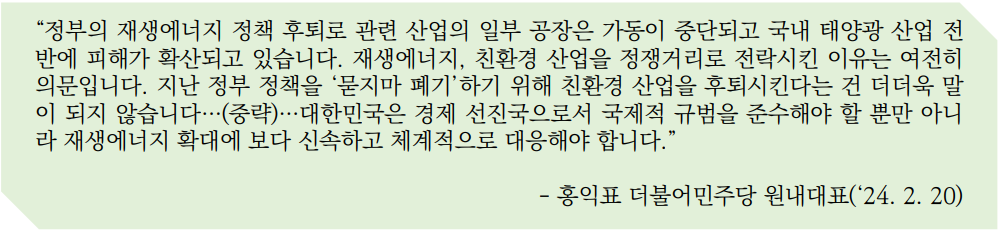
Hong Ikpyo, on the other hand, sharply criticized the Yoon Suk Yeol administration’s energy policy and strongly emphasized the need to expand the share of renewable energy.
In fact, a nuclear phase-out and a higher share of renewable energy can be seen as “twin policies.” The basic structure of the Moon administration’s energy policy was to reduce dependence on nuclear power while making up the shortfall through renewable energy. Within that framework, Hong argued that the previous administration’s policy of fostering renewable energy should be resumed.
■ (Issue 3) Deregulatory Reform vs. Economic Democracy
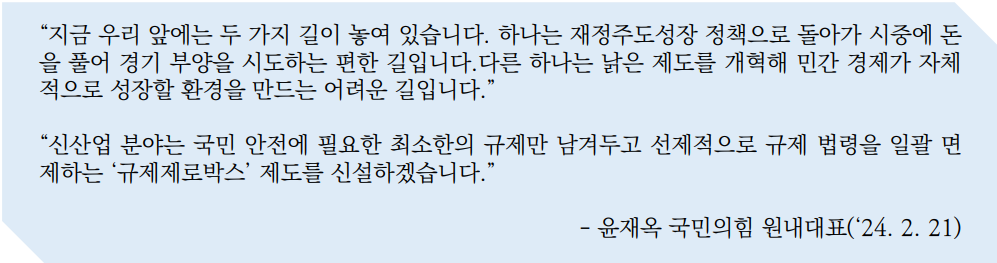
The policy areas emphasized by the two floor leaders in the economic and industrial sphere also diverged. Yoon Jaeok selected “regulatory reform that revives the growth DNA of the Korean economy” as the third of his five major livelihood reform tasks, stressing the following.
More specifically, Yoon noted that only about half of the 223 regulatory innovation bills had passed. He expressed a willingness to amend the Industrial Sites and Development Act and the Act on the Employment of Foreign Workers, and also indicated a policy direction toward abolishing the so-called Mobile Device Distribution Improvement Act, as well as easing the fixed book price system and regulations on large discount stores’ business operations.
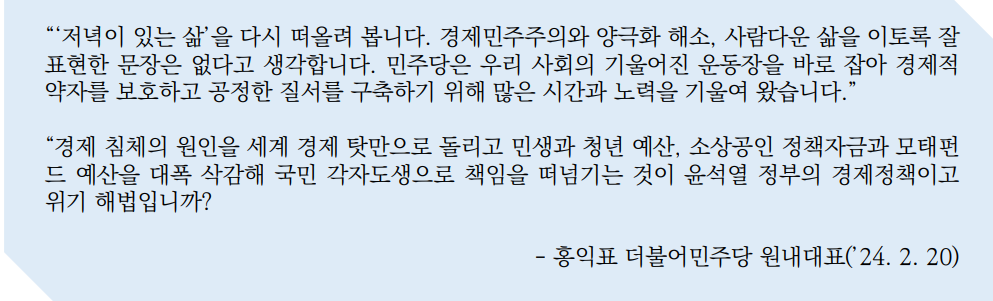
Hong Ikpyo invoked the once widely used political slogan, “a life with evenings.” In doing so, he emphasized the need to protect the economically vulnerable and reaffirmed a commitment to “economic democracy.”
Meanwhile, although Hong’s speech showed some agreement on the need to foster next-generation industries under the theme of an “innovative economy,” it offered no blueprint or clear view on regulatory innovation. Instead, he proposed such measures as the enactment of a “Korean-style IRA,” passage of legislation to foster the artificial intelligence industry, and expanded R&D spending.
■ Evaluation and Implications
Traditionally, the conservative People Power Party has focused on free competition based on the free market economy, regulatory innovation, removal of barriers to entry, and sustainable “selective welfare.” The Democratic Party of Korea, which presents itself as a progressive party, has advocated protecting the vulnerable, redistribution, stronger corporate regulation, and universal welfare. Yet in these speeches, the contrast between the ruling and opposition parties in their views of the economy and industry appears relatively muted, making their differences less sharply defined than expected.
In particular, Hong Ikpyo’s speech gives the impression of being considerably more moderate than the Democratic Party’s previous line and stance. In fact, he even proposed active cooperation between the two parties while expressing support for the need for government policy assistance to help new industries achieve a soft landing and to support innovative firms. Compared with Yoon Jaeok, who clearly laid out the traditional conservative value system through labor reform and regulatory innovation, the Democratic Party of Korea appeared more focused on stability than on ideological clarity.
This also seems clearly related to the fact that economic and industrial policy competition between the ruling and opposition parties has been relatively weak ahead of the 22nd general election. Instead, public attention has been concentrated on political issues such as the nature of the president’s governance, the opposition party’s judicial risks, and controversies surrounding the president’s family.
Nevertheless, differences in the two sides’ basic understanding of and approach to the economic order remain visible throughout. The People Power Party stresses the urgency of labor reform and promises swift legislative action at the National Assembly level after the election, whereas the Democratic Party of Korea places greater importance on social consensus and tripartite dialogue among labor, management, and government. Accordingly, if the ruling party wins the general election, labor reform is likely to accelerate rapidly. If the opposition prevails, however, the atmosphere is expected to be little different from that of the 21st National Assembly.
Energy policy, too, is likely to be shaped differently depending on the election outcome. If the opposition continues to hold a majority of seats, it would be difficult to rule out additional legislation aimed at increasing dependence on renewable energy and pressuring companies to implement RE100 commitments.
In addition, since the People Power Party has already promised to expand non-face-to-face medical treatment, foster the innovative mobility industry, and provide additional support for strategic industries such as semiconductors, a ruling party victory would likely lead to sweeping structural changes across industry as a whole. A full-scale revision of the Serious Accidents Punishment Act and amendments to the Labor Standards Act to supplement the 52-hour workweek system would also become more likely. At the same time, deregulation to facilitate the supply and demand of foreign labor is also likely.
On the other hand, if progressive opposition parties including the Democratic Party of Korea secure a majority in the National Assembly, there is a strong possibility that many anti-market and anti-business bills pursued in the 21st National Assembly will be pushed again. There would also likely be considerable political friction over such measures as easing the Serious Accidents Punishment Act, as proposed by the government, and introducing a broad flexible work-hour system.
Original title: [총선 특집 주요 정당 공약·정책 분석] 여야 교섭단체 대표 연설 비교
Author: Ju-jin Yoon
Date: 2024-02-27
Source: https://www.cfe.org/bbs/bbsDetail.php?cid=bill&pn=1&idx=26476