
Raising damages to stop technology theft... assessing concerns over side effects between large and mid-sized firms
-
Writer
CFE
-



 Sympathy for the legislative intent, but concerns over increased disputes and reduced cooperation between large and small firms
▪ Client firms sued for technology theft are required to present a “specific manner of conduct,” causing confusion over whether this means presentation or proof
▪ Unlike publicly disclosed patents, secret technologies have unclear targets and scope of infringement
▪ Technology theft is both an infringement of property rights and an anti-market act… Companies themselves must establish principles of ethical management
■
Contents of the bill to amend the law
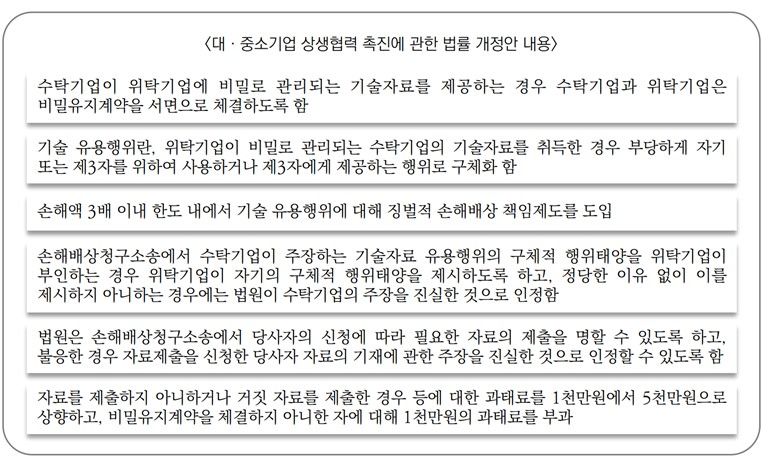
In July 2021, the 21st National Assembly passed a partial amendment to the Act on the Promotion of Collaborative Cooperation between Large Enterprises and Small-Medium Enterprises in order to prevent the leakage of subcontractors’ technologies and strengthen damages for technology theft by principal contractors. This is the so-called “SME Technology Theft Prevention Act.” In some quarters, it is also referred to as the “Win-Win Cooperation Act.” The details are as follows.
Overall, the amendment deals with preventive measures for cases in which a principal contractor—likely to be a large or mid-sized company—misappropriates or steals the technology of a subcontractor, which is likely to be an SME (confidentiality agreements); defining the specific scope of technology misappropriation; expanding the scope of damages to be borne by the principal contractor when losses occur due to technology misappropriation (through the introduction of punitive damages); distributing the initial burden of proof regarding whether technology misappropriation occurred (from the subcontractor to the principal contractor); and strengthening sanctions for refusal to submit materials during litigation.
■
Amendment process and current status of the bill
This law was prepared as a revised bill by integrating and jointly reviewing bills proposed by the government and six lawmakers from both the ruling and opposition parties, and it passed the plenary session on July 23, 2021. After Cabinet approval, it was promulgated on August 17, 2021.
The only lawmaker to vote against it was Yang Geumhee of the People Power Party. Of the eight abstentions, seven were from People Power Party lawmakers, while Jo Eungcheon of the Democratic Party of Korea was the only ruling-party lawmaker to abstain.
As it was a noncontroversial bill, support overwhelmingly exceeded opposition and abstentions. However, during deliberations by the Legislation and Judiciary Committee, which was responsible for the final legal and textual review, some objections and concerns were raised. The reason was Article 40-4, which the amendment sought to newly introduce. A dispute arose between the government and the ruling and opposition parties over the so-called “shift in the burden of proof.”
Under the amendment, when a damages suit arises between a subcontractor and a principal contractor over technology misappropriation, if the subcontractor alleges that the principal contractor misappropriated its technology, the principal contractor is required to “present a specific manner of conduct” showing that this was not the case. More generally, if an SME alleges technology theft by a large company, the large company must present “facts supporting that no such act occurred.” If it fails to do so, the intent of the bill is to accept the subcontractor’s (SME’s) claim as true.
In this regard, the business community and some People Power Party lawmakers argued that this effectively places the burden of proof unilaterally on large companies (principal contractors), whereas the Moon Jae-in administration and the Democratic Party of Korea countered that it merely eases SMEs’ burden of proof to some extent, and that it is enough to “present” specific facts—the burden of proof itself has not shifted. The debate between Jeon Juhye of the People Power Party and Minister of SMEs and Startups Kwon Chilseung clearly illustrates why this disagreement arose.
In response, Song Gihun of the Democratic Party of Korea argued that, in reality, unless the large company, as the original contractor, presents facts specifically denying technology theft, it is difficult to determine responsibility, and that it is therefore possible to distribute part of the burden of proof to the defendant (the principal contractor).
At the 5th session of the Legislation and Judiciary Committee of the 388th National Assembly, Kim Hyeongdu, Deputy Minister of the National Court Administration, offered the following view on this provision.
Article 40-4(1) of the bill provides that “where the principal contractor has reasonable grounds for being unable to disclose it,” the contractor need not present the specific manner of conduct, and paragraph (2) allows the court to order the submission of materials to determine whether such grounds are justified.
Paragraph (4) further provides that if the court does not accept this and again orders presentation, the principal contractor may file an “immediate appeal.” In a sense, this guarantees a right of defense. The provision on immediate appeal was a revision reflecting the opinion of the National Court Administration.
■
Assessment of the bill
1. Measures are needed to prevent side effects arising from the unclear boundary between “presentation” and “proof”
As discussed above, when a subcontractor alleges that technology misappropriation occurred, the principal contractor denying it bears the initial burden of presenting a “specific manner of conduct.”
Given the practical reality that SMEs, which clearly face many limitations in manpower, funds, and management conditions, cannot realistically be expected to bear the entire burden of proof, there is broad sympathy for the view that shifting part of that burden to large companies is unavoidable.
However, as Jeon Juhye repeatedly asked, it remains controversial whether the matter ends with mere “presentation,” or whether, after presentation, the principal contractor must additionally “prove” the validity and truthfulness of those facts. Once litigation begins, it is highly likely that the subcontractor will deny the specific manner of conduct presented by the principal contractor, and in that case the principal contractor will have to make additional efforts to persuade the court.
As a result, some argue that the law could discourage large companies from building cooperative relationships with SMEs and engaging in joint technology development. According to a September survey conducted that same year by the Federation of Korean Industries (FKI) of the 1,000 largest companies by domestic sales, 24.4% of respondents were concerned about “a sharp increase in disputes with partner firms,” while 22.4% identified as a likely problem “dealing only with existing firms for fear of problems if transactions are discontinued.” Another 17.9% cited “hindrance to technological cooperation with partner firms.” There is also the possibility that global foreign companies may come to avoid Korean SMEs.
Accordingly, some argue that institutional measures are needed to clearly distinguish between presentation and proof. One alternative being discussed is legislation requiring an institution composed of third-party technical experts to determine whether technology theft occurred based on materials submitted by both the principal contractor and the subcontractor.
2. As technical materials differ in nature from patents, the scope of proof required of principal contractors may expand
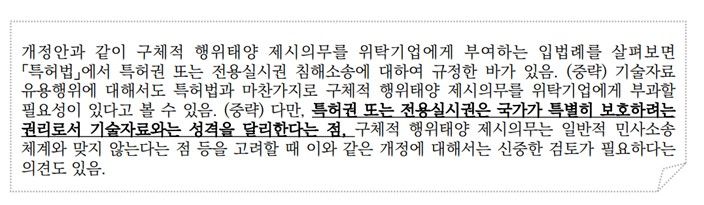
The most important precedent referred to in drafting this amendment was patent law. Article 40-4 of this amendment in effect applies, almost verbatim, Article 126-2 of the Patent Act, the “obligation to present a specific manner of conduct.” The legislative review report submitted to the Legislation and Judiciary Committee explains it as follows.
What is the difference between the content of a patent right under patent law and the “technology” referred to in technology misappropriation under this bill?
A patent means that the state officially recognizes an exclusive and monopolistic right over technology or other inventions created by an individual or company. In return, the contents of a patent are disclosed so that anyone can inspect them. Therefore, the object of infringement can be sufficiently specified, and both the party using the patented technology and third parties can determine whether infringement has occurred.
By contrast, when technical materials are alleged to have been misappropriated, their content and scope are kept secret by the subcontractor. For that reason, the principal contractor cannot know the object or scope of the alleged technology misappropriation, so the subcontractor must first specify them. Therefore, compared with the specific manner of conduct that must be presented in patent infringement disputes, the specific manner of conduct that must be presented in technology misappropriation disputes may become much broader. The burden of proof thus becomes heavier.
3. Technology theft is an anti-market unfair practice; companies themselves must strengthen ethical principles to protect corporate value
In June 2023, the Yoon Suk Yeol administration and the People Power Party announced, through policy consultations, that punitive damages for technology theft would be raised from triple to quintuple damages in order to eradicate harm from technology theft. They also plan to establish a “one-stop technology protection platform” through which the government will support the entire process from the occurrence of technology theft to the resolution of the damage.
Intellectual property rights are one form of property right protected under our Constitution and laws, giving legal rights to human technology and ideas. The basic foundation of the market economic order is the system of property rights. Only when ownership and property rights are fully guaranteed do economic actors have the incentive to pursue profit, accumulate wealth, and form capital, the engine of growth. In that process, competition, investment, and innovation take place, and social utility increases through free trade and transactions.
However, it should not be overlooked that legislation that defines a particular group of economic actors as a “potential class of offenders” may itself produce side effects by hindering free cooperation and transactions among firms. In that sense, companies themselves need to establish principles of ethical management that can prevent and sanction the theft of other firms’ technology by their executives and employees. This is a preemptive measure to prevent judicial punishment and a decline in corporate credibility arising from allegations of technology theft, and it can also be seen as a self-protective measure to safeguard shareholders’ property rights.
Wiki:
https://www.cfe.org/w/bbsDetail.php?idx=85
Original title: 기술 탈취 근절 위해 손해배상 상향조정...대·중기 간 부작용 우려 평가
Author: Ju-jin Yoon
Date: 2023-07-20
Source: https://www.cfe.org/bbs/bbsDetail.php?cid=bill&pn=3&idx=25892