
Investment Tax Credit Raised from 8% to 25%: K-Chips Act II Positive for Investment and Employment
-
Writer
CFE
-



 A “Mere Dribble” Over Fears of Reduced Tax Revenue, a “Big Boost” Amid Warnings of a Semiconductor Crisis… The K-Chips Act Passed After Many Twists and Turns
▪ Aftershocks from the passage of the “8% Special Tax Treatment Control Act” in December 2022 led the government and the National Assembly to rush through additional revisions
▪ In the wake of the U.S. CHIPS Act, Korea also sought a “survival solution” amid global competition over tax cuts and incentives
▪ Although tax revenue may decline in the short term, long-term effects are expected through increased investment and employment
■
Details of the Legislative Amendment
The “Partial Amendment to the Restriction of Special Taxation Act” passed by the National Assembly on March 30, 2023, is also commonly called the “K-Chips Act.” It was modeled after the “CHIPS and Science Act,” which took effect in the United States in August 2022.* It applies higher tax credit rates not only to investments in national strategic technologies such as semiconductors, but also to investments for the commercialization of new growth and source technologies. In that sense, it can be seen as a law intended to encourage greater corporate investment not only in semiconductors but also in key industries such as secondary batteries, vaccines, and displays.
However, shortly before this law was passed, in December 2022, the National Assembly had already processed an amendment to the Restriction of Special Taxation Act. That amendment likewise raised investment tax credit rates for key technologies such as semiconductors. Why, then, did the National Assembly process similar legislative amendments in succession with only about a three-month gap? The answer becomes clear when the December 2022 bill (the first amendment) and the March 2023 bill (the second amendment) are examined together.
The adjustments to investment tax credit rates can largely be divided into national strategic technologies, new growth and source technologies, and general categories, with a separate temporary adjustment to investment tax credit rates specially applied to increased investment amounts in 2023. As shown in the table, the changes from before the first amendment through the second amendment are listed in sequence.
As the table shows, the increase reflected in the second amendment was larger than the increase reflected in the first amendment. The investment tax credit rate for large corporations investing in national strategic technologies nearly doubled (8% → 15%), and when the temporary investment tax credit rate applicable only to increased investment in 2023 is added, they receive a tax benefit of 25%. Small and medium-sized enterprises investing in national strategic technologies can receive deductions of up to 35%.
■
Revision Process and Legislative Status
First Amendment
The dramatic increase in the deduction rate during the second amendment process was the result of widespread dissatisfaction across the economic and industrial sectors over the first amendment, along with President Yoon Suk Yeol’s strong call for further revision of the law.
In fact, even during discussions on the first amendment, there were consistent calls to raise the investment tax credit rate for large corporations investing in national strategic technologies to 25%.
The reason was the United States and Taiwan. The U.S. CHIPS Act, which had already taken effect, included tax credits of up to 25% for semiconductor manufacturing equipment investment, and at the time Taiwan had likewise introduced a bill to raise its investment tax credit rate to 25%. (The law in fact passed Taiwan’s Legislative Yuan in January 2023.) China also announced that it would pour a massive 187 trillion won into semiconductor technology development by 2025, fueling claims of a “crisis in Korea’s semiconductor industry.”
The ruling People Power Party formed a Special Committee on Strengthening Semiconductor Industry Competitiveness (hereafter, the “ruling party semiconductor special committee”), appointed independent lawmaker Yang Hyangja, an industry expert, as its chair, and began preparing early to raise investment tax credit rates. It proposed allowing 20% of investment by large corporations and 25% by mid-sized firms in national advanced strategic industry facilities through 2030 to be deducted from corporate tax. Meanwhile, the Democratic Party of Korea opposed the ruling party’s proposal, arguing that tax credits for large corporations and mid-sized firms should be capped at 10% and 15%, respectively.
The Ministry of Economy and Finance was even more defensive. Concerned about reduced tax revenue resulting from expanded tax credits, it proposed an 8% investment tax credit rate for large corporations investing in national strategic technologies. Amid intense political confrontation between the ruling and opposition parties, the Restriction of Special Taxation Act drifted until the government’s proposal—an “8% tax credit for large corporations”—passed the plenary session. The status of its passage was as follows.
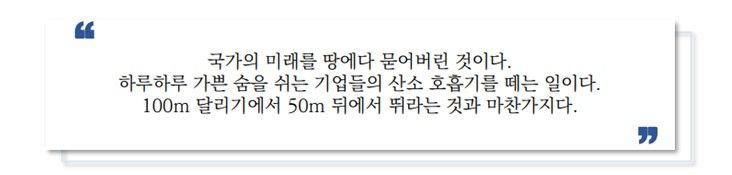
After the bill passed, Yang Hyangja, chair of the ruling party semiconductor special committee, issued the following statement.
The backlash to the first amendment was fierce. The business community and the media poured out criticism, calling it “half-baked,” “a virtual retreat,” and “an anticlimax.” One week later, President Yoon Suk Yeol underscored the need for an additional amendment, saying, “I ask the Ministry of Economy and Finance to actively review measures, in consultation with relevant ministries, to further expand tax support for semiconductors and other national strategic industries.”
The Ministry of Economy and Finance moved quickly. On New Year’s Day, Deputy Prime Minister for Economic Affairs Choo Kyung-ho promised to announce within a week a plan to raise the investment tax credit rate for national strategic technologies to over 10%, and on the 3rd, the government unveiled a proposal to raise the tax credit rate for large corporations investing in national strategic technologies to as high as 25% (15% plus an additional temporary 10% for increased investment).
Second Amendment
When the extraordinary session of the National Assembly opened in February of the following year, discussions began on the government-proposed amendment to the Restriction of Special Taxation Act. In the Tax Subcommittee of the Strategy and Finance Committee, the competent standing committee, the Democratic Party opposed the additional benefits going to large corporations and expressed concern about short-term tax revenue losses caused by tax credits. It also showed discomfort with the government’s abrupt shift in position: in December 2022, it had argued for the so-called “8% plan,” only to quickly reverse course and advocate raising the tax credit rate again.
Despite various criticisms and concerns, as the global “semiconductor war” intensified and warning signs appeared in domestic companies’ semiconductor exports, public opinion began to tilt toward further raising investment tax credit rates. The Democratic Party of Korea then indicated during the March extraordinary session that it would accept the proposal from the government and the ruling party, opening the way for passage. On March 30, the National Assembly held a plenary session and passed the amendment to the Restriction of Special Taxation Act. The status of its passage was as follows.
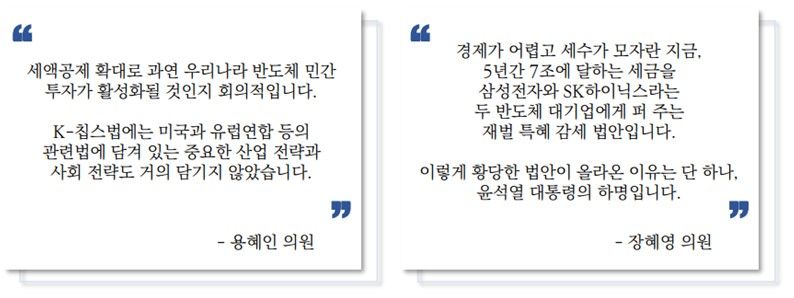
Unlike the vote on the first amendment, the second amendment did draw opposing votes. There was also debate against the bill. Yonghye In, a lawmaker from the Basic Income Party, said she opposed the bill because it lacked a more fundamental strategy for responding to the U.S.-led effort to restructure the semiconductor supply chain. Jang Hyeyoung of the Justice Party emphasized that the bill was effectively a “special favor for chaebol” and even characterized it as legislation ordered from above by President Yoon Suk Yeol.
1.
A Survival Solution to Respond to the U.S.-Led “De-Globalization” Strategy in Semiconductors
The previous free-trade order, under which semiconductors were produced and traded freely across borders and political blocs within a globally specialized division of labor, is being replaced by an order in which semiconductors are strategically produced and traded within exclusive and monopolistic cooperative relationships among friendly and allied countries. Through the CHIPS and Science Act, the United States seeks to prevent major semiconductor firms from expanding production facilities in China and ultimately to drive “de-Chinaization.” U.S. Secretary of Commerce Gina Raimondo openly revealed that intent, saying, “America’s goal is to be the only country in the world where every company with advanced semiconductor technology conducts research and development and mass production.”
For Korean semiconductor companies, which already have large-scale production facilities in China, this has created a situation in which they must seek new investment destinations to replace China. If Korea’s investment environment improves, the incentive to invest domestically rises accordingly, while dependence on China can be reduced at the same time—a double benefit. Expanding investment tax credit rates for national strategic technologies can therefore be seen as a national-level survival strategy to reduce risks for Korean firms amid the accelerating order of “technology supremacy competition.”
2. An Unavoidable Choice Amid Global Competition in Corporate Tax Cuts and Incentives
Another major variable that must be considered in deciding whether to expand investment tax credits is that major countries around the world are engaged in a “tax-cut race” to reduce corporate tax burdens, including corporate income taxes, while also offering extraordinary incentives to attract manufacturing firms.
According to the 2022 Tax Handbook published in April 2022 by the National Assembly Budget Office, 20 OECD countries lowered corporate tax rates between 2011 and 2021, while only six countries—including Korea—raised them. Countries that reduced corporate tax rates included many manufacturing powerhouses such as the United States, Japan, the United Kingdom, and France.
The United States allocated subsidies worth about $39 billion (50 trillion won) for companies building semiconductor plants domestically, while the European Union announced that it would mobilize €43 billion (62 trillion won) to foster the semiconductor industry within the region. The Japanese government provided a subsidy of 476 billion yen (4.6 trillion won) to Taiwan’s TSMC, which is building a semiconductor plant in Kumamoto Prefecture.
This is not limited to semiconductors. In April 2023, the Japanese government decided to support Honda’s battery investment plan with 160 billion yen (about 1.46 trillion won), and in June it decided to provide a subsidy of 120 billion yen (1.09 trillion won) for Toyota’s battery production expansion plan. To foster the display industry, the Chinese government is providing support for land, water, and electricity costs, as well as subsidies for manufacturing equipment.
According to the OECD, government industrial promotion and support policies—through public spending, tax support, and financial preferences—increased from 3,909 cases in 2018 to 5,081 cases in 2020.
In a situation where major countries around the world are making all-out efforts to attract foreign firms and encourage the reshoring* of their own companies through institutional and financial support, it appears that the Korean government also needed strong incentives to prevent an exodus of domestic firms and induce expanded domestic production facilities.
* Reshoring: the phenomenon in which companies that moved production facilities overseas to reduce production and labor costs return to their home country
3. Short-Term Concerns About Reduced Tax Revenue, but Long-Term Expectations of Growth and Higher Revenue
Another issue surrounding the expansion of investment tax credit rates is concern over “reduced tax revenue.” In its Fiscal Estimates and Tax Issues report published in June 2023, the National Assembly Budget Office estimated that the increase in the tax credit rate for national strategic technologies and the introduction of temporary investment tax credits would reduce 2024 tax revenue by 2.9991 trillion won. The government also expects a shortfall in tax revenue.
In the short term, broader tax deduction coverage naturally means tax revenue may decline under a simple calculation. In the long term, however, some expect that it will instead contribute to expanding tax revenue and promoting economic growth. This is because if companies move forward with investments that had been postponed in their internal decision-making process in order to benefit from temporary investment tax credits, their spending and hiring will also increase accordingly, stimulating the market.
The Federation of Korean Industries (FKI), in its November 2022 report “An Analysis of the Economic Effects of Corporate Tax Cuts,” found that a 1 percentage point cut in the top corporate tax rate increases corporate investment as a share of total assets by 5.7 percentage points and employment by 3.5%. The expansion of investment tax credit rates, which effectively amounts to a tax cut, is expected to have the same effect.
Wiki:
https://www.cfe.org/w/bbsDetail.php?idx=84
Original title: 투자세액공제율 8% → 25%, K-칩스법Ⅱ 투자·고용에 긍정적
Author: Ju-jin Yoon
Date: 2023-07-13
Source: https://www.cfe.org/bbs/bbsDetail.php?cid=bill&pn=3&idx=25875