
Revised Commercial Act: A Direct Violation of Shareholders’ Ownership and Property Rights
-
Writer
CFE
-

 The strengthened 3% rule and separate election of audit committee members have made corporate management even more difficult
▪ The Revised Commercial Act passed in December 2020 directly infringes on shareholders’ ownership and property rights
▪ Greater risk of threats to management control, raising concerns that strong companies may become “prey” for speculative capital
▪ A “Galapagos” regulation introduced 63 years ago and found only in Korea… the business community is united in calling for improvement
■
Details of the legal amendment
On December 9, 2020, three bills—collectively nicknamed both the “Three Fair Economy Acts” and the “Three Corporate Regulation Acts”—passed the National Assembly. Among them, the economic bill that drew the most attention was the Revised Commercial Act, whose main contents are as follows.
In this case, a parent company shareholder must hold at least 1% of the total issued shares if the company is unlisted, and at least 0.5% of the total issued shares continuously for six months or longer if it is a listed company. The scope of litigation includes not only directors of the subsidiary, but also its promoters, executive officers, auditors, and liquidators.
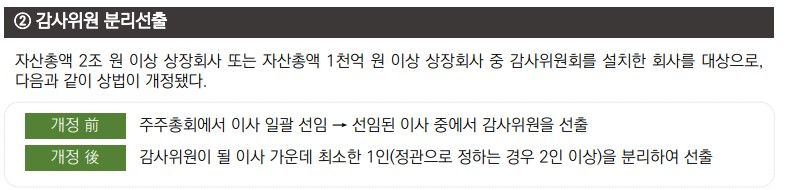
Before the amendment, the Commercial Act did not distinguish between director candidates who would become audit committee members and those who would not; all directors were elected together first, and then audit committee members were selected from among them. As a result, the rule limiting the controlling shareholder’s voting rights to 3% had little practical effect. By contrast, under the amended Commercial Act, the first audit committee member is elected separately and the 3% rule applies at the same time, making it far more likely that audit committee members will be elected according to the preferences of minority shareholders.
■ Status of deliberation and passage
This bill was already highly controversial from the moment it was first introduced. When the Legislation and Judiciary Committee’s subcommittee, the competent standing committee, failed to reach any meaningful conclusion, the then-ruling Democratic Party of Korea took the lead in forming an agenda coordination committee* and passed an alternative bill reflecting the ruling party’s preferred direction, which was then referred to the full committee. The then-opposition People Power Party opposed the bill’s passage in the standing committee chamber, chanting, “Those who thrive by dictatorship perish by dictatorship!” and “It will fail! It will fail! It will fail!” Nevertheless, Yoon Hojung, chair of the Legislation and Judiciary Committee and a Democratic Party lawmaker, pushed the bill through by vote.
The Revised Commercial Act submitted to the plenary session was voted on and passed on December 9 as follows.
■
Evaluation of the bill
1. Infringement of shareholders’ ownership rights, property rights, and management rights
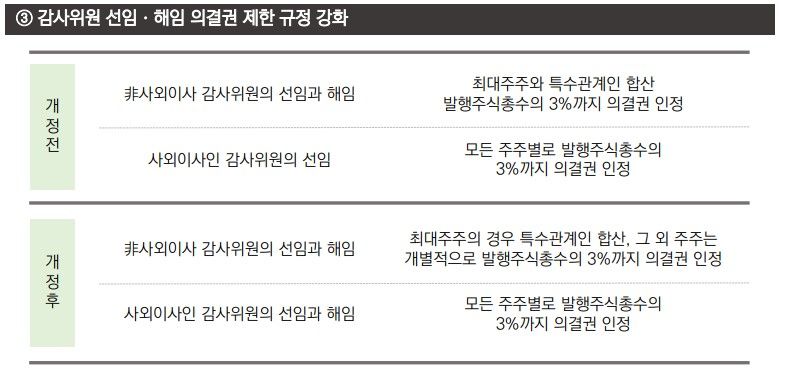
Who owns a company? In principle, ownership of a corporation belongs to its shareholders. Recognizing ownership in proportion to the amount of equity held is a fundamental principle of the market economic order. Political democracy follows the principle of one person, one vote, but shareholder capitalism follows the principle of one share, one vote. Restricting each shareholder to exercising voting rights of only up to 3%, regardless of the size of the stake held, in effect threatens shareholders’ ownership rights and the management rights they may exercise on that basis. Article 37(2) of the Korean Constitution provides that “the essential aspects of freedom and rights shall not be violated.” In a market economy, property rights fall within those essential rights. This is why controversy over the “unconstitutionality” of the 3% voting cap continues to recur. There is also criticism that it violates the “principle of shareholder equality.” In Case 2018Da9920, the Supreme Court held that “shareholders, in their legal relationship with the company, must be treated equally according to the number of shares they hold. Absent special circumstances, any agreement under which the company grants superior rights or benefits only to certain shareholders in violation of this principle is null and void.” In the case of the controlling shareholder, voting rights are restricted by aggregating the holdings of related parties, whereas ordinary shareholders are not subject to the same rule, resulting in their enjoying a comparatively superior position.
2. Minority shareholder participation remains weak in practice... while threats to corporate control and the possibility of outside intervention increase
This amendment to the Commercial Act is broadly based on two stated purposes. The first is monitoring and checking large shareholders. The second is expanding minority shareholder participation. Accordingly, on the one hand it restricts the voting rights of the controlling shareholder and related parties, while on the other it broadens opportunities for minority shareholders through the multiple derivative suit system and the separate election of audit committee members. In reality, however, there is growing concern that the originally intended expansion of minority shareholder participation and authority has failed to materialize, while only the risk of management interference and threats to control by speculative capital and activist funds has increased.
For example, in the case of an “audit committee member who is not an outside director,” the controlling shareholder may exercise voting rights only up to 3% when combined with related parties. By contrast, if a group seeking to attack management control strategically splits 3% stakes among multiple shareholders or funds and has each of them exercise voting rights, it can exert substantial influence over the election of audit committee members. Even in the case of an audit committee member who is an outside director, because each shareholder’s voting rights are valid only up to 3%, the same result may occur. The same rule applies mutatis mutandis to ordinary auditors.
Why do such concerns arise? Because of the powerful authority and internal position of auditors and audit committee members. Under the pretext of audit duties, they can freely access key technologies and management-related information within the company, and they may also maliciously obstruct major investment decisions. Meanwhile, complaints are also mounting that this rule only makes corporate management more difficult, as many companies have failed to appoint auditors at all because the 3% voting cap prevents them from meeting quorum requirements.
3. The 3% rule, born in 1961, is a Galapagos regulation found only in Korea
Under Korean law, the controversial 3% rule was first introduced in 1961 in the original Commercial Act enacted by the Legislation and Judiciary Committee of the Supreme Council for National Reconstruction.
What about major foreign countries? According to Research on Corporate Systems to Promote Corporate Growth, published in 2013 by the Korea Institute for Industrial Economics and Trade, it is difficult to find provisions in the commercial laws of major countries that restrict the voting rights of large shareholders, controlling shareholders, or related parties when appointing auditors or audit committee members.
The Federation of Korean Industries (FKI) likewise announced that, after reviewing the relevant legal systems of the G5 countries—the United States, the United Kingdom, Germany, France, and Japan—it found no legislative examples of separate election of audit committee members or restrictions on major shareholders’ voting rights.
The business community’s position is that the “3% voting rights restriction” should be eased as soon as possible. In a 2022 survey by the Korea Chamber of Commerce and Industry (KCCI) of 336 listed companies on “Recent Difficulties in Shareholders’ Meetings and Changes in Shareholder Activities,” 68.2% of responding firms said they were experiencing difficulties due to the separate election system for audit committee members.
Wiki:
https://www.cfe.org/w/bbsDetail.php?idx=83
Original title: 상법개정안, 주주소유권과 재산권 정면 침해
Author: Ju-jin Yoon
Date: 2023-07-06
Source: https://www.cfe.org/bbs/bbsDetail.php?cid=bill&pn=3&idx=25867