
A 1% Cut in Corporate Tax Will Help Create Jobs and Revitalize the Economy
-
Writer
CFE
-


 A 1% Cut in the Corporate Tax Rate Will Help Create Jobs and Revitalize the Economy
Main Provisions of the Bill and Legislative Status
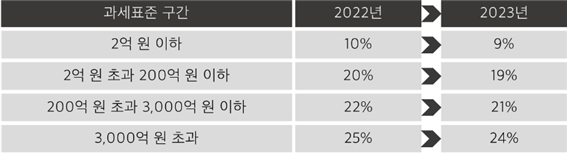
On December 23, 2022, the National Assembly held a plenary session and passed an amendment to the Corporate Tax Act that lowered the tax rate by 1 percentage point across all tax base brackets. As a result, the top corporate tax rate fell from the previous 25% to 24%.
The amendment was proposed by 40 lawmakers, including Rep. Seonggeol Ryu, and 274 lawmakers participated in the vote. The voting results were as follows.
During the voting process, a total of three lawmakers came forward to speak in debate. The main arguments for and against were as follows.
“I am convinced that a cut in the corporate tax rate will play not just a triple role, but a quadruple one: preventing domestic companies from relocating abroad, stimulating foreign companies’ investment in Korea, creating domestic jobs, and boosting the vitality of the Korean economy.”
- Rep. Seokjun Song, People Power Party
“A corporate tax cut for the very largest corporations is also problematic. The claim that cutting corporate taxes will increase investment is already an absurd myth.”
- Rep. Gyeonghyeop Kim, Democratic Party of Korea
Assessment and Outlook
1. A 1% Cut in the Corporate Tax Rate: A Rational Improvement to the Tax System in Line with Global Standards
Major countries around the world are competing to cut corporate taxes. Since 2008, 24 of the 38 OECD member countries have lowered their corporate tax rates. Only six countries—Korea, Mexico, Turkey, Slovakia, Iceland, and Latvia—have raised them.
The average corporate tax rate among OECD countries is 21.2%. Korea’s top corporate tax rate of 25% was therefore as much as 3.8 percentage points higher. In that context, even a 1% cut in the corporate tax rate can be seen as an encouraging change.
2. Expected to Contribute to a “Virtuous Economic Cycle,” Including Greater Investment and Employment
According to the November 2022 Federation of Korean Industries report, Analysis of the Economic Effects of Corporate Tax Cuts, a 1 percentage point cut in the corporate tax rate is projected to increase corporate investment as a share of total assets by 5.7 percentage points and employment by 3.5%.
A 2016 analysis by the Korea Development Institute (KDI) reached a similar conclusion. Its report, The Effect of Changes in the Corporate Tax Rate on Corporate Investment, found that an analysis of listed Korean firms from 2002 to 2014 showed that when the average effective corporate tax rate fell by 1 percentage point, the investment rate increased by 0.2 percentage points.
3. Corporate Tax Cuts Benefit the Socially Vulnerable Even More
A 2022 KDI report, Evaluation of the Corporate Tax Rate Structure Reform Plan and Future Policy Tasks, projected that cutting the corporate tax rate would reduce the corporate tax burden borne by workers, especially vulnerable groups such as part-time workers. It also explained that in highly labor-intensive sectors such as social welfare services, transportation, and wholesale and retail, the phenomenon of “tax shifting” to workers is particularly evident. Put differently, when the corporate tax rate is lowered, wage gains for workers in these industries are more pronounced.
※ Corporate Tax Cut = Tax Cut for the Rich? A Misperception and Misunderstanding
Corporate income tax—that is, the tax imposed on income earned by corporations—is what we generally call the corporate tax. Yet politicians and the media often equate the corporate tax with a “tax on the rich” or a “chaebol tax.” Is that correct?
For example, this would mean understanding the taxes paid by the corporation Samsung Electronics as if they were the same as the income tax or property tax paid by Samsung Electronics Chairman Jae-yong Lee. But this is a mistaken claim, stemming not only from a complete misunderstanding of the nature of the corporate tax, but also from a lack of understanding of how, and upon whom, the burden of the corporate tax ultimately falls.
According to the theory of tax incidence, the corporate tax is ultimately shifted onto shareholders, executives and employees, and consumers. The more a company pays in corporate tax, the more shareholder dividends and employee compensation are bound to decline; and if the company seeks to offset the profits lost to taxation, it must raise the prices of its products and services. Naturally, as the corporate tax burden grows, corporate investment and employment are inevitably constrained. This, too, harms ordinary citizens.
Therefore, it is not appropriate to call a cut in the corporate tax rate a so-called “tax cut for the rich.” The corporate tax is value-neutral.
Shortcomings and Future Tasks
1. A Disappointing Outcome Compared with the Yoon Suk Yeol Administration’s Original Goal
The Corporate Tax Act amendment originally proposed by the government was as follows.
Compared with the amended Corporate Tax Act that was ultimately passed, the differences are clear.
First, the tax base brackets were simple—effectively a two-tier structure. This is one of the most important points in corporate tax reform. According to a December 2022 press release from the Ministry of Economy and Finance, 24 OECD countries, including the United States, have adopted a single-rate system, while 11 countries, such as Australia, use a two-tier system. Only Korea and Costa Rica use four or more brackets. The IMF and OECD have both recommended that the Korean government simplify its corporate tax brackets.
Why is simplification of the corporate tax base bracket structure necessary? Under a progressive multi-tier bracket system, firms’ incentive to pursue higher profits can be significantly reduced, and they may be encouraged to artificially split up businesses and organizations to avoid higher tax rates. In the end, companies have less incentive to grow, while various tax-avoidance-related costs arise, which in turn lead to lower wages for workers or higher prices.
Second, the government had attempted to lower the top corporate tax rate to 22%. Even the 24% top rate, after the 1 percentage point cut, is still widely regarded as high compared with major countries around the world. For that reason, the business community has urged the government to again pursue the proposal of “22% for tax bases exceeding 20 billion won.”
2. The Faded Spirit of Bipartisan Agreement
One final point worth noting is that when the bill passed in December 2022, a considerable number of lawmakers cast votes against it or abstained. As the ruling party insisted on the government’s original proposal and the opposition persistently opposed the corporate tax cut itself, National Assembly Speaker Jinpyo Kim proposed a compromise of a 1% cut, and the bill was dramatically brought to the floor. Even though the ruling and opposition parties reached an agreement through such a difficult process, it remains regrettable that a group of lawmakers still broke away in opposition to the corporate tax cut itself.
Ireland, once the poorest country in Europe, has now risen to become one of the richest countries in the world. In the 1960s, Ireland’s per capita GDP was around $700—slightly less than half that of the United Kingdom at the time. Today, the situation has completely reversed. As of 2022, Ireland’s per capita GDP exceeds $130,000, more than twice that of the United Kingdom.
Among the many factors behind this transformation, one of the most notable is the dramatic cut in the corporate tax rate. As the graph shows, Ireland’s current corporate tax rate is 12.5%. Having fallen below 40% in the 1980s, the rate then dropped rapidly and finally reached 12.5% in 2003. Ireland, which has maintained this rate for 20 years, recorded double-digit growth in 2022.
The U.S. companies that have established European branches in Ireland include globally renowned multinationals such as Apple, Google, Intel, Meta (Facebook), Amazon, and Pfizer. It is worth noting that companies attracted by Ireland’s low corporate tax rate chose Ireland over continental Europe and the United Kingdom.
Most experts find the driving force that made corporate tax cuts possible in “politics.” It was in the late 1980s that a favorable political wind began to blow in Ireland, where partisan conflict had been severe. A grand bargain among labor, management, and government led to the conclusion of a “social partnership agreement,” under which tax cuts, wage and price stability, and employment expansion were pursued simultaneously.
As the 21st National Assembly approaches the end of its term after making progress through a 1% cut in the corporate tax rate, the business community is watching Yeouido with both hope and concern over whether lawmakers will pursue another cut before the term ends, or leave the task to the 22nd National Assembly. As the Irish case shows, the starting point for solving the problem lies in politics. Is it too much to hope that, even amid political strife and confrontation, the global standard of lower corporate taxes can at least be discussed on a bipartisan basis?
Original title: 법인세 1% 인하, 일자리 창출과 경제활성화에 기여할 것
Author: Ju-jin Yoon
Date: 2023-06-29
Source: https://www.cfe.org/bbs/bbsDetail.php?cid=bill&pn=3&idx=25841