
Economic and Constitutional Issues in Strengthening the Capital Gains Tax and Institutional Reform Tasks
-
Writer
CFE
-

1. Problem Statement: Problems with the Recent Introduction of a Capital Gains Tax Cap and the Strengthening of Surtax Rates on Multi-Homeowners
The housing capital gains tax is a policy tool intended to recapture speculative gains and improve tax equity. However, under a structure in which taxation arises only upon sale, if tax rates or deduction requirements change abruptly, taxpayers can defer taxation by choosing not to sell their homes. This is the so-called lock-in effect, a paradox in which a tax system intended to curb prices instead rigidifies transaction supply (OECD, 2022).
Moon Yoonsang (2024) examined changes in housing transaction volume and prices before and after the strengthening of the capital gains tax on multi-homeowners in 2017, and reviewed the lock-in effect. The core basis of this study is the observation that sellers respond by moving forward or delaying the timing of sales based on the policy announcement and implementation dates. However, this result concerns the effect of past surtax rates on multi-homeowners and does not constitute empirical evidence that the deduction cap for high-priced single-homeowners announced in 2026 will produce an effect of the same magnitude.
The government’s policy objectives also need to be considered. The 2026 tax revision proposal presented support for actual residents, stronger tax equity for high-priced and non-owner-occupied homes, and greater selling opportunities for multi-homeowners. The issue is whether, in pursuing these goals, changes in the capital gains tax deduction cap and surtax rates excessively undermine liquidity in the transaction market (Ministry of Finance and Economy, 2026a).
The 2026 tax revision proposal is a tax legislation agenda item to be discussed in the National Assembly together with the FY2027 budget proposal. However, submission of the government bill and official designation as a bill accompanying the revenue budget under Article 85-3 of the National Assembly Act are separate procedures, and it is necessary to confirm whether this amendment will receive such designation. The National Assembly should review not only tax revenue and tax equity, but also the impact on transaction lock-in, residential mobility, and property rights (Ministry of Finance and Economy, 2026b; National Assembly Budget Office, 2026).
2. Key Issues in the 2026 Capital Gains Tax Reform
◩ Introduction of a deduction cap: A sharp increase in tax burdens on large capital gains and transaction lock-in
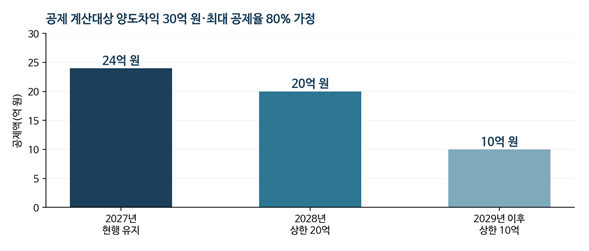
According to the government proposal, the special long-term holding deduction for one-household, one-homeowners will recognize 4% per year each for the holding period and the residency period through 2027. In 2028, this will shift to 2% per year for holding and 6% per year for residency, and from 2029 onward to 8% per year for residency, while maintaining the maximum deduction rate of 80%. However, a new cap on the deduction amount will be introduced: KRW 2 billion in 2028 and KRW 1 billion from 2029 onward (Ministry of Finance and Economy, 2026a).
The goal of preventing excessive tax benefits from being concentrated on high-priced owner-occupied homes is worth considering. OECD (2022) points out that unlimited capital gains tax exemptions on owner-occupied housing can provide large benefits to high-asset households. However, Korea’s special long-term holding deduction is a different system from a full exemption of all capital gains and should not be directly equated with it. In designing a deduction cap under Korea’s system, it is also necessary to examine inflation embedded in nominal gains, apportionment under the partial exemption for high-priced homes, and the impact on residential mobility.
Comparison of the Special Long-Term Holding Deduction Reform Proposal for One-Household, One-Homeowners
Category
2027
2028
(Government proposal)
From 2029 onward (Government proposal)
Holding-period deduction
4% per year
2% per year
Abolished
Residency-period deduction
4% per year
6% per year
8% per year
Maximum deduction rate
80%
80%
80%
Cap on deduction amount
None
KRW 2 billion
KRW 1 billion
Source: Ministry of Finance and Economy (2026a), “2026 Tax Revision Proposal PART 02.” The 2028 and 2029 figures are from the government proposal and may change depending on the National Assembly’s deliberations.
◩ Reduced holding deduction even for long-term rentals: The paradox of weakening incentives to supply rental housing
The government proposal also reforms the special long-term holding deduction for multi-homeowners in non-adjustment-target areas, in addition to one-household, one-homeowners. In 2027, a deduction of 2% per year of the holding period (up to 30% for 15 years) will be recognized, but in 2028 it will shift to either 2% per year for residency or 1% per year for holding, and in 2029 it will be restructured around the residency-period deduction. The cap on the deduction amount will be KRW 2 billion in 2028 and KRW 1 billion from 2029 onward (Ministry of Finance and Economy, 2026a).
Reform Proposal for the Special Long-Term Holding Deduction for Multi-Homeowners in Non-Adjustment-Target Areas
Category
2027
2028 government proposal
2029 onward government proposal
Deduction standard
Holding
2%/year
Residency
2%/year or holding
1%/year
Residency
2%/year
(holding deduction abolished)
Maximum deduction rate
30% for 15 years of holding
Up to 30% for residency / up to 15% for holding
30% for 15 years of residency
Cap on deduction amount
None
KRW 2 billion
KRW 1 billion
Source: Ministry of Finance and Economy (2026a), “2026 Tax Revision Proposal PART 02.” The detailed requirements, overlapping application, and applicable targets need to be confirmed during the legislative process. These figures are from the government proposal and do not mean implementation has been finalized.
For example, a person who has owned a rental home for a long period but has not personally resided in it may no longer receive the existing holding-period deduction under the 2029 government proposal. This is a separate issue from the deduction cap for high-priced single homes, and the history of providing long-term rental services and incentives to dispose of such properties should be evaluated separately. However, a reduction in the holding deduction for landlords does not necessarily mean an immediate decline in the total rental housing stock or a rise in jeonse and monthly rent prices.
◩ Resumption, temporary easing, and re-tightening of surtax rates: Concerns over bunching in sale timing and transaction lock-in
The National Tax Service (2026) announced that the general suspension of higher capital gains tax rates for multi-homeowners ended on May 9, 2026. Accordingly, from May 10, the provision once again applied under which 20 percentage points are added to the basic tax rate for owners of two homes and 30 percentage points for owners of three or more homes when transferring homes subject to the surtax in adjustment-target areas. However, individual application must be judged separately, including transitional measures for cases in which applications for land transaction permits and contract/final payment requirements were satisfied before the end of the suspension (Joint Ministries, 2026; National Tax Service, 2026).
About three months later, in August 2026, the government announced a plan to ease the surtax in 2027 to +5 percentage points for owners of two homes and +10 percentage points for owners of three or more homes, apply +10 and +15 percentage points respectively in 2028, and then return to +20 and +30 percentage points from 2029 onward (Ministry of Finance and Economy, 2026a). This too is a government proposal whose effect will be finalized only after legislation by the National Assembly and promulgation of the law. Accordingly, this report distinguishes between the proposed tax rates and the surtax rates actually in force (Ministry of Finance and Economy, 2026a, 2026b).
The government’s intention to expand selling opportunities can itself be positively evaluated. However, if the resumption, easing, and re-tightening of surtax rates are announced in quick succession, taxpayers may prioritize decisions on sale, gifting, or continued holding based on the policy schedule rather than normal housing or asset choices. This is why not only the problem of high tax rates but also the issue of the predictability of institutional change must be addressed together (Moon Yoonsang, 2024).
Changes in Higher Capital Gains Tax Rates on Multi-Homeowners in Adjustment-Target Areas
Source: National Tax Service (2026), Ministry of Finance and Economy (2026a). Note: The figures for 2027–2029 are government proposals, and application may differ depending on the home subject to taxation, the holding period, and special provisions.
3. Tax Burdens and the Possibility of Transaction Lock-In Under a Capital Gains Tax Cap (Deduction Cap)
◩ Arithmetic differences resulting from the introduction of a deduction cap
A capital gains tax cap here does not mean a ceiling on tax payable, but a ceiling on the amount of the special long-term holding deduction subtracted from capital gains income. Even if the deduction rate is the same, the larger the capital gain eligible for deduction, the greater the difference in the deduction amount before and after introduction of the cap. To illustrate this, a hypothetical one-home case was calculated in which the taxpayer meets the 80% deduction rate by holding and residing in the home for at least 10 years.
Examples of Changes in Deduction Amounts for One Home Held and Occupied Long Term (Unit: KRW 100 million)
Capital gain subject to deduction calculation
2027
80% deduction
2028
KRW 2 billion cap
From 2029 onward
KRW 1 billion cap
Reduction in 2029
(compared with 2027)
15
12
12
10
2
30
24
20
10
14
40
32
20
10
22
Note: This is a simplified example assuming that the capital gain subject to deduction calculation is the amount to which the deduction applies after completing necessary calculations such as the partial exemption apportionment for one-homeowners. It is not the actual increase in capital gains tax and does not reflect the tax base, basic deduction, progressive tax rates, local income tax, or various special provisions. Source: Author’s calculation based on Ministry of Finance and Economy (2026a).
Note: Arithmetic comparison of the policy proposal assuming deductible capital gains of KRW 3 billion and a deduction rate of 80%. This is not a tax calculation table. Source: Ministry of Finance and Economy (2026a), author’s calculation.
The policy effect of the deduction cap has a basis in tax equity insofar as it is concentrated on high-priced homes with large capital gains. On the other hand, even for the same amount of capital gains, the actual economic burden differs depending on how long the home was held, inflation during that period, and changes in family composition. Therefore, the validity of the cap system should be evaluated not only in terms of increased taxes on certain high-priced homes, but also in terms of residential mobility and tax equity regarding real gains.
◩ Case verification considering the partial exemption apportionment for high-priced homes
What matters more in practice is that the 80% deduction rate is not directly multiplied by the entire gain from the sale of a home. In the case of a high-priced home owned by a one-household, one-homeowner, the capital gain corresponding to the portion exceeding the KRW 1.2 billion exemption threshold is first calculated. In a simplified case excluding necessary expenses and special provisions, taxable capital gains are calculated as total capital gains × (sale price − KRW 1.2 billion) ÷ sale price, after which the deduction rate and deduction cap for the relevant year are applied (National Tax Service, 2026; Ministry of Finance and Economy, 2026a).
Comparison of Deduction Amounts Reflecting Apportionment of Gains on High-Priced Homes
(Hypothetical Cases, Unit: KRW 100 million)
Acquisition price
→
Sale price
Simple capital gain
Apportioned capital gain exceeding KRW 1.2 billion
Deduction amount applying 80%
2029
Applying KRW 1 billion cap
10
→
30
20
12.0
9.6
9.6
10
→
40
30
21.0
16.8
10.0
10
→
50
40
30.4
24.32
10.0
25
→
75
50
42.0
33.6
10.0
Note: Assumes a one-household, one-homeowner who has held and resided in the home for at least 10 years and qualifies for the 80% deduction rate. This is a conceptual simulation reflecting only apportionment based on the KRW 1.2 billion exemption threshold for high-priced homes, with expense deductions and special provisions omitted. The case of acquisition at KRW 2.5 billion and sale at KRW 7.5 billion applies the same deduction calculation structure as the government’s explanatory materials. The reduction in deduction amount is not the actual tax amount. / Source: Author’s calculation based on Ministry of Finance and Economy (2026a) and National Tax Service (2026).
For example, if the acquisition price is KRW 1 billion and the sale price is KRW 3 billion, the ordinary simple capital gain is KRW 2 billion, but after apportionment under the high-priced-home partial exemption, the amount subject to deduction calculation is KRW 1.2 billion, and the 80% deduction is KRW 960 million. Therefore, in this example, the KRW 1 billion cap in 2029 does not directly apply. By contrast, if the sale price rises to KRW 4 billion or KRW 5 billion, the cap may become a real constraint. This shows that the effect of the deduction cap depends not only on the holding period of each household, but also on the exemption apportionment and the actual taxable gain (Ministry of Finance and Economy, 2026a).
Another example showing the effect of the deduction cap on disposal decisions is the case of a single home acquired for KRW 2.5 billion and sold for KRW 7.5 billion. The capital gain subject to deduction calculation after applying the partial exemption apportionment is KRW 4.2 billion, and the 80% deduction is KRW 3.36 billion. Applying the KRW 1 billion cap under the 2029 government proposal reduces the deduction by KRW 2.36 billion. This is not additional tax payable, but a reduction in the deduction amount before calculation of the tax base; the actual tax must be determined by applying progressive tax rates, the basic deduction, necessary expenses, and other conditions (Ministry of Finance and Economy, 2026a; National Tax Service, 2026).
◩ The effect of the deduction cap converted into actual tax amounts
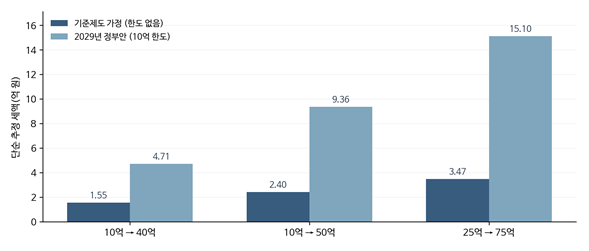
The reduction in the deduction amount should not be confused with the increase in actual tax. When the current general progressive tax rates and progressive deductions, the KRW 2.5 million basic capital gains deduction, and local income tax (10% of the calculated capital gains tax) are applied, the impact of the deduction cap becomes clearer. The cases below are comparisons that hold other elements of the tax law constant and change only the KRW 1 billion cap in the 2029 government proposal; they are not final tax calculations predicting actual tax payable (National Tax Service, 2026; Ministry of Finance and Economy, 2026a).
Comparison of Hypothetical Capital Gains Tax Before and After Introduction of the Special Long-Term Holding Deduction Cap
Acquisition
→
Sale
Tax without deduction cap
(A)
2029 government proposal tax
(B)
Additional tax
(B − A)
2029 tax
/ nominal gain
KRW 1 billion
→
KRW 4 billion
KRW 155 million
KRW 471 million
KRW 316 million
about 15.7%
KRW 1 billion
→
KRW 5 billion
KRW 240 million
KRW 936 million
KRW 696 million
about 23.4%
KRW 2.5 billion
→
KRW 7.5 billion
KRW 347 million
KRW 1.51 billion
KRW 1.163 billion
about 30.2%
Note: A simplified model applying more than 10 years of holding and residency, an 80% special long-term holding deduction rate, apportionment for the portion exceeding the KRW 1.2 billion exemption threshold, the general progressive tax rates (42% and 45%) and progressive deductions, the KRW 2.5 million basic capital gains deduction, and 10% local income tax. Actual necessary expenses, incidental acquisition and transfer costs, tax reductions, other income, individual special provisions, and future tax rate changes are excluded. The expanded KRW 25 million basic deduction for long-term residents selling homes priced at KRW 3 billion or less is not applied to the above cases. Basis of calculation: National Tax Service (2026), Ministry of Finance and Economy (2026a); author’s calculation.
Note: The figures in the graph are merely examples under the relevant conditions, and are not the average tax burden across the market or the finalized tax under the amendment bill.
Source: Hypothetical calculations using the National Tax Service basic tax rate table and the deduction cap in Ministry of Finance and Economy (2026a).
In the case of acquisition at KRW 2.5 billion and sale at KRW 7.5 billion, changing only the deduction cap increases the estimated tax from about KRW 347 million to KRW 1.51 billion. The tax corresponds to about 30.2% of the nominal capital gain of KRW 5 billion. Note: A simplified model applying more than 10 years of holding and residency, an 80% special long-term holding deduction rate, apportionment for the portion exceeding the KRW 1.2 billion exemption threshold, the general progressive tax rates (42% and 45%) and progressive deductions, the KRW 2.5 million basic capital gains deduction, and 10% local income tax. Actual necessary expenses, incidental acquisition and transfer costs, tax reductions, other income, individual special provisions, and future tax rate changes are excluded. The expanded KRW 25 million basic deduction for long-term residents selling homes priced at KRW 3 billion or less is not applied to the above case. Basis of calculation: National Tax Service (2026), Ministry of Finance and Economy (2026a); author’s calculation.
Further research is needed on the effect of a tax burden of this magnitude on decisions to sell and acquire replacement housing, but it shows why it is difficult to describe a change in the deduction cap simply as an adjustment of tax benefits for wealthy asset holders. However, an increase in tax liability does not negate home ownership itself or legally prohibit a sale.
Conversely, for a one-homeowner who acquired a home for KRW 1 billion, sells it for KRW 3 billion, and has lived in it for more than 10 years, the deduction after apportionment is KRW 960 million, so the KRW 1 billion cap does not apply. Rather, assuming the government proposal’s expanded basic deduction (from KRW 2.5 million to KRW 25 million), the capital gains tax burden could decrease slightly if other conditions remain the same. It should therefore be clarified that even under the same reform proposal, the net effect differs by taxpayer (Ministry of Finance and Economy, 2026a, 2026c).
◩ Distinguishing nominal capital gains from inflation-adjusted gains
Housing prices reflect long-term general inflation as well as changes in construction costs, land costs, and location premiums. If the entire difference between the acquisition price and the sale price is interpreted as an increase in real purchasing power, the general inflation accumulated during long-term holding may be mistaken for real gains. The following is a hypothetical example intended only to explain the meaning of inflation adjustment, separate from actual tax law calculations.
Comparison of Nominal Gains and Inflation-Adjusted Gains for a Long-Held Home
(Example, Unit: KRW 100 million)
Item
Assumed value
Interpretation
Home price at acquisition
10.0
Acquisition cost at the base point
Cumulative consumer price inflation over holding period
30%
Assumed figure for explanatory analysis
Home price at sale
15.0
Nominal capital gain
5.0
Inflation-adjusted acquisition cost
(purchasing power at time of sale)
13.0
10.0 × 1.30
Economic gain after inflation adjustment
2.0
Economic gain in purchasing power at the time of sale
Note: The cumulative CPI increase of 30% is an assumption for explanation and is not an actual statistical figure for any specific period. Inflation-adjusted gain is not capital gain under the tax law and is not actual tax payable. Calculation: author.
In this example, KRW 300 million of the nominal gain of KRW 500 million corresponds to general inflation. Of course, changing the tax base so that only real gains are taxed could improve tax neutrality, but this raises new issues such as how representative the consumer price index is for individual homes, how to verify acquisition and sale timing, and increased complexity of the system. Therefore, multiple reform options should be compared, including full inflation indexation of acquisition cost, partial retention of the long-term holding deduction, indexation of the deduction cap, and transitional measures reflecting inflation (OECD, 2022).
◩ A reform centered on the residency period and lifecycle mobility
Assume a taxpayer who held a home for 10 years but actually lived in it for only 3 years. The deduction rate would fall from 52% in 2027, combining 40% for holding and 12% for residency, to 38% in 2028 and 24% in 2029. This means that changes in tax burden can arise even when the deduction cap is not reached. It should be examined whether separate consideration is needed for households that do not live directly in the home for long periods due to reasons such as providing rental housing, job transfers, children’s education, or family caregiving (Ministry of Finance and Economy, 2026a).
The government proposal also includes raising the basic capital gains deduction from KRW 2.5 million to KRW 25 million for one-homeowners who have lived in the home for more than 10 years and sell for KRW 3 billion or less, as well as temporary tax relief for one-homeowners aged 65 or older relocating from the Seoul metropolitan area to non-metropolitan areas (subject to certain requirements and caps). Accordingly, it cannot be said that the reform proposal increases taxes for all one-homeowners. On the other hand, high-priced homeowners and non-residents who do not meet these conditions may face reduced deductions, so the proposal should be evaluated by category (Ministry of Finance and Economy, 2026a; Ministry of Finance and Economy, 2026c).
◩ Ripple effects of changes in surtax rates on the sales and rental markets
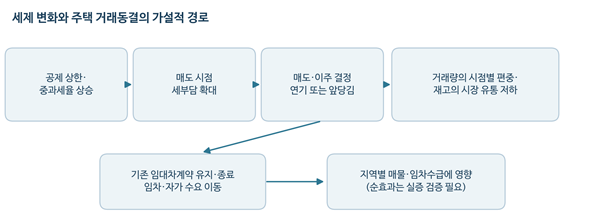
If higher surtax rates are expected to return, some owners may rush to sell before the effective date, while after the deadline they may delay disposal or choose to gift the property instead. As a result, a temporary increase in transaction volume may be followed by contraction, and the supply of homes to the market may be influenced more by the tax schedule than by end-user demand. As noted above, Moon Yoonsang’s (2024) analysis shows that this lock-in effect was observed under actual past policies.
However, even if multi-homeowners sell rental housing, this does not necessarily reduce total housing services. If renter households without homes purchase such properties, rental housing stock may decline, but rental demand may also decline at the same time. Policy evaluation should examine not only the number of listings from multi-homeowners, but also whether buyers already own homes, how existing tenants relocate, and actual regional jeonse and monthly rent prices (OECD, 2022).
Source: Prepared with reference to Moon Yoonsang (2024) and OECD (2022). Note: The net effects on transaction volume and rental prices require separate verification using regional transaction and rental data.
If people cannot sell their homes because of the tax burden:
A substantial restriction on the right to dispose of property
4. Constitutional Review of the Right to Dispose of Housing and the Freedom of Residence and Movement
◩ If people cannot sell their homes because of the tax burden: A substantial restriction on the right to dispose of property
Property rights do not consist merely of the right to hold an asset in one’s name. They also substantively include the ability to use the asset, earn income from it, and dispose of it when necessary. Article 23(1) of the Constitution guarantees property rights while providing that their content and limits shall be determined by law, and Article 23(2) requires that the exercise of property rights conform to public welfare. Accordingly, taxation of real estate capital gains cannot itself be regarded as an infringement of property rights, but if the method of concentrating tax burdens at the time of disposal becomes excessive, its impact on the substantive exercise of property rights needs to be examined (Article 23 of the Constitution of the Republic of Korea; Constitutional Court, 2008).
Long-term increases in housing prices reflect nominal inflation. If a cap on deduction amounts is applied without inflation adjustment, there may be cases in which the tax burden becomes high relative to real gains. In the earlier case of acquisition at KRW 2.5 billion and sale at KRW 7.5 billion, the assumed additional tax of KRW 1.163 billion shows how large the cost of choosing to sell at a given point can become. However, because the system does not legally prohibit sale or deprive a person of property rights, the constitutional focus of this analysis is whether the high tax burden constitutes a substantial restriction on disposal and whether the burden is proportionate (National Tax Service, 2026; Ministry of Finance and Economy, 2026a; Article 23 of the Constitution of the Republic of Korea).
◩ If the tax burden makes even moving difficult: Restriction on the freedom of residence and movement
Article 14 of the Constitution guarantees freedom of residence and movement. Taxes arising from the sale of a home do not directly restrict where one may live, but if elderly people downsizing, or households moving for work transfers or family caregiving, face a significant tax burden, the cost of mobility choices may increase. Even where capital gains are large, the entire proceeds of disposal do not become freely consumable income, and households that must acquire replacement housing after moving may face substantial financial constraints. Such mobility barriers should be assessed not through asset prices, but through actual rates of forgone moves, length of residence, and ability to acquire replacement housing (Article 14 of the Constitution of the Republic of Korea; National Tax Service, 2026).
However, the Constitutional Court has held that even if the Comprehensive Real Estate Tax may indirectly disadvantage residential mobility, that alone does not establish a direct infringement of the freedom of residence and movement. Accordingly, this report does not conclude that a violation of the freedom of residence and movement has already been established. Rather, it raises the issue that institutional design must consider how serious the indirect constraints caused by capital gains tax reform are and whether sufficient exceptions and deferral mechanisms exist for vulnerable taxpayer groups (Constitutional Court, 2008).
◩ If the burden is excessive relative to the purpose of taxation: Potential violation of the principle against excessive restriction
Tax legislation is recognized as an area of broad legislative discretion. The goal of improving tax equity for high-value assets and curbing speculation can also be evaluated as a legitimate public interest. However, restrictions on fundamental rights under Article 37(2) of the Constitution must be reviewed not only for legitimacy of purpose and suitability of means, but also for minimal impairment, balance of legal interests, and prohibition of infringement on the essential content of rights. In particular, even where it is necessary to reduce deduction benefits for large capital gains, alternative measures should be compared, such as an inflation-indexed cap, a phased cap, and tax deferral for elderly or long-term residents (Article 37(2) of the Constitution of the Republic of Korea; Constitutional Court, 2024).
On the other hand, if the special long-term holding deduction for high-priced homes is recognized without limit, this may raise equity concerns because larger tax benefits would be concentrated on households with greater assets. OECD (2022) likewise points out that broad capital gains tax exemptions for owner-occupied homes may provide greater benefits to high-asset groups. However, this is not the same system as Korea’s special long-term holding deduction, and policy evaluation must consider the balance among tax equity, transaction liquidity, real gains, and transitional rules.
◩ Holding tax precedents alone are insufficient: A separate constitutional review is needed for capital gains tax
In 2008, the Constitutional Court recognized the legislative purpose of the Comprehensive Real Estate Tax itself, but held the relevant housing taxation provisions constitutionally nonconforming on the grounds that they lacked sufficient burden-adjustment mechanisms for one-homeowners holding homes for residential purposes over a certain period and for persons without significant other assets or income. By contrast, in 2024 the Constitutional Court held that the Comprehensive Real Estate Tax provisions for a different tax system and tax year did not violate the principle against excessive restriction or the principle of tax equality. These precedents do not stand for the proposition that housing taxation is always unconstitutional; rather, they show that the level of burden on taxpayers, adjustment mechanisms, and legislative purpose must be examined comprehensively.
Both decisions concern the Comprehensive Real Estate Tax, which is a holding tax. They are not direct rulings on the constitutionality of capital gains tax imposed on income realized at the time of disposal, especially not on a cap on long-term residency-related income deductions that has not yet been enacted into law. Therefore, rather than stating definitively whether the capital gains tax cap is unconstitutional, it is more appropriate to frame this as a policy argument that the tax amount, real capital gains, and constraints on residential mobility resulting from the reduction in deductions should be quantified in order to examine constitutional proportionality, equality, and protection of legitimate expectations (Constitutional Court, 2008; Constitutional Court, 2024; Ministry of Government Legislation, 2026).
Major Constitutional Review Items for the Capital Gains Tax Deduction Cap and Surtax Rates
Review area
Standard of review
Key issue
Items for empirical and institutional evaluation
Property rights
(Article 23)
Net real capital gains remaining after sale and restrictions on disposal choices
Effective tax burden by acquisition and sale timing, inflation-adjusted gains, transaction lock-in rate
Residence and movement
(Article 14)
Whether high tax burdens on sale delay moves to replacement housing
Cases of relocation among the elderly, job-transfer households, and family-care households, and need for deferral
Excessive restriction
(Article 37(2))
Whether there is excessive restriction relative to the goal of tax equity and whether alternatives are absent
Comparison of cost-effectiveness of inflation-indexed caps, phased application, and deferred taxation
Equality and protection of legitimate expectations
(Article 11, etc.)
Differential treatment and predictability based on holding/residency type and policy effective date
Burden by type of long-term holding, actual residency, and rental provision, and transitional measures
Note: This is an analytical framework based on Articles 14, 23, and 37(2) of the Constitution, and does not imply a finding that the government proposal is unconstitutional. Source: Prepared based on the Constitution of the Republic of Korea, Constitutional Court (2008; 2024), and Ministry of Government Legislation (2026).
5. Ways to Improve the Capital Gains Tax System
First, the introduction of a cap on the amount of the special long-term holding deduction should be redesigned from the perspectives of tax equity and transaction liquidity. There are grounds for limiting excessive deduction benefits concentrated on high-priced homes, but there is also a strong need to distinguish between nominal gains accumulated through long-term inflation and real capital gains. Cost estimates should be presented showing which approach best improves both equity and administrative costs: inflation indexation of acquisition cost, partial retention of the long-term holding deduction, phased application of the cap, or regular inflation indexation of the deduction cap (OECD, 2022).
Second, institutional design is needed to avoid blocking lifecycle mobility for one-homeowners with long-term actual residency. For moves involving downsizing due to aging, job transfers, family support, or relocation to regional areas, deferral of taxation or tax deferral upon acquisition of replacement housing may be comparatively reviewed so that disposal tax liability does not operate as an excessive barrier to entry. Rather than blanket exemptions, the target group, period, cap, and post-management conditions should be designed to distinguish such cases from speculative repeat transactions (OECD, 2022).
Third, the higher capital gains tax rates on multi-homeowners and the residency-centered reform of the long-term holding deduction in non-adjustment-target areas should be reviewed together. Short-term speculation suppression and long-term rental service provision are different policy targets, so rather than imposing the same disposal disadvantage solely on the basis of the number of homes owned or regulated area status, evaluation should distinguish among holding and rental periods, contractual stability, and the actual degree of transaction lock-in. It should also be taken into account that when rental housing is sold, rental demand as well as rental supply may decline (Moon Yoonsang, 2024; OECD, 2022).
Fourth, capital gains tax reform should secure predictability on the basis of medium-term principles to be maintained for a certain period and sufficient transitional measures. Frequent adjustments, such as announcing temporary easing immediately after the end of a suspension, can destabilize transaction and tax planning. It is desirable to include not only tax equity but also policy credibility and market liquidity in performance indicators (Moon Yoonsang, 2024).
Fifth, the constitutional impact assessment of tax reform should be institutionalized. Legislative materials should present not only expected tax revenue from each policy but also effective tax burdens after deduction reductions, inflation-adjusted real capital gains, and the impact on decisions to dispose of or relocate housing. Exceptions and transitional measures applicable to taxpayers with different characteristics—such as long-term one-homeowners, non-resident landlords, the elderly, and households relocating to regional areas—should also be evaluated. Such verification is precisely how the balance between protection of property rights and tax equity can be made concrete (Article 23 and Article 37(2) of the Constitution of the Republic of Korea; Constitutional Court, 2008; 2024).
Directions for Tax Reform by Key Issue
Policy issue
Direction for improvement
Policy outcomes to be verified
Cap on long-term holding deduction amount
Reconsider or ease the cap; compare methods reflecting real gains and transitional measures
Whether sales are delayed, lifecycle mobility, effective tax burden
Conversion of holding deduction into residency deduction
Expand the reasonable range of recognition for unavoidable non-residency and periods of rental provision
Balance between incentives for actual residency and mobility rights
Surtax on multi-homeowners
Rationalize uniform surtax rates; distinguish short-term speculation from long-term rental supply
Transaction liquidity, changes in new rental listings and rental demand
Frequent institutional changes
Announce medium-term tax principles, transitional rules, and pre-implementation impact assessment
Policy predictability; mitigation of sharp fluctuations in transaction timing and volume
Constitutional impact assessment
Disclose in advance during legislation the burdens on real capital gains, ability to pay, and residential mobility, and design transitional measures
Effective tax burden, delayed moves, elderly residential mobility, balance of legal interests
Deduction for multi-homeowners in non-adjustment-target areas
Verify the effects of reducing the holding deduction and converting it into a residency deduction on long-term rental supply and disposal incentives
History of long-term rental provision, delayed sales, and changes in transaction volume
Source: Prepared based on Ministry of Finance and Economy (2026a), Moon Yoonsang (2024), OECD (2022), and Constitutional Court (2008; 2024).
6. Conclusion: From Punitive Taxation to a Predictable Tax System that Protects Property Rights
Capital gains tax should be a legitimate means of taxing realized capital gains, but if more people choose not to sell their homes in order to avoid high tax burdens, this can hinder the efficient allocation of resources and residential mobility. Adjustments to the cap on the special long-term holding deduction and the surtax on multi-homeowners target different taxpayer groups, but they share the common feature that the structure of tax burdens affects transaction decisions. The policy goal of strengthening fair taxation and the efficiency goal of preventing transaction lock-in must both be considered.
In particular, the government’s 2026 reform proposal contains a structure that somewhat expands selling opportunities for multi-homeowners while reducing long-term holding deductions and raising surtax rates again from 2029. Whether this combination will actually increase listings, or instead produce side effects such as the concentration of sales and gifts in certain years, requires both ex ante prediction and ex post verification. The performance indicators for real estate taxation need to be expanded beyond tax revenue or housing prices to include transaction volume, residential mobility, and the supply and demand of jeonse and monthly rentals.
Accordingly, in this regular session of the National Assembly, the capital gains tax reform proposal should not be evaluated merely as a revenue adjustment or a strengthening of taxation on high-priced homes. The phased application of the cap on the special long-term holding deduction and the surtax rates on multi-homeowners should be presented by taxpayer type in terms of their effects on the timing of sales and gifts, tax revenue, and residential mobility from 2027 to 2029, and less restrictive alternatives such as inflation-indexed deductions and tax deferral should be compared. If the Speaker of the National Assembly designates the relevant bill as a bill accompanying the revenue budget, the committee review deadline of November 30 under Article 85-3 of the National Assembly Act will apply; accordingly, even in a schedule-driven review, sufficient verification must be conducted regarding the balance among tax equity, transaction liquidity, and protection of property rights (Article 85-3 of the National Assembly Act; National Assembly Budget Office, 2026).
Ultimately, real estate taxation should aim for a stable structure in which tax burdens can be predicted, rather than a uniform system that suppresses transactions. This hypothetical simulation shows that for high-priced homes occupied over the long term, the introduction of a deduction cap alone can significantly change tax liability, but this alone does not prove actual abandonment of sales or unconstitutionality. In legislating, the government should disclose together the expected effective tax rates, the impact on residential mobility by taxpayer type, the benefits to tax equity, and less restrictive alternatives. The legitimacy of the tax system should be judged not only by whether it secures reasonable revenue, but by how well it balances the substantive exercise of property rights and the freedom to choose residential mobility (Articles 14, 23, and 37(2) of the Constitution of the Republic of Korea; Constitutional Court, 2008, 2024).
◩ References
Joint Ministries (2026.2.12.), “End of the Suspension of Higher Capital Gains Tax Rates on Multi-Homeowners and Supplementary Measures.”
Republic of Korea Policy Briefing.
National Tax Service (2026), “Capital Gains Tax Rate Table and Calculation Structure.”
National Tax Service (2026.3.1.), “End of the Suspension of Higher Capital Gains Tax Rates on Multi-Homeowners, Active Support for Taxpayers Through Dedicated Filing and Consultation Channels.”
National Assembly Act (effective 2026.10.2), Article 85-3, “Automatic Referral to the Plenary Session of the Budget Bill, etc.,” National Law Information Center.
National Assembly Budget Office (2026), 2026 Public Finance of the Republic of Korea, “Designation of Bills Accompanying the Revenue Budget,” p. 257.
Constitution of the Republic of Korea (fully amended 1987.10.29), Articles 11, 14, 23, 37, 38, and 59. National Law Information Center.
Moon Yoonsang (2024), The Economic Effects of Housing Capital Gains Tax, KDI Policy Study Series 2024-08.
Ministry of Government Legislation (2026.8.4.), “Legislative Notice of Partial Amendment to the Income Tax Act,” Ministry of Finance and Economy Notice No. 2026-213.
Ministry of Finance and Economy (2026a), “2026 Tax Revision Proposal PART 02” (2026.8.10.).
Ministry of Finance and Economy (2026b), “Government Finalizes the 2026 Tax Revision Proposal” (2026.9.1.).
Ministry of Finance and Economy (2026c), “2026 Tax Revision Proposal: Policy and Real Estate Tax FAQ at a Glance.”
Constitutional Court (2008.11.13.), “Decision of Constitutional Nonconformity, etc. Concerning the Comprehensive Real Estate Tax,” consolidated cases including 2006Hun-Ba112.
Constitutional Court (2024.5.30.), “Case Concerning the 2020 Comprehensive Real Estate Tax,” 2022Hun-Ba189, etc. (consolidated), constitutional.
OECD (2022), Housing Taxation in OECD Countries. OECD Tax Policy Studies.
Original title: 양도소득세 강화의 경제적․헌법적 문제와 제도개혁 과제
Author: Center for Free Enterprise (CFE)
Date: 2026-11-06
Source: https://www.cfe.org/bbs/bbsDetail.php?cid=issue&pn=1&idx=29716