
Assessment of the 2027 Budget and National Fiscal Management Plan and Directions for Sustainable Fiscal Reform
-
Writer
CFE
-

◩ Key Summary
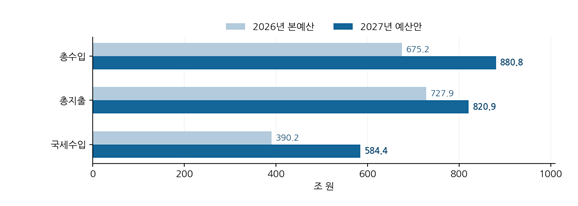
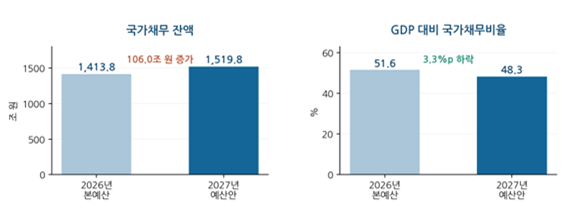
In 2027, total government revenue will reach 880.8 trillion won, an increase of 205.6 trillion won (30.4%) from the previous year’s original budget. At the same time, total expenditure will also rise by 93.0 trillion won (12.8%), while the outstanding national debt will increase by 106.0 trillion won, from 1,413.8 trillion won to 1,519.8 trillion won. Although the national debt-to-GDP ratio will fall from 51.6% to 48.3%, this does not mean that the debt balance itself has actually declined (government, 2026a: 2–3).
The increase in tax revenue generated by the semiconductor boom should be used not as a justification for expanding spending, but as an opportunity to reduce national debt and restore fiscal buffers. However, because the increase in total revenue includes earmarked resources such as social security funds, it does not mean that all additional revenue can be immediately used for debt repayment. Priority should first be given to applying a debt-management-first principle to excess tax revenue available within the general budget and to surplus fund resources.
Large-scale fiscal support risks creating a crowding-out effect by displacing private sector production factors and investment opportunities. Since not all public spending suppresses private investment, it is necessary to distinguish between areas such as public infrastructure and basic research, which can promote private investment, and areas such as direct subsidies, which may distort resource allocation.
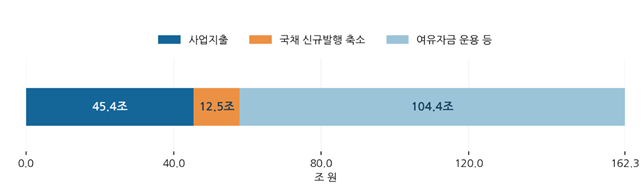
For the newly established Future Response Fund (2027 revenue proposal: 162.3 trillion won), priority should be given to government bond repayment, reducing new issuance, and macroeconomic stabilization functions. In addition, the investment-eligible projects within the Growth Engine Account should be gradually spun off into a Korean-style sovereign wealth fund with independent performance accountability. The key lesson from Norway is not to replicate its funding source itself, but to adopt its principles of long-term saving, independent management, and withdrawal discipline.
1. Raising the Issue: Where Should Boom-Time Tax Revenue Be Used?
The government presents the 2027 budget proposal as an expansionary fiscal policy for a “great leap forward toward an irreplaceable Republic of Korea.” It seeks to simultaneously pursue concentrated investment in advanced sectors such as semiconductors, physical AI, and AI data centers; support for youth and local regions; and structural reform of mandatory spending. The real issue is not simply how large the budget becomes, but by what criteria unexpectedly strong tax revenues are allocated and whether a fiscal system can be established that remains sustainable even after a downturn (government, 2026a: 1–6).
The increase in total revenue for 2027 amounts to 205.6 trillion won, of which 194.2 trillion won comes from higher national tax revenue. Total expenditure will also rise by 93.0 trillion won in a single year. The government emphasizes the decline in the national debt-to-GDP ratio as a fiscal achievement, but over the same period the outstanding national debt still increases by 106.0 trillion won. The effect of a larger denominator—nominal GDP—must be evaluated separately from changes in the numerator—the debt balance.
The priorities of fiscal management become even more important when revenue projections are boosted by a temporary boom. If recurring expenditures are initiated on the basis of temporary tax revenue, securing funding becomes difficult once the business cycle turns. As a result, pressure for tax hikes or additional borrowing may intensify. Even if the government pursues growth and redistribution goals simultaneously, what is first needed is a rule requiring that a substantial portion of excess tax revenue be used for debt reduction and risk preparedness.
This report evaluates the government’s plan and presents directions for policy improvement, focusing on five issues: ① the mismatch between tax revenue expansion and the increase in outstanding national debt, ② the risk that expanded spending may crowd out the private economy, ③ the purpose and operating structure of the Future Response Fund, ④ the fiscal neutrality of education grants and support for local national universities, and ⑤ the effectiveness of expenditure restructuring and performance management.
Key Indicators in the 2026 Original Budget and the 2027 Budget Proposal
Indicator
2026
2027 proposal
Change
Total revenue
675.2
880.8
+205.6
National tax revenue
390.2
584.4
+194.2
Total expenditure
727.9
820.9
+93.0
Consolidated fiscal balance
-52.7
+59.9
+112.6
Managed fiscal balance
-107.8
-3.1
+104.7
Outstanding national debt
1,413.8
1,519.8
+106.0
National debt/GDP
51.6%
48.3%
-3.3%p
Note: Amounts are in trillion won. The comparison is based on the 2026 original budget. The change in the managed fiscal balance indicates a reduction in the size of the deficit. Source: government (2026a), pp. 2–3.
Although total revenue exceeds total expenditure by 59.9 trillion won, producing a consolidated fiscal surplus, the managed fiscal balance—which excludes the balance of social security funds—still shows a deficit of 3.1 trillion won. Since the two indicators differ in coverage, care must be taken not to assess debt repayment capacity solely on the basis of a consolidated fiscal surplus.
2. Tax Revenue Rises by 200 Trillion Won, but National Debt Still Increases by 106 Trillion Won
◩ Priority Between Revenue Growth and Debt Reduction
The government’s projection that improved performance by semiconductor firms will increase corporate tax and income tax revenue is meaningful in terms of improving fiscal conditions. However, the 49.8% increase in national tax revenue projected for 2027 should not be treated as a medium-term repeatable growth rate. Because the semiconductor cycle is sensitive to global demand, prices, and capital investment, it is risky to link above-trend tax revenue to a permanent expansion of fiscal spending (government, 2026a: p. 2; government, 2026b: p. 7).
Source: government (2026a), p. 2. 2027 government proposal compared with the 2026 original budget.
The 205.6 trillion won increase in total revenue should not be viewed as cash that can be freely spent in full. Total revenue includes fund revenue, and each source differs in nature and statutory purpose. Accordingly, this report’s principle of “government bond repayment first” is a policy principle concerning the order of allocation of available additional tax revenue and surplus fund resources. The actual amount available for repayment should be calculated only after a detailed review of inter-account transfers and fund operations.
◩ A Lower Debt Ratio Does Not Mean a Lower Debt Balance
Compared with the 2026 original budget, the 2027 government proposal increases the outstanding national debt from 1,413.8 trillion won to 1,519.8 trillion won, an increase of 106.0 trillion won. Over the same period, the national debt-to-GDP ratio falls by 3.3 percentage points, from 51.6% to 48.3%. Since the absolute amount and the ratio move in opposite directions, it is inappropriate to judge the debt problem as resolved on the basis of the ratio alone.
Note: The increase in the outstanding national debt is not the same concept as net government bond issuance. Source: government (2026a), p. 3.
Annual changes in the outstanding national debt are related not only to government bond issuance and repayment, but also to changes in other liabilities borne by the government. Therefore, it is inaccurate to immediately describe the 106.0 trillion won increase as “106 trillion won in net government bond issuance.” Still, the fact that the total stock of government debt is increasing is clear, and policy priorities need to be redesigned so that, during boom periods, the pace of increase is slowed or the balance itself is reduced.
3. Medium-Term Fiscal Outlook: The Improvement in 2027 Is Hard to Regard as a Structural Recovery
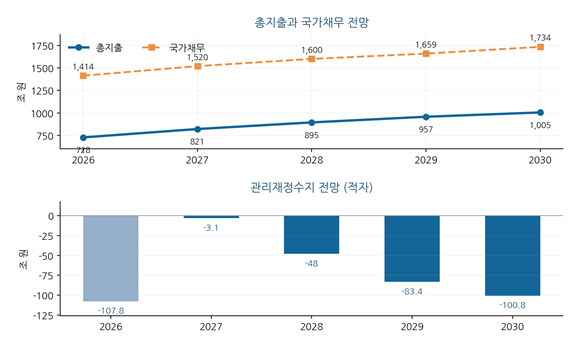
The government projects that the managed fiscal deficit will shrink to 3.1 trillion won in 2027 (-0.1% of GDP). However, the deficit widens again to -48.0 trillion won in 2028, -83.4 trillion won in 2029, and -100.8 trillion won in 2030. The managed fiscal balance as a share of GDP also deteriorates to -2.9% by 2030. A temporary improvement in the budget balance should be distinguished from a genuine improvement in the medium- to long-term fiscal structure (government, 2026b: p. 9).
Key Medium-Term Fiscal Management Projections, 2026–2030
Indicator
2026
2027
2028
2029
2030
Total revenue
675.2
880.8
920.5
951.8
984.6
Total expenditure
727.9
820.9
894.6
957.4
1,005.2
Managed fiscal balance
-107.8
-3.1
-48.0
-83.4
-100.8
National debt
1,413.8
1,519.8
1,600.3
1,659.1
1,734.1
Debt/GDP
51.6%
48.3%
48.9%
48.8%
49.0%
Note: Amounts are in trillion won. 2026 is based on the original budget; from 2027 onward, figures are government proposals/plans. Source: government (2026b), pp. 7–9.
Note: The projections are based on government plans and are neither actual results nor final confirmed figures. Source: government (2026b), pp. 7–9.
While total expenditure is projected to reach 1,005.2 trillion won by 2030, national debt is expected to rise to 1,734.1 trillion won. In particular, despite plans to gradually lower the growth rate of total expenditure after 2027, mandatory spending is projected to grow by an average of 8.5% per year. Given demographic change, pensions and healthcare, and interest payments, using excess tax revenue during boom periods to secure fiscal buffers could have even greater effects in subsequent years.
4. A 93 Trillion Won Expansion in Total Expenditure: The Possibility of Crowding Out the Private Economy
◩ Fiscal Expansion Does Not Necessarily Increase Private Investment and Is Highly Likely to Cause Inefficient Resource Allocation and Distortion
The 12.8% growth rate in total expenditure for 2027 exceeds the major past growth rates cited by the government. Spending in industry, SMEs, and energy rises by 29.7%, while general and local administration increases by 22.8%. Rapid growth in fiscal spending may support short-term demand, but if public projects absorb scarce inputs first—such as private capital, skilled labor, land, and electricity—they may also raise investment costs for the private sector (government, 2026a: p. 4).
The so-called crowding-out effect can be examined not only through the channel in which expanded government bond issuance raises interest rates in financial markets and the private sector’s financing costs, but also through the channel in which the government directly replaces private projects or distorts resource flows through subsidies. However, because the 2027 government proposal anticipates a surge in tax revenue and a sharp improvement in the managed fiscal balance, one cannot conclude that the 93 trillion won increase in total expenditure has already caused higher interest rates or lower private investment. Additionality and the possibility of private substitution must be examined project by project.
Core electricity grids and water infrastructure for the semiconductor supply chain, as well as basic research at the pre-competitive stage, can serve as complements that induce new private investment. By contrast, if the government directly supports the commercialization of particular technologies or firms while broadly assuming market loss risks, it may weaken responsible private investment judgment. Therefore, investment projects should be evaluated under strict distinctions regarding their public-good characteristics, the specific evidence of market failure, the extent of private capital participation, the possibility of cost recovery, and the criteria for termination.
Effects on the Private Economy and Evaluation Criteria by Type of Major Fiscal Investment
Type of fiscal investment
Expected effect
Key points to review
Public infrastructure · basic research
May complement private investment
Actual bottleneck relief · external effects · additionality
Direct subsidies by industry
Short-term investment · production expansion
Distortion from firm selection · substitute investment · sunset provisions
Government equity · fund investment
Return recovery · risk sharing
Private co-investment · loss burden · rate of return
Income transfers · cash support
Distribution · consumption stabilization
Targeting · recurring expenditure · incentive effects
Source: compiled by the author. The crowding-out effect must be verified through each project’s financial, factor-input, and private-substitution channels, and it is not a uniformly applicable outcome for all spending.
5. The Future Response Fund Should Be Used Primarily for Government Debt Management and Fiscal Stabilization
◩ For the Newly Established 162.3 Trillion Won Fund, Operating Discipline Matters More Than Spending Expansion
The government has proposed creating a Future Response Fund that accumulates above-trend internal tax revenue increases and other resources, with planned 2027 revenue of 162.3 trillion won. It would be allocated into 45.4 trillion won for project spending, 12.5 trillion won for reducing new government bond issuance, and 104.4 trillion won for surplus fund management and other uses. Since “reducing new bond issuance” does not directly reduce debt in the same way that repayment does, when evaluating the fiscal stabilization performance of the fund, the reduction in issuance, actual repayment, and accumulated balances should each be disclosed separately (government, 2026a: pp. 5–6).
Note: The government’s breakdown of the use and management of the proposed 162.3 trillion won in fund revenue. A reduction in new issuance is distinct from repayment of existing government bonds. Source: government (2026a), pp. 5–6.
The Future Response Fund must not be operated as a backdoor channel that makes it easier to expand fiscal spending. First, laws or regulations should establish either a minimum share or a priority order within the fund for debt management and stabilization, and compliance should be disclosed to the National Assembly and the public. The accumulated resources should be managed in consideration of the benchmark and estimation error for trend tax revenue, the risks of investment assets, and the interest rates and maturities of national debt financing.
In addition, while using fund revisions alone to flexibly execute large-scale projects may speed policy responses, it also risks weakening the National Assembly’s budget review and execution oversight. Long-term investment resources and macroeconomic stabilization resources need to be separated in accounting terms, and ex ante evaluation, ex post disclosure, and medium-term expenditure ceilings for new projects should be established. The starting point is to make the priority of national debt management institutionally clear.
◩ The Investment-Eligible Portion of the Growth Engine Account Should Be Separated into a Korean-Style Sovereign Wealth Fund
The 14.2 trillion won Growth Engine Account includes AI development, autonomous driving and space, supply chain support, financial and corporate equity investments, and infrastructure projects. Because these projects differ in profitability, publicness, and payback periods, they are difficult to manage under a single investment evaluation method. It would be possible to identify projects in which performance can remain as assets—such as equity and fund investments—and gradually convert them into a Korean-style sovereign wealth fund separate from subsidy and contribution programs.
Norway’s Government Pension Fund Global (GPFG) differs from Korea in that it is built on oil-related resources, while Korea’s fiscal structure is tied to semiconductor tax revenue. Even so, its institutional principles—professional and long-term management of investment assets, fiscal rules governing the relationship with the government budget, withdrawal discipline, and intergenerational asset accumulation—are worth considering. Norway uses an expected real return of 3% as a medium-term withdrawal guideline, while adjusting actual withdrawals in light of economic conditions and risk (Norwegian Ministry of Finance, 2026).
Direction for Designing the Growth Engine Account of the Future Response Fund and a Korean-Style Sovereign Wealth Fund
Category
Current 2027 plan
Proposed improvement
Nature of resources
Fund Growth Engine Account, 14.2 trillion won
Manage the investment-eligible portion separately
Project scope
Mixed AI · technology · equity investment · infrastructure
Separate non-profit subsidies and contributions from investment assets
Operating entity
Projects centered in individual government ministries
Independent professional management · limited policy intervention
Performance criteria
Centered on execution · output by project
Risk-adjusted returns · long-term asset growth
Fiscal relationship
Fund projects · management of surplus resources
Equity investment after prioritizing debt management · withdrawal rule
Source: government (2026a), p. 6; Norwegian Ministry of Finance (2026); author’s proposal. This does not imply an automatic conversion of the entire account.
6. Expenditure Restructuring and Performance Management: Net Effects Matter More Than Superficial Savings
The government has proposed restructuring discretionary spending worth 38.6 trillion won and mandatory spending worth 69 trillion won in the 2027 budget formulation process. The direction—abolishing some 2,100 projects and adjusting job-seeking benefit payment methods as well as the formulas for local allocation tax and grants—is positive. However, since the adjustments to local allocation tax worth 30.5 trillion won and education grants worth 32.5 trillion won largely involve changes in the structure of fiscal allocation, they should not be simplistically interpreted as pure spending cuts (government, 2026a: pp. 9–10).
The government’s plan includes introducing an integrated performance evaluation for fiscal projects to replace self-evaluation by ministries, reducing, abolishing, or consolidating projects based on evaluation results, budget management focused on actual execution, and expanded inspections of improper benefit receipt. It is desirable to reduce the budgets of poorly performing projects in practice and disclose the results of improvements to the public. However, if the new evaluation system remains limited to document review and project renaming, it will be difficult to improve an inefficient expenditure structure (government, 2026b: pp. 19–20). The evaluation the government must conduct goes beyond checking whether execution rates were high. It must analyze whether the private sector would have invested on its own, whether subsidies merely brought forward the timing of investment, whether results remain after support ends, and whether there are less costly ways to achieve the policy objective. In particular, for subsidies, R&D, university support, and regional development, performance indicators, budget termination criteria, and the treatment of recoverable outcomes should all be clearly specified at the contract stage.
Five Priority Fiscal Reform Tasks from the Center for Free Enterprise (CFE) Perspective
Priority task
Direction for institutional improvement
Verification indicators
National debt management
Rule prioritizing allocation of excess tax revenue to debt reduction
Actual repayment amount · issuance reduction amount · outstanding balance
Medium-term fiscal rules
Manage cyclically adjusted balance and expenditure growth rate
Structural fiscal balance · debt path
Future Response Fund
Stabilization first · controls on transfers across accounts
Fund balance · grounds for withdrawal · reporting to the National Assembly
Growth engine investment
Turn investment-eligible portions into a sovereign wealth fund
Private matching · risk-adjusted returns
Fiscal project evaluation
Sunset clauses · independent evaluation · disclosure of net savings
Project termination rate · net savings · private substitution
Source: based on a review of government (2026a; 2026b) and the author’s proposal. The policy priorities and indicators are not a final government decision.
7. Conclusion and Policy Recommendations: Choice and Responsibility Matter More Than Fiscal Size
The 2027 budget proposal chooses both to capitalize on the opportunity of a tax revenue boom and to raise expectations for new fiscal spending. The mere fact that the national debt ratio is declining does not make light of the 106.0 trillion won increase in national debt, nor does the fact that expenditure has expanded by 93.0 trillion won guarantee an increase in growth potential. What is needed now is not competition over the size of the budget, but fiscal discipline that reduces the burden on future generations and choices that support private sector-led growth.
The government should change its operational priorities so that the first beneficiary of the tax revenue boom is not new fiscal projects, but the sustainability of the national finances. Only when it simultaneously prioritizes government bond repayment and fiscal stabilization, converts investment-eligible growth engine resources into a sovereign wealth fund, and pursues rigorous performance reform in education finance and spending programs can expansionary fiscal policy truly become responsible fiscal policy.
◩ ① A Certain Portion of Excess Tax Revenue Should Be Mandatorily Allocated to Reducing National Debt
When a tax revenue boom arrives, the threshold for new spending should be raised and fiscal capacity should first be built up. After distinguishing between the trend growth rate and the trend level of tax revenue, it is worth considering a rule that allocates a certain portion of additional resources—excluding normal essential expenditures—first to government bond repayment and reducing new issuance. Such a rule should also include clear exception and return procedures so that extraordinary fiscal responses remain possible during recessions.
◩ ② Fiscal Policy Should Complement, Not Replace, Private Investment
Support for future growth engines should concentrate on technological development and removing bottlenecks in public infrastructure. In commercialization investment that the private sector can bear, participation by private capital and shared responsibility for profits and losses should be the principle. The additionality of government subsidies, the possibility of private substitution, and performance after support ends should be disclosed, and projects that undermine competitive resource allocation should be adjusted.
◩ ③ Redesign the Future Response Fund as a Mechanism for Long-Term Saving and Investment Discipline
Resources for debt repayment and fiscal stabilization should be clearly separated from resources for long-term investment. Only the portion whose investment outcomes can remain as assets over the long term should be operated in the form of a sovereign wealth fund, and the fund’s professionalism, independence, performance accountability, and National Assembly oversight should all be secured. Spending on highly public-interest projects should be separated from the sovereign wealth fund and subjected to normal fiscal project evaluation.
◩ References
• Government (2026a). “2027 Budget Proposal: A Great Leap Forward Toward an Irreplaceable Republic of Korea.” September 2026.
• Government (2026b). “Key Contents of the 2026–2030 National Fiscal Management Plan.” September 2026.
• Ministry of Education (2026). “2027 Ministry of Education Budget Proposal of 117.6 Trillion Won” and explanatory materials. September 2, 2026. https://eiec.kdi.re.kr/policy/materialView.do?num=2861
• Norwegian Ministry of Finance (2026). Meld. St. 1 (2026–2027), National Budget 2027, fiscal policy framework. https://www.regjeringen.no/en/documents/meld.-st.-1-20262027/id3177186/?ch=3
Original title: 2027년 예산안·국가재정운용계획 평가와 지속가능한 재정개혁 방향
Author: Center for Free Enterprise (CFE)
Date: 2026-11-02
Source: https://www.cfe.org/bbs/bbsDetail.php?cid=issue&pn=1&idx=29704