
Structural Problems in Inheritance and Gift Taxation and Directions for Reform
-
Writer
CFE
-

◩ Key Summary
Debate over Korea’s inheritance and gift taxes often centers on whether the top marginal rate of 50% is appropriate. In reality, however, the actual tax burden is determined not only by the rate itself but also by deductions, taxable base brackets, the unit of taxation, the method of aggregating lifetime gifts, and various special provisions. Accordingly, international comparisons should look not only at the top rate, but also at deduction and exemption levels, the unit of taxation, whether thresholds are indexed to inflation, and the actual share of tax revenue collected.
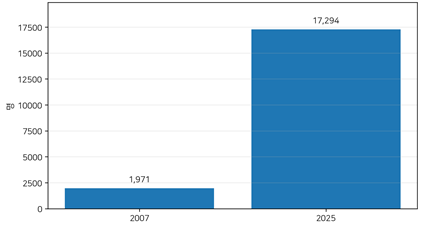
Recently, in Korea, the scope of inheritance tax liability itself has been expanding rapidly. In 2025, 22,524 decedents were subject to inheritance tax assessment, and among them, 17,294—or 76.8%—had a taxable base of KRW 1 billion or less. In 2007, the number of taxable cases in the same bracket was 1,971. By contrast, the average assessed tax amount in this bracket was recently KRW 50.63 million, not significantly different from the earlier KRW 54.67 million. This suggests that recent changes are related not only to rising tax liabilities per person, but also to an increase in the number of taxpayers (National Tax Service data, re-cited from Korea Economic Daily, Sept. 27, 2026).
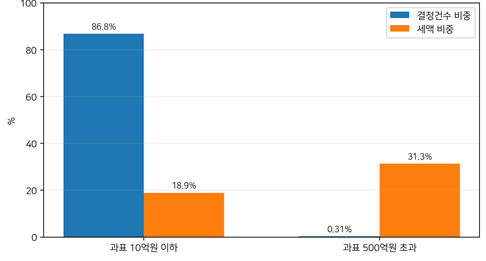
In the gift tax as well, both a broadening tax base and a concentration of revenue appear simultaneously. Of the 181,653 assessed cases in 2025, 86.8% had a taxable base of KRW 1 billion or less, yet these accounted for only 18.9% of total tax assessed. By contrast, cases above KRW 50 billion represented just 0.31% of all assessed cases but accounted for 31.3% of total tax assessed (National Tax Service data, re-cited from Korea Economic Daily, Sept. 27, 2026).
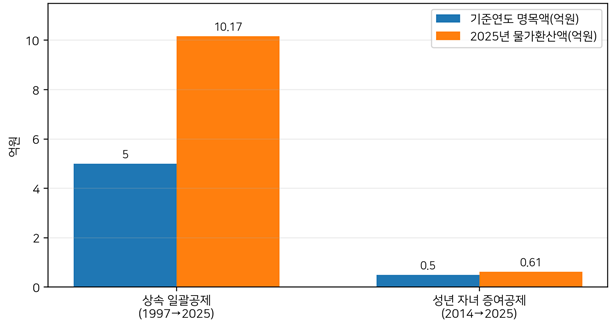
The long-term freeze in deduction amounts is also an important issue. Using the nationwide CPI for a simple conversion, KRW 500 million in 1997 corresponds to about KRW 1.02 billion in 2025 purchasing power, and KRW 50 million in 2014 corresponds to about KRW 61.5 million. These figures do not indicate the proper statutory deduction amount; rather, they serve as reference points showing that a long-term freeze in nominal deductions can lead to a reduction in their real value (based on chained application of the OECD annual CPI index and National Data Portal CPI data for 2023–2025).
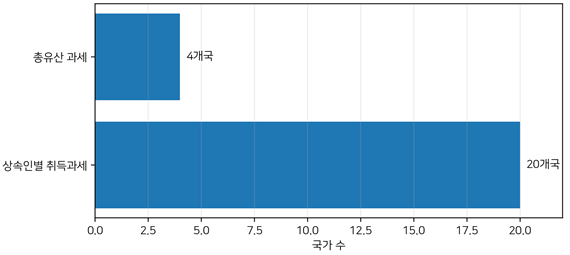
According to an OECD comparison for 2021, of the 24 countries that levy inheritance or estate taxes, 20 taxed based on the actual property received by each heir, while Korea, the United States, the United Kingdom, and Denmark used the total estate as the unit of taxation. In addition, inheritance, estate, and gift taxes accounted for an average of 0.36% of total tax revenue across the OECD, and 0.51% on average among countries that actually imposed such taxes. The countries where the figure exceeded 1% were Belgium, France, Japan, and Korea (OECD, 2021).
This report identifies four structural problems in Korea’s inheritance and gift tax system: 1) the long-term freeze in deductions and the decline in their real value; 2) fiscal drag caused by inflation and fixed taxable base brackets; 3) the gap between total estate taxation and the taxpaying capacity of individual heirs; and 4) institutional inconsistency between inheritance and gift taxation. As policy options, it examines updating deduction levels, indexing deductions and tax brackets to inflation, shifting to an inheritance acquisition tax, and integrated reform of inheritance and gift taxation, while also considering the trade-offs involving revenue, distribution, and administrative costs.
Key Point
What matters is not the top marginal rate alone, but deductions, taxable base brackets, the unit of taxation, inflation indexation, and actual tax revenue together.
1. Raising the Issue
Korea’s inheritance and gift tax applies a five-bracket progressive rate structure, ranging from 10% to a top rate of 50% as the taxable base increases. Yet it is difficult to assess the burden of inheritance tax solely by looking at the top marginal rate. The actual burden varies greatly depending on how much of the inherited property is deducted before taxation, from what level higher rates begin to apply, and whether taxation is imposed on the total estate or on the property actually received by each heir (National Tax Service, Guide to Inheritance and Gift Taxes).
A representative deduction under the current inheritance tax system is the lump-sum deduction of KRW 500 million. Under the gift tax, an adult receiving property from a lineal ascendant is eligible for a basic deduction of KRW 50 million, aggregated over the preceding 10 years. Because these thresholds are set in nominal amounts, they are not automatically adjusted even when prices and asset values rise (Inheritance and Gift Tax Act, Articles 21 and 53).
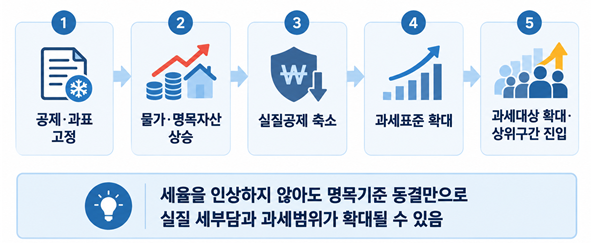
As a result, even without raising statutory tax rates, rising nominal asset values combined with fixed deductions and tax brackets can expand the tax base or push taxpayers into higher-rate brackets. Conversely, even if a high statutory rate is maintained, the actual number of taxpayers may remain limited if exemption thresholds are generous and indexed to inflation. For this reason, international comparisons must review deduction and exemption levels, the unit of taxation, inflation indexation, and the actual share of tax revenue alongside the tax rate itself.
From this perspective, this report examines the current state of Korea’s inheritance and gift tax system and compares it with those of major countries. It then analyzes four issues—the real value of deductions, inflation and taxable base brackets, the unit of taxation, and consistency between inheritance and gift taxes—and presents corresponding policy options and considerations.
2. The Current State and Changes in Korea’s Inheritance and Gift Tax System:
The Emergence of Automatic Tax Increases
◩ Expansion of the Inheritance Tax Base
The most noticeable recent change in the inheritance tax is the increase in the number of taxable cases. In 2025, 22,524 people were subject to inheritance tax assessment, and among them, 17,294, or 76.8%, had a taxable base of KRW 1 billion or less. The largest group was the KRW 100 million to KRW 300 million bracket with 5,394 cases, followed by KRW 500 million to KRW 1 billion with 4,319 cases, KRW 100 million or less with 4,158 cases, and KRW 300 million to KRW 500 million with 3,423 cases (National Tax Service data, re-cited from Korea Economic Daily, Sept. 27, 2026). The number of inheritance tax cases with a taxable base of KRW 1 billion or less rose from 1,971 in 2007 to 17,294 in 2025. By contrast, the average assessed tax amount in this bracket was recently KRW 50.63 million, not much different from KRW 54.67 million in 2007.
These data suggest that recent changes in inheritance tax are related not only to increases in the average tax paid by each taxpayer, but also significantly to the increase in the number of taxable persons. At the same time, the increase in taxable cases cannot be explained solely by the freeze in deductions. Rising real estate and financial asset prices, asset accumulation among older households, and the occurrence of large inheritances have also played a role. Policy evaluation therefore needs to distinguish between the effect of real asset growth and the effect of frozen nominal thresholds.
Source: National Tax Service data, re-cited from Korea Economic Daily (Sept. 27, 2026).
◩ Expansion of the Gift Tax Base and Concentration of Revenue
In 2025, the number of assessed gift tax cases was 181,653. Of these, 86.8% had a taxable base of KRW 1 billion or less. However, this group accounted for only 18.9% of total gift tax assessed. By contrast, cases with a taxable base above KRW 50 billion accounted for only 0.31% of assessed cases but 31.3% of total tax assessed (National Tax Service data, re-cited from Korea Economic Daily, Sept. 27, 2026).
This means that two phenomena are occurring at once in the gift tax. The experience of taxation is spreading to a broader range of asset holders, while actual tax revenue is concentrated in large and ultra-large gifts. Therefore, making the basic deduction more realistic and maintaining progressivity on large gifts are not necessarily issues that must be adjusted in the same direction.
Note: Method for calculating CPI-adjusted values: For Korean CPI in 1997, 2014, and 2022, the OECD annual index (2015=100) was used, and for 2023–2025, the nationwide annual CPI increase published by the National Data Portal was chained to calculate 2025-equivalent values. The CPI base year itself does not affect the conversion ratio. Results are rounded and presented as KRW 500 million in 1997 ≈ KRW 1.02 billion in 2025, and KRW 50 million in 2014 ≈ KRW 61.5 million in 2025.
Source: National Tax Service data, re-cited from Korea Economic Daily (Sept. 27, 2026).
◩ Automatic Tax Increases: The Automatic Rise in Inheritance and Gift Taxes as Inflation Advances Under Long-Fixed Tax Brackets and Deductions
The current lump-sum inheritance tax deduction is KRW 500 million. The deduction for gifts from lineal ascendants is KRW 50 million for adults and KRW 20 million for minors, with the ceiling applied by aggregating deductions over the preceding 10 years (Inheritance and Gift Tax Act, Articles 21 and 53). The taxable base brackets to which inheritance and gift tax rates apply are also based on nominal thresholds of KRW 100 million, KRW 500 million, KRW 1 billion, and KRW 3 billion.
The fact that the nominal amount remains the same does not mean that the real tax-free range remains the same. Using the nationwide CPI for a simple conversion, KRW 500 million in 1997 corresponds to about KRW 1.02 billion in 2025 purchasing power, and KRW 50 million in 2014 corresponds to about KRW 61.5 million in 2025 purchasing power. The calculation uses the OECD’s annual CPI index for Korea (1997, 2014, 2022) and chains it with the National Data Portal’s annual CPI growth for 2023–2025. This is not a proposal for an appropriate deduction amount, but rather a reference point showing the scale of the change in real value.
Source: OECD annual CPI index (Korea) and National Data Portal Consumer Price Survey. Simple converted values.
3. International Comparison of Inheritance and Gift Tax Systems in Major Countries
◩ The Institutional Structure Must Be Considered Alongside the Top Marginal Rate
Korea’s top inheritance and gift tax rate of 50% is high by international standards. Japan’s top rate is 55%, the United States and the United Kingdom apply 40%, and France applies a top rate of 45% for lineal descendants. In Germany, rates vary depending on family relationship and the amount acquired, with a rate structure going up to 30% for close family members (OECD, 2021; tax authorities of each country).
However, actual tax burdens are difficult to compare based on the top marginal rate alone. In the United States, the federal basic exclusion amount for estate tax in 2026 is $15 million per person, while Germany and France apply individual deductions for each heir. Even with the same top rate, the scope of taxation can differ greatly depending on the threshold at which taxation begins and on per-heir deductions.
Country
Top Rate (Representative)
Deduction / Exemption Features
Basic Unit of Taxation
Automatic Inflation Adjustment
Korea
50%
Lump-sum deduction of KRW 500 million
Total estate
None
Japan
55%
JPY 30 million + JPY 6 million per statutory heir
Reflects statutory inheritance shares
Limited
United States
40%
$15 million in 2026
Total estate
Yes
United Kingdom
40%
Basic £325k + residence £175k (subject to conditions)
Total estate
Permitted by law · currently frozen
Germany
Up to 30% for close family
Individual deductions such as €400k for children
Per heir
Fixed-amount standard
France
Up to 45% for lineal descendants
Individual deductions such as €100k for children
Per heir
Fixed-amount standard
Source: OECD (2021), IRS, HMRC, and the tax authorities of Germany, France, and Japan. Because of institutional differences across countries, there are limits to interpreting these figures as a simple ranking of tax burdens.
◩ In the OECD, Taxation Based on Each Heir’s Acquisition Is the Majority Approach
According to the OECD’s 2021 comparison, among 24 member countries imposing inheritance or estate taxes, 20 applied a recipient-based inheritance tax based on the property actually acquired by each heir. Korea, the United States, the United Kingdom, and Denmark used an estate tax model that taxes the decedent’s total estate (OECD, 2021).
Per-heir taxation can directly reflect each heir’s actual acquisition amount and family relationship at the taxation stage. By contrast, total estate taxation focuses on the overall scale of wealth left by the decedent. Neither method automatically implies a lower tax burden; total revenue and distributional effects may differ depending on how deductions and rates are set.
Source: OECD (2021), Inheritance Taxation in OECD Countries.
◩ Whether Thresholds Are Indexed to Inflation Also Changes the Real Scope of Taxation: The U.S. Federal Estate Tax and Inflation Indexation
The U.S. federal estate tax operates an inflation adjustment mechanism alongside a high basic exclusion amount. In 2026, the basic exclusion amount is $15 million, and the IRS adjusts the relevant thresholds through an annual procedure. However, the large changes between 2018 and 2026 include adjustments to the basic amount resulting from legislative amendments, and should therefore be distinguished from the effect of simple inflation indexation alone (IRS, 2026).
The United Kingdom operates a basic nil-rate band of £325,000 and a residence nil-rate band of £175,000, but these thresholds are currently frozen through the 2030–2031 tax year (HMRC). The contrast between the United States and the United Kingdom shows that, beyond the level of the exemption threshold, the question of how to manage threshold amounts over the long term is an independent issue of policy design.
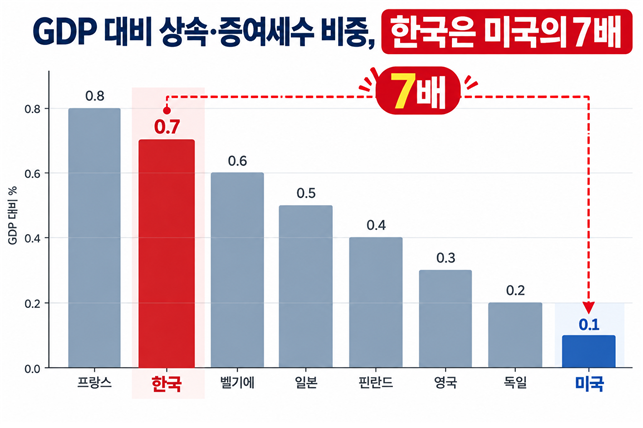
◩ Korea Also Falls into the Relatively High Group in Terms of Actual Revenue Share: Inheritance and Gift Tax Revenue as a Share of GDP Is Seven Times That of the United States
According to OECD Revenue Statistics for the same tax category—Estate, inheritance and gift taxes (4300)—as a share of GDP in 2023, France stood at 0.8%, Korea 0.7%, Belgium 0.6%, Japan 0.5%, Finland 0.4%, the United Kingdom 0.3%, Germany 0.2%, and the United States 0.1% (OECD Revenue Statistics).
In a separate OECD comparison, inheritance, estate, and gift taxes accounted for 0.36% of total tax revenue on average across the OECD, and 0.51% on average among countries actually levying such taxes. At that time, the countries exceeding 1% were Belgium, France, Japan, and Korea (OECD, 2021). These indicators show that Korea’s characteristics must be examined not only in terms of nominal tax rates, but also in terms of actual revenue structure.
Source: OECD Revenue Statistics, 2023, tax category 4300.
4. Structural Problems in the Inheritance and Gift Tax System
◩ Long-Term Freeze in Deductions and Decline in Real Value
The first issue is that nominal deductions fixed over a long period can shrink the real tax-free range. If deduction amounts remain unchanged while prices rise, the real exemption effect provided by the same nominal deduction declines.
An inflation adjustment does not directly determine the appropriate deduction amount. Inherited property is not a consumer good; it consists largely of real estate and financial assets, and asset prices do not move in the same way as the CPI. Even so, CPI conversion is the simplest and most transparent benchmark for showing that long-frozen nominal thresholds do not represent neutral policy maintenance.
◩ Fiscal Drag Caused by Inflation and Fixed Tax Brackets
The second issue is that not only deductions, but also tax rate brackets are fixed in nominal terms. The current 10–50% rates apply according to taxable base thresholds of KRW 100 million, KRW 500 million, KRW 1 billion, and KRW 3 billion. If prices and nominal asset values rise while the brackets remain fixed, taxpayers may move into higher tax brackets even if their real wealth has not changed much.
This phenomenon is separate from the question of whether the tax rates themselves are appropriate. It is possible to keep rates unchanged while indexing deductions and taxable base brackets to inflation; conversely, even without increasing rates, real tax burdens can rise through the freezing of nominal thresholds. Policy evaluation therefore needs to distinguish between nominal tax rates and real tax positions.
Source: Compiled by the author. Applies the fiscal drag mechanism, similar to bracket creep in income tax, to nominal thresholds in inheritance and gift taxation.
◩ The Gap Between Total Estate Taxation and the Taxpaying Capacity of Individual Heirs
The third issue is the unit of taxation. If one child inherits all of a KRW 3 billion estate, and if three children each inherit KRW 1 billion from that same estate, the total estate is the same, but the economic benefit to each heir is different. Total estate taxation emphasizes the size of the wealth left by the decedent, whereas taxation based on each heir’s acquisition directly reflects the taxpaying capacity of the actual recipient.
At the same time, this does not mean that one system is absolutely superior. Total estate taxation may be simpler from an administrative and collection standpoint, while per-heir taxation may create incentives for split inheritance because the burden varies with the number of heirs and their relationships to the decedent. The choice of system must compare fairness, revenue, avoidance potential, and administrative cost together.
◩ Institutional Inconsistency Between Inheritance and Gift Taxation
The fourth issue is that, despite inheritance and gift taxes both involving gratuitous intergenerational transfers of wealth in economic terms, their deductions, aggregation periods, and special provisions are designed separately. If only one of the two systems is adjusted significantly, taxation may affect the choice between lifetime gifts and posthumous inheritance by changing their relative tax price.
Accordingly, inheritance and gift taxes should be examined not merely as separate taxes, but from the perspective of an integrated wealth transfer tax system covering basic deductions, aggregation of prior gifts, and purpose-specific special provisions.
5. Directions for Improving the Inheritance and Gift Tax System
◩ Updating Deduction Levels
If deduction levels are reconsidered, the amount should not be set based on CPI alone. It is necessary to examine consumer prices, the distribution of household net wealth, the prices of major inherited assets such as housing, the ratio of inheritance tax cases to total deaths, and tax burden and revenue effects by asset bracket.
In particular, expanding deductions may exclude relatively lower asset brackets from taxation, while also reducing tax liabilities for large inheritances. It is therefore important to disclose the distributional effects of updating deductions by asset bracket. The current inflation-adjusted value of KRW 500 million in 1997—about KRW 1.02 billion—is only one reference point, not a policy target.
◩ Introducing Inflation Indexation (Linking Tax Brackets and Deduction Amounts to a Price Index)
If a one-time adjustment is followed by another long freeze, the same problem may recur. It is therefore worth considering linking deductions and taxable base brackets to an objective price index. Several methods are possible, including annual adjustment, periodic adjustment at fixed intervals, or adjustment once cumulative inflation reaches a certain level.
If only deductions are indexed while tax brackets remain unchanged, the problem of bracket creep remains in part. Therefore, if inflation indexation is introduced, it is logically consistent to review not only basic deductions but also taxable base brackets together. By contrast, using asset prices as the automatic indexation benchmark would require separate and careful review because of large regional and asset-specific variation.
◩ Reviewing a Shift to an Inheritance Acquisition Tax
The core of shifting to an inheritance acquisition tax is not tax reduction itself, but changing the unit of taxation from the decedent’s total estate to the actual amount acquired by each heir. Depending on how per-heir deductions and rates are set, it is possible to design a system that keeps total revenue roughly similar to the current system while adjusting only the distribution of burdens.
However, such a shift could increase incentives to reduce progressivity by increasing the number of heirs or by making prior gifts. Accordingly, rules for aggregating prior gifts, determining beneficial ownership, and reporting and collecting jointly inherited property would need to be designed together. It is also necessary to evaluate whether the system change would increase taxpayer compliance costs and administrative costs.
◩ Integrated Reform of Inheritance and Gift Taxation
Deductions, aggregation periods for prior gifts, taxable base brackets, and purpose-specific special provisions—such as those for marriage, childbirth, and business succession—should be reviewed from the perspective of a single system of intergenerational wealth transfer. If basic deductions remain fixed for a long time while individual special provisions are repeatedly added, institutional complexity may increase and differences based on personal circumstances may widen.
In the case of business succession, it is important to distinguish whether the core issue is liquidity rather than the overall rate and deduction structure of inheritance tax. Where asset values are high but cash is limited—as with unlisted company shares—liquidity measures such as installment payment or payment deferral can be compared. The OECD also explains that many countries operate installment payment systems for inheritance tax or separate schemes for business assets.
Structural Problem
Possible Policy Direction
Related Considerations
Long-term freeze in deductions · decline in real value
Update deduction levels
Revenue · distributional effects, asset distribution
Inflation · fixed taxable base brackets
Index deductions · taxable base brackets to inflation
Adjustment cycle, choice of index
Gap between total estate and individual taxpaying capacity
Review shift to an inheritance acquisition tax
Split inheritance · prior gifts · administrative cost
Inconsistency between inheritance and gift taxation
Integrated reform of the wealth transfer tax system
Aggregation period · special provisions · business succession
Source: Compiled by the author. The four directions below are policy options for comparison and review, not a single prescribed solution.
6. Conclusion
The problems of Korea’s inheritance and gift tax system cannot be explained by the single number of a 50% top marginal rate. Recently, the number of inheritance tax cases has expanded significantly, and in the gift tax as well, the taxpayer base has broadened. At the same time, gift tax revenue is concentrated in large and ultra-large transfers. It is therefore necessary to examine both the expansion of the tax base and the concentration of tax revenue at the same time.
In international comparison as well, Korea’s distinctive feature is not simply its high rate. In the OECD comparison, taxation based on each heir’s acquisition is the majority approach, while Korea belongs to the small group of countries that maintain total estate taxation. Moreover, inheritance, estate, and gift tax revenue amounted to 0.7% of GDP in 2023, a relatively high level among major comparison countries. The United States operates both a high basic exclusion amount and an inflation adjustment mechanism.
The long-term freeze in deductions is a separate issue. The fact that nominal amounts remain unchanged does not mean that the real tax-free range also remains unchanged. If prices rise over a long period, the real value of deductions declines, and if taxable base brackets are also fixed, the likelihood of entering higher tax brackets increases. At the same time, the appropriate deduction amount must be determined not by CPI alone, but by considering asset distribution and the effects on revenue and redistribution.
In future discussions of tax reform, four questions may be central. First, do the current deductions provide an appropriate real tax-free range? Second, how should fiscal drag resulting from inflation be managed? Third, should the unit of taxation be the total estate or the actual amount acquired by each heir? Fourth, are differences between inheritance and gift taxation unduly influencing the timing of transfers?
The corresponding policy options—updating deductions, inflation indexation, shifting to an inheritance acquisition tax, and integrated reform of inheritance and gift taxation—each involve both advantages and costs. Before adopting any one direction, it is important to disclose and compare revenue and distributional effects by asset bracket, tax avoidance potential, administrative costs, and taxpayer compliance costs. Discussion of inheritance and gift taxes should move beyond a simple debate for or against the top marginal rate and expand into a structural discussion that evaluates real value, actual acquisition amounts, tax neutrality, and fiscal effects together.
◩ References
● National Data Portal. Consumer Price Survey, 2025 Annual Consumer Price Index.
● National Law Information Center. Inheritance and Gift Tax Act (laws and regulations in force in 2026).
● National Tax Service. Guide to Filing Inheritance and Gift Taxes and Information on Tax Rates and Deductions.
● Korea Economic Daily (Sept. 27, 2026). Article on inheritance tax assessment status by taxable base bracket (re-citing National Tax Service data).
● Korea Economic Daily (Sept. 27, 2026). Article on gift tax deduction amounts and assessment status by taxable base bracket (re-citing National Tax Service data).
● HM Revenue & Customs. Inheritance Tax thresholds.
● Internal Revenue Service. Instructions for Form 706, 2026 basic exclusion amount.
● OECD (2021). Inheritance Taxation in OECD Countries, OECD Tax Policy Studies No. 28.
● OECD. Revenue Statistics, category 4300: Estate, inheritance and gift taxes.
● OECD/FRED. Consumer Price Index: Total for Korea, annual series (OECD source).
Original title: 상속·증여세제의 구조적 문제와 개선 방향
Author: Center for Free Enterprise (CFE)
Date: 2026-10-06
Source: https://www.cfe.org/bbs/bbsDetail.php?cid=issue&pn=1&idx=29598