
Problems with University Endowment Investment Regulations and Building an Autonomous Fund Management System
-
Writer
CFE
-
※ Key Message
The focus of university reserve fund policy should shift from “how much has been accumulated” to “how is it managed and accounted for?” Universities should be allowed to choose freely among direct management, private OCIOs, pooled investment vehicles, and outsourcing to specialized institutions, while the government should focus less on uniform asset regulations and more on disclosure, risk management, and fiduciary responsibility.
◩ Key Summary
As of fiscal year 2025, the cumulative reserves in tuition accounts of private four-year universities and junior colleges nationwide reached KRW 12.2358 trillion, surpassing KRW 12 trillion. Including reserves in school foundation accounts, the total comes to about KRW 12.86 trillion. However, if the university reserve fund issue is viewed simply as one of “money being stockpiled,” policy alternatives are likely to remain limited to suppressing accumulation or forcing expenditures. (Ministry of Education and Korea Student Aid Foundation data; Hankyung, Sept. 27, 2026)
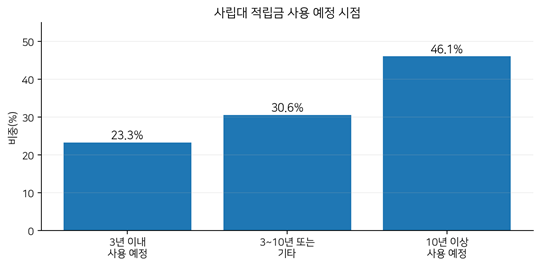
The more important issue is the structure of reserve fund management. Of the estimated year-end balance of KRW 11.3694 trillion in reserve fund management plans, KRW 5.2409 trillion, or 46.1%, is not scheduled for use for at least 10 years. Yet a substantial share is managed mainly through bank deposits, and about 19.7% of balances deposited with financial institutions reportedly received interest rates below the benchmark rate at the time of subscription. If long-term funds are managed the same way as short-term funds, losses in real value due to inflation and growing opportunity costs can accumulate. (Ministry of Education and Korea Student Aid Foundation data; Hankyung, Sept. 27, 2026; Kyosu Shinmun, 2026)
The current reserve fund system overlaps purpose-based spending controls, a 50% cap on securities investment, fund management review, and budget and accounting procedures. The problem is not simply whether investment is permitted, but whether this ratio- and procedure-centered regulatory framework adequately reflects the maturity, liquidity, and risk profile of long-term funds held for more than 10 years. Leading universities abroad distinguish between long- and short-term funds and use a variety of structures, including in-house professional management, external outsourcing, and pooled investment vehicles. Korea likewise needs to shift toward a system that broadens universities’ choices while strengthening disclosure and fiduciary accountability. (Private School Act Articles 32-2 and 32-3; NACUBO, 2026; University of Oxford, 2026; UTAM, 2026)
Policy Direction
Deregulation → Expanded Choice → Stronger Accountability. Universities should choose management methods according to the size, maturity, and risk tolerance of their reserves, while the government should shift from specifying investment destinations to overseeing investment policy statements, diversification, conflict-of-interest prevention, long-term performance disclosure, and fiduciary responsibility.
• Gradually replace the uniform 50% cap on securities investment with principle-based regulation centered on fiduciary responsibility
• Classify reserves into short-, medium-, and long-term categories and allow asset allocation matched to fund maturity
• Allow universities to choose freely among direct management, private OCIOs, pooled investment vehicles, and outsourcing to specialized institutions
• Permit multiple pooled investment markets for small and regional universities
• Use university-specific spending policies so investment returns can be cycled back into education, research, and scholarships
• Shift the government’s role from ex ante investment control to disclosure, risk management, and accountability rules
1. Introduction: The Problem Is Not the Size of Reserves but How They Are Managed
In fiscal year 2025, the cumulative reserves in tuition accounts of 143 private four-year universities and 117 junior colleges nationwide totaled KRW 12.2358 trillion, up KRW 671.4 billion, or 5.8%, from the previous year. Including foundation accounts, the total reaches about KRW 12.86 trillion. Looking only at these figures, one might criticize universities for complaining of financial hardship while leaving large sums unused. (Ministry of Education and Korea Student Aid Foundation data; Hankyung, Sept. 27, 2026)
However, treating reserves as unnecessary surplus funds does not adequately reflect the nature of university finance. Universities must prepare for future large-scale expenditures such as construction and renovation of educational facilities, student scholarships, research support, and retirement costs. The Private School Act permits reserves for these purposes and requires them to be managed as principal-preservation reserves and discretionary reserves, further divided into research, construction, scholarship, retirement, and specific-purpose reserves. (Private School Act Article 32-2)
Financial conditions also vary greatly from one university to another. It is difficult to assess large metropolitan universities and small regional universities directly exposed to student population decline by the same standard. Accordingly, the policy question must go beyond “Why are they accumulating reserves?” to “How long will the funds be held, how should they be managed over that period, and how should the returns be cycled back into the university’s core functions?”
2. Current Status and Management of University Reserves
◩ Nearly Half of Reserve Funds Are Long-Term Funds Held for More Than 10 Years
One of the most important variables in reserve fund management is the planned timing of use. Of the estimated year-end balance of KRW 11.3694 trillion across 277 reserve fund management plans for fiscal year 2025, KRW 5.2409 trillion, or 46.1%, was classified as not to be used for at least 10 years. Funds expected to be used within 3 years amounted to KRW 2.6527 trillion, or 23.3%. (Ministry of Education and Korea Student Aid Foundation data; Hankyung, Sept. 27, 2026; Kyosu Shinmun, 2026)
However, in these sectors the benefits of maintaining separation and competition are greater than those of consolidation into a single corporation. The five power generation subsidiaries were split in 2001 to introduce competition, so mechanisms for comparison and competition should be preserved. Port authorities also differ in cargo structure and regional strategy, and centralized integration could actually weaken local autonomy. Oil and gas likewise differ in procurement markets, pricing structures, infrastructure, and business risk, making it more reasonable to preserve separate specialization and accountability than to integrate them. By contrast, since all mines operated by Korea Coal Corporation have been closed, its function has effectively ended, making liquidation after debt settlement and legal revision the appropriate direction.
Current Status of University Reserves and Implications
Indicator | Scale / Share | Implication
Cumulative reserves in tuition accounts | KRW 12.2358 trillion | Fiscal year 2025
Increase from previous year | KRW 674.1 billion (+5.8%) | Reserve size is growing
Including foundation accounts | KRW 12.86 trillion | Total private school sector basis
Scheduled for use after 10+ years | KRW 5.2409 trillion (46.1%) | Long-term fund characteristics
Scheduled for use within 3 years | KRW 2.6527 trillion (23.3%) | Need for short-term liquidity
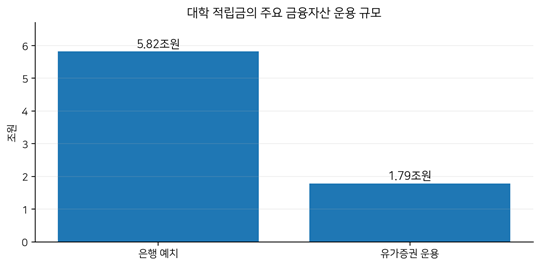
Bank deposits | KRW 5.8187 trillion | Deposit-centered management
Securities investment | KRW 1.7856 trillion | Relatively limited
Deposits below benchmark interest rate | KRW 1.6439 trillion | Debate over management efficiency
Source: Hankyung and Kyosu Shinmun reports (Sept. 2026) citing materials submitted by the Ministry of Education and Korea Student Aid Foundation.
Source: Based on estimated year-end balances. The 3–10 year or other shares are calculated as the residual share.
The appropriate way to manage KRW 10 billion to be used for facility repairs one year from now cannot be the same as for KRW 10 billion to be used 15 years from now. For short-term funds, principal preservation and liquidity are key. For long-term funds, however, it is also necessary to manage the erosion of purchasing power due to inflation and the opportunity cost over a long period. Deposits have the advantage of preserving nominal principal, but they do not necessarily preserve real value over the long run.
◩ A Management Structure in Which Even Long-Term Funds Remain in Deposits
As of 2025, of university reserves, KRW 5.8187 trillion was reportedly deposited in banks and other institutions, while KRW 1.7856 trillion was managed through securities. Deposit-centered management is not inherently wrong. But when a substantial share of funds is not planned for use for more than 10 years, managing even long-term funds like short-term cash can create a mismatch between asset and liability maturities. (Ministry of Education and Korea Student Aid Foundation data; Hankyung, Sept. 27, 2026)
Source: Hankyung report (based on Ministry of Education and Korea Student Aid Foundation data). This does not represent all asset categories, but rather a comparison of major management balances.
It has also been reported that of KRW 8.33 trillion deposited with financial institutions, KRW 1.643 trillion, or about 19.7%, received interest rates below the benchmark rate at the time of subscription. Thus, the issue with university fund management is not best framed as the simplistic criticism that “they did not invest enough in stocks,” but rather as whether asset allocation policy is systematically aligned with the timing of use and risk characteristics of the reserves. (Ministry of Education data; Hankyung, Sept. 27, 2026; Kyosu Shinmun, 2026)
Institutional incentives must also be considered. If losses occur through active investment, the responsibility of university executives and staff becomes directly visible. By contrast, the opportunity loss from managing funds for 10 years at excessively low interest rates is relatively less visible. This asymmetry of accountability can create the incentive that “doing nothing is the safest choice.” (See Korea Student Aid Foundation advisory materials on university accounting and reserve fund management)
3. Structural Problems in the Current Regulatory and Institutional Framework for Reserve Fund Management
◩ The Current Regulatory Framework: Overlapping Purpose Regulations, Investment Caps, Review, and Accounting Controls
The current university reserve fund system is not one that bans investment outright, but rather a regulatory framework layering reserve purposes, investment caps, deliberation procedures, and accounting and supervisory devices. Article 32-2 of the Private School Act classifies reserve purposes into research, construction, scholarships, retirement, and specific purposes, and requires in principle that they be used accordingly. At the same time, it allows securities as defined under the Capital Markets Act to be acquired up to one-half of total reserves, excluding reserve amounts transferred from tuition accounts to non-tuition accounts. It also sets separate limits for investment in venture firms utilizing technologies and patents of faculty and students. In other words, the law directly controls both the use of funds and the total amount that may be invested. (Private School Act Article 32-2, National Law Information Center, 2026)
Separate procedural controls are added to management decision-making. Under Article 32-3 of the Private School Act and Articles 14-8 and 14-9 of its Enforcement Decree, a fund management review committee is established to deliberate on annual fund management plans and operational guidelines. The Enforcement Decree allows participation by external experts such as those with experience in asset management and risk management, professors in related fields, certified public accountants, and lawyers. While this supplements expertise, a committee that deliberates periodically is functionally different from a professional management organization that constantly monitors markets and performs asset allocation, manager selection, risk management, and performance analysis. (Private School Act Article 32-3; Enforcement Decree of the Private School Act Articles 14-8 and 14-9, 2026)
Budget and accounting procedures are also tied to reserve fund management. The Special Rules on Financial and Accounting Rules for Private School Institutions require reserve fund management plans as budget attachments and recognize investment securities as a separate asset item in accounting. The Korea Student Aid Foundation has advised that when a reserve fund management plan is linked to the main budget, in addition to deliberation by the fund management review committee, consultation with the university council and tuition review committee procedures may also be required. These controls are meaningful for preventing misuse and arbitrary investment, but they can create tension in long-term investing, where asset allocation may need to be adjusted in response to changing market conditions. (Special Rules on Financial and Accounting Rules for Private School Institutions, Article 10 and Appendix 2; Korea Student Aid Foundation, Jan. 21, 2026; June 11, 2026)
◩ A Uniform 50% Investment Cap Regardless of Fund Maturity
The 50% cap on securities investment has the advantage of limiting excessive risk exposure and increasing regulatory predictability. However, it has the limitation of being applied based on total reserves regardless of the planned timing of use, university liquidity, financial soundness, or the degree of portfolio diversification. Funds to be used for scholarships two years from now and funds to be used for facility investment 15 years from now are managed under the same statutory ceiling. Considering that 46.1% of the estimated year-end balance in reserve fund management plans for fiscal year 2025 consists of long-term funds with a horizon of over 10 years, the gap between actual fund maturity and uniform ratio regulation merits review. (Private School Act Article 32-2; Ministry of Education and Korea Student Aid Foundation data; Hankyung, Sept. 27, 2026; Kyosu Shinmun, 2026)
The core of long-term fund management lies not in the holding ratio of a particular asset itself, but in managing timing of use, needed liquidity, loss tolerance, and expected return together. NACUBO likewise explains that universities’ spending needs and institutional financial structure and risk preference should be considered alongside the portfolio. Limiting risk through a single statutory ratio is simple, but from the perspective of asset-liability management (ALM), it may fail to adequately reflect the characteristics of long-term funds. (NACUBO, 2025a; 2026b)
◩ Fragmentation Between Purpose-Based Accounting Control and Asset Management
Distinguishing purposes such as research, construction, scholarships, and retirement, and restricting off-purpose use, is necessary to protect the trust of university stakeholders and donors. However, purpose-based accounting management and separation of investment portfolios are not the same issue. Scholarship reserves, research reserves, and construction reserves can each be tracked separately in accounting in terms of shares and uses, while the actual investment assets are managed as an integrated portfolio. This preserves purpose control while enhancing economies of scale and diversification benefits. (Private School Act Article 32-2; Special Rules on Financial and Accounting Rules for Private School Institutions; NACUBO, 2025b)
In foreign university endowments, it is common to preserve use restrictions and accounting records for individual donor funds while combining institution-wide investment governance with integrated asset allocation. Korea’s system likewise needs to clarify standards distinguishing “purpose-based use” from “integrated management,” allowing separate accounting alongside integrated management. This is not about allowing off-purpose use, but about reducing inefficiency at the investment execution stage. (NACUBO, 2025b; University of Toronto Asset Management, 2026)
◩ Gaps in Management Expertise Across Universities and Constraints on Choice
The current system supplements expertise by allowing external experts to participate in fund management review committees. However, it is unrealistic to expect the same in-house management capability from a university with reserves in the hundreds of billions of won and a small university with reserves in the billions or tens of billions. Advisory cases from the Korea Student Aid Foundation also show examples of universities considering adoption of OCIO arrangements to improve reserve fund returns and asking about procedures for selecting outsourced managers and the allocation of authority between review committees and boards. This demonstrates that there is demand in the field for external professional management. (Korea Student Aid Foundation, Sept. 2 and Oct. 2, 2024; Enforcement Decree of the Private School Act Article 14-8)
Accordingly, the focus of regulatory reform should not be on requiring the same investment organization or management method for all universities. Some universities can appoint internal CIOs, some are better served by private OCIOs, some small universities need pooled vehicles, and some may prefer conservative management centered on deposits and bonds. Regulation should be designed not to block these choices, but to allow each university to select a method suited to its costs, capabilities, and fund maturities. (NACUBO, 2025a; Korea Student Aid Foundation, 2024)
Current Regulations Related to University Reserve Fund Management: Institutional Status, Structure, and Issues
Regulatory / Institutional Element | Current Structure | Critical Issue
Reserve purpose | Purpose-based management for research, construction, scholarships, etc. | Need to distinguish purpose-based accounting control from portfolio management
Cap on securities acquisition | In principle, up to 50% of reserves | Uniform total-volume regulation regardless of fund maturity and liquidity
Fund management review | Management plans and guidelines reviewed by committee | Procedural expertise and ongoing management capability are separate issues
Budget / accounting linkage | Management plans tied to budget and accounting procedures | Possible tension with rapid adjustments to market change
Management accountability | Losses and procedural violations are visible | Opportunity costs from prolonged low-return management are less visible
4. International Cases: Autonomy and Diversity in Management Methods
When comparing foreign university endowment cases, it is not appropriate to simply follow return figures. The legal nature of university endowments, donor culture, tax systems, and financial markets differ from Korea’s. What is worth noting is the structure: long-term funds are separately identified, a variety of methods are used under professional governance—including direct management, external outsourcing, and pooled vehicles—and stable spending rules are used to support both current education and research and preservation of purchasing power for future generations.
◩ United States: Relatively High Returns Through Autonomous Diversification and Spending Policies
If the policy environment has changed, governance can also be reviewed. However, it must first be verified whether the reasons for introducing competition have truly disappeared and whether the benefits in investment and bargaining power from integration outweigh the costs of losing competition. The unification of KORAIL and SR may improve user convenience and seat management efficiency, but it could also weaken competitive pressure that allows comparison of service, fares, and operational performance.
◩ United Kingdom: Universities’ Own Professional Reserve Management and Pooled Fund Structures
Even if integration is unavoidable, it is not necessary to concentrate all authority in a single central organization. In the power sector, responsibility accounting by energy source, region, and project can be maintained, with performance disclosed to preserve internal comparison and competition. In ports, policy planning and overseas bases can be integrated while still ensuring sufficient autonomy for regional branches over operations, fees, and marketing. In rail as well, the possibility of competition should be reexamined by function, such as facilities, control, and operations.
◩ Canada: Independent Professional Institutions Dedicated Solely to University Assets
The University of Toronto operates the University of Toronto Asset Management Corporation (UTAM) as a separate specialized institution dedicated to investing university-owned assets. UTAM separately manages the Long Term Capital Appreciation Pool (LTCAP), a long-term fund, and the Expendable Funds Investment Pool (EFIP), which holds short- and medium-term operating funds. At the end of 2025, LTCAP totaled approximately CAD 5.4 billion, and the university’s Business Board approves investment policy and risk-return objectives while UTAM executes them. In other words, long-term endowment assets and short-term liquidity funds are separated, with university governance setting policy and the professional institution handling execution. (UTAM, 2026; University of Toronto Business Board, 2025)
◩ Australia: Separation of Pools by Fund Maturity and Use of External Professional Managers
At Australian National University (ANU), only funds with an investment horizon exceeding 3 years are placed in the Long Term Investment Pool (LTIP), while shorter-term funds are managed separately in the General Cash Float. LTIP targets CPI+3.5% over a rolling 7-year period and applies an annual distribution rate of 4.5% for sustainable allocation. Most of the assets are invested through professional external managers. This is a clear example of separating long-term investment from short-term liquidity management based on fund maturity. (Australian National University, “Long Term Investment Pool and General Cash Float,” confirmed 2026)
The University of Melbourne likewise manages long-term donated assets in a Gift Investment Portfolio, with strategic investment decisions overseen by the university’s Investment Management Committee and much of the actual execution delegated to specialized external advisory and management institutions. In 2025, the market value of the long-term gift asset portfolio was about AUD 1.522 billion, and AUD 68 million was distributed for various university purposes. This is a model combining internal governance with external professional management. (University of Melbourne, 2025 Gift Investment Report; Responsible Investment Guide, 2025)
International Cases Related to University Reserve Fund Management and Implications
Country / Case | Core Management Structure | Implications for Korea
United States / university endowments | Diversification + long-term performance evaluation + spending policy | A circular structure linking investment and spending on education and research
United Kingdom / Oxford, Cambridge | In-house professional managers, pooled funds, rolling-average distribution rules | Combines expertise and economies of scale with stable spending
Canada / Toronto | Specialized corporation dedicated to university assets, separated long- and short-term pools | Separation of policy decision-making and management execution
Australia / ANU, Melbourne | Separate investment pools by maturity, use of external professional managers | Allocate only long-term funds to risk assets and externalize expertise
5. Directions for Improvement: Deregulation, Expanded Choice, and Stronger Accountability
◩ Shift the Uniform 50% Investment Cap Toward Fund Maturity and Fiduciary Responsibility
In the short term, it is worth considering relaxing the securities investment cap for long-term reserves held for more than 10 years. In the medium to long term, consideration should be given to shifting from a system in which the law sets a uniform ratio to principle-based regulation centered on the prudent investor rule and fiduciary responsibility. Universities would set target returns, risk limits, required liquidity, strategic asset allocation, and performance evaluation criteria through an investment policy statement (IPS), with the board and investment committee responsible for them. (Current investment cap: Private School Act Article 32-2)
◩ Manage Reserves by Short-, Medium-, and Long-Term Use Periods
Proposed Management Direction by Reserve Fund Use Period
Category | Example Period | Basic Management Direction
Short-term funds | Within 3 years | Focus on liquidity and principal preservation through deposits, MMFs, short-term bonds, etc.
Medium-term funds | 3–10 years | Combine high-quality bonds and diversified market assets
Long-term funds | 10+ years | Long-term diversified investment in domestic and foreign equities and bonds, with each university determining risk level
The government does not need to set mandatory ratios for these periods and asset categories. The key is to ensure that investment policy reflects not only reserve purpose but also timing of use and required liquidity. ANU’s model of clearly separating long-term investment pools and short-term operating funds may also serve as a useful reference. (Australian National University, confirmed 2026)
◩ Let Universities Freely Choose Among Direct Management, OCIOs, Pooled Investment Vehicles, and Public Fiduciary Management
Typology of University Reserve Fund Management Models
Management Model | Appropriate When | Key Characteristics | Policy Principle
In-house CIO / direct management | Large reserves and internal expertise | University directly performs asset allocation and management | Choice
Private OCIO | Some scale but lacking specialized personnel | Outsources asset allocation, management, and risk management to specialists | Choice
Pooled investment vehicle | Small and regional universities | Multiple universities pool only the investment function to gain economies of scale | Participation
Public professional fiduciary manager | Universities preferring public-style management | Outsourcing to a specialized institution under a separate legal basis | Choice
There is no need for the government to define any one of these as the correct answer. Large universities may appoint their own CIOs, mid-sized universities may use private OCIOs, and small universities may choose among multiple pooled investment vehicles. Universities that do not want risk may continue to choose conservative management centered on deposits and bonds. The key is that universities determine their management model in light of cost, expertise, and fund maturity.
◩ The National Pension Service Should Be a Reference Model, Not a Mandatory Outsourcing Institution
The idea of utilizing the expertise of the National Pension Service (NPS) in managing university reserve funds can be explored, but simply combining university funds with the National Pension Fund would not be appropriate. The NPS has a distinct legal purpose as pension assets for subscribers. To permit direct fiduciary management, a separate legal basis, account and profit-loss separation, and a clear accountability structure would be required. Still, the NPS approach of combining direct management, external outsourcing, and domestic and international assets can serve as a reference model for long-term fund management. As of the end of June 2026, for the financial sector portion of its assets, the NPS managed 47.9% directly and 52.1% through external outsourcing. (National Pension Service Investment Management, 2026)
Accordingly, the policy objective should not be “let’s entrust it to the National Pension Service,” but rather “let’s make NPS-style public fiduciary management available as an option while allowing it to compete with private OCIOs, pooled vehicles, and in-house management.” University and pension assets and profit-and-loss accounts should be completely separated, and performance should be compared based not on the ownership structure of the manager but on return, risk, cost, and governance.
◩ Maintain Purpose-Based Accounting but Allow Integrated Investment Management
There should be clear permission for a structure in which use purposes such as scholarships, research, and construction are strictly maintained while actual management is conducted in a single integrated portfolio and each reserve fund’s share is separated in accounting. This is not about allowing off-purpose use, but about lowering investment costs and increasing diversification effects. Overseas cases such as Cambridge CUEF and Toronto LTCAP, which pool multiple funds or long-term assets, demonstrate the practical feasibility of this approach. (University of Cambridge, 2026; UTAM, 2026)
◩ Spending Policies That Return Investment Income to Education and Research
The purpose of fund management is not to turn universities into investment companies. Its purpose is to preserve the real value of long-term assets while supplying stable support for scholarships, research, and education from investment performance. Universities should be able to choose their own approach, whether by applying a distribution rate to a rolling average of net asset value as Oxford does, or by setting expenditure amounts based on the average value of recent years as many U.S. universities do. Rather than imposing a uniform spending rate, the government should encourage each university to establish a spending policy suited to its own financial condition and long-term objectives. (University of Oxford, 2026; NACUBO, 2026b)
◩ Government Oversight Should Shift From Ex Ante Investment Control to Disclosure, Risk Management, and Fiduciary Responsibility
As autonomy expands, transparency and accountability become even more important. However, it is more efficient for the government to require disclosure of the planned timing of reserve fund use, asset allocation, 1-, 3-, 5-, and 10-year returns, benchmark-relative performance, liquidity, external management fees, investment committee composition, conflicts of interest, and the scale of returns cycled back into education and research, rather than approving individual financial products or setting uniform allocation ratios. Accountability should be assessed not mainly by whether short-term losses occur, but by whether investment procedures are reasonable, diversification is sufficient, liquidity is appropriate, costs are controlled, and long-term risk-adjusted performance is sound. This does not mean “eliminating regulation,” but shifting the focus of regulation from ratios and ex ante procedures to fiduciary responsibility and performance disclosure.
6. Conclusion: Let Universities Choose How to Manage University Funds
The fact that university reserves have exceeded KRW 12 trillion does not in itself justify concluding that the reserves are excessive. Universities need to hold a certain amount of long-term assets to prepare for future expenditures such as facility investment, scholarships, research, and restructuring. The issue is not how much money they have, but how it is being managed. When more than KRW 5 trillion of current reserves is classified as long-term funds to be used after 10 years, treating those funds the same as short-term deposits can lead to cumulative erosion of purchasing power and opportunity costs. (Ministry of Education and Korea Student Aid Foundation data; Hankyung, Sept. 27, 2026)
The current system already permits securities investment within a certain range and also has a fund management review committee and external expert arrangements. Therefore, the starting point for reform is not “let’s newly allow investment,” but rather converting the current framework—centered on purpose-based controls, a 50% aggregate cap, and budget and review procedures—into one that considers fund maturity along with the risk and return of the overall portfolio. In exchange for broader investment freedom, university boards and investment committees should be assigned clear fiduciary responsibility for reasonable investment policy, diversification, appropriate liquidity, conflict-of-interest management, cost control, and performance disclosure. (Private School Act Articles 32-2 and 32-3)
International cases do not point to a single correct answer. The United States combines diversification and spending policies; Oxford and Cambridge use in-house professional managers and pooled funds; Toronto has a specialized corporation dedicated to university assets; and ANU and Melbourne distinguish between long- and short-term funds or actively use external professional managers. The common thread is not uniform compulsion of a single management method, but designing expertise and accountability structures according to the purpose and duration of funds. (NACUBO, 2026; University of Oxford, 2026; University of Cambridge, 2026; UTAM, 2026; ANU, 2026; University of Melbourne, 2025)
In Korea as well, NPS-style public fiduciary management, private OCIOs, pooled investment vehicles, and in-house management can all be left open as options. There is no reason for the government to decide which method is superior. Each university differs in reserve fund size, professional personnel, timing of use, and risk tolerance. The government’s role is not to designate investment destinations, but to reduce barriers to entry and choice so that diverse management markets can function, while strengthening information disclosure and accountability rules.
If the system is reformed around the three principles of deregulation, expanded choice, and stronger accountability, university reserves can function not as sleeping assets but as a sustainable source of funding for education and research that does not rely solely on tuition and government support.
Final Recommendations
◆ The government should not decide where university money is invested; universities should choose, and universities should bear responsibility for the results of that choice.
◆ The policy evaluation standard should also shift from “how much has been accumulated” to “how responsibly has it been managed in line with fund maturity, and how much has been cycled back into education and research?”
◩ References
• National Law Information Center, Private School Act Article 32-2 (Reserve Funds) and Article 32-3 (Fund Management Review Committee), effective May 12, 2026.
• National Law Information Center, Enforcement Decree of the Private School Act Articles 14-8 and 14-9, effective Dec. 23, 2025.
• National Law Information Center, Special Rules on Financial and Accounting Rules for Private School Institutions, Article 10 and Appendix 2.
• National Pension Service Investment Management, Fund Management Status and 2026 Management Data,
https://fund.nps.or.kr/oprtprcn/otln/getOHED0013M0.do?menuId=MN24001730
• Kyosu Shinmun, “Private University Reserves Reach KRW 12 Trillion… KRW 5.2 Trillion Not Planned for Use for More Than 10 Years,” Sept. 28, 2026.
• Hankyung, “Private Universities Leave KRW 12 Trillion in Reserves… Yet Park Funds in ‘2% Deposits’ Out of Fear of Loss,” Sept. 27, 2026.
• Korea Student Aid Foundation, “Inquiry on Whether Fund Management Review Committee Deliberation Is Required,” response dated Jan. 21, 2026; “Whether University Council and Tuition Review Committee Meetings Are Mandatory for Reserve Fund Management Plans,” response dated June 11, 2026.
• Korea Student Aid Foundation, “Whether the National Contract Act Applies Mutatis Mutandis When Selecting an Outsourced Manager for Tuition-Account Reserve Funds,” inquiry dated Sept. 2, 2024; response dated Oct. 2, 2024.
• Australian National University (2026), “Long Term Investment Pool and General Cash Float,” https://services.anu.edu.au/financial-management/investments/long-term-investment-pool-and-general-cash-float-gcf
• NACUBO (2025a), “Why Endowment Size Should Not Dictate Your School’s Investment Approach,” 2025 Endowment Leadership Series.
• NACUBO (2025b), “Nuts and Bolts of Endowment Management,” 2025 Endowment Leadership Series.
• NACUBO (2026a), “U.S. Higher Education Endowments Report Stable Returns, Increase Spending to $33.4 Billion in FY25,” Feb. 12, 2026.
• NACUBO (2026b), “Your Endowment Questions, Answered,” Feb. 12, 2026.
• University of Cambridge (2025), “Financial Management Information 2024–25.”
• Cambridge University Reporter (2026), “CUEF Governance and Investment Structure.”
• University of Melbourne (2025), “2025 Gift Investment Report”; “Responsible Investment Guide.”
• University of Oxford (2025), “Annual Report and Accounts 2024/25.”
• University of Toronto Asset Management Corporation (UTAM) (2025), “2025 Annual Report.”
• University of Toronto Asset Management Corporation (UTAM), “Investing.”
• University of Toronto Business Board (2025), “Investments: Semi-Annual Update on Investment Performance to June 30, 2025.”
• University of Toronto Business Board (2026), “Semi-Annual Update on Investment Performance and Responsible Investing Activities to December 31, 2025.”
Original title: 대학 적립금 운용규제의 문제와 자율적 기금운용체계 구축방안
Author: Center for Free Enterprise (CFE)
Date: 2026-10-01
Source: https://www.cfe.org/bbs/bbsDetail.php?cid=issue&pn=1&idx=29583