
You Can’t Engineer the Growth of Young People and Businesses with Taxes
-
Writer
CFE
-
◩ Key Summary
Policy Recommendations
◆
The expansion of the Earned Income Tax Credit and the tapered support structure after firms graduate from SME status are positive in that they improve the effectiveness of support for low-income workers and reduce the growth cliff facing firms.
◆
Support for young people’s IRP accounts is easier to use for those with greater ability to contribute and larger tax liabilities, so policymakers should assess both the actual incidence by income bracket and the net additional saving effect.
◆ Support for SMEs needs to shift away from a firm’s “status” and toward additional growth activities such as new investment, R&D, safety performance, and workforce training.
◆ The domestic production tax credit has the advantage of linking supply chains with actual production, but the government’s long-term selection of industries and products may distort the entry of new technologies and resource allocation.
◆ The performance of tax expenditures should be evaluated not by total investment but by net additional investment, employment, and output newly generated because of tax support, and sunset provisions, automatic termination, and external verification should be strengthened.
1. Raising the Question: Can the Problems of Youth and Growth Be Solved Through Taxes?
As the first direction of its 2026 tax reform proposal, the government presented “supporting a rebound in potential growth beyond the semiconductor boom,” tying together the expansion of future growth engines, stronger competitiveness for SMEs and ventures, and support for productive finance and capital markets. In areas affecting everyday livelihoods, it proposed expanding the Earned Income Tax Credit and supporting youth IRPs and productive finance ISAs. The proposal has a strong character of actively steering investment, saving, employment, business growth, and industrial location through tax instruments (Ministry of Finance and Economy, 2026a; 2026b).
The goal itself—expanding growth and economic opportunity for young people—is valid. However, the validity of the policy goal must be distinguished from the conclusion that a specific tax instrument is the best means to achieve it. Because tax benefits alter relative prices, capital and choices may shift in response to tax-code requirements rather than market profitability or consumer demand. Accordingly, the question is not only “Is there a justification for support?” but also “Is steering behavior through taxation more efficient than other means?” (OECD, 2026a).
This report examines the reform proposal using four criteria. First, does the tax support create additional activity that would not have occurred otherwise? Second, does it excessively discriminate among similar economic activities depending on industry, firm size, or financial product? Third, does it exclude young people and early-stage firms with limited capacity to use the support? Fourth, could the same goal be achieved more simply and transparently through regulatory reform or direct spending? The discussion below proceeds in the order of youth support, business growth, strategic industries, and tax expenditures.
2. Youth Support Tax Measures: Economic Opportunity Matters More Than Tax Benefits
Major Youth Support Tax Measures in the 2026 Tax Reform Proposal
Category
Government proposal
Positive elements
Key issues
Earned Income Tax Credit
Gross income thresholds: single-person households 26 million won · single-earner households 37 million won · dual-earner households 52 million won, with higher benefit amounts
Refundable even when tax liability is small
Accessibility for young people and platform workers with volatile incomes
Monthly rent tax credit
Youth credit rate 17%, annual cap on eligible rent 12 million won
Helps ease the current housing-cost burden
Tax support alone has limits in supply-constrained areas
Youth IRP
A 15% credit rate for ages 15–34
Supports long-term saving and retirement preparation
Additional benefits accrue to the bracket previously subject to the 12% rate
Note: The government proposal is still before National Assembly deliberation. Source: Prepared based on Ministry of Finance and Economy (2026a; 2026b; 2026c).
◩ The expansion of the EITC is positive because it can also support young people with little tax liability
The Earned Income Tax Credit is not aimed exclusively at young people, but it can have a direct effect on young workers with low incomes who are entering the labor market. The government proposal raises the gross income threshold from 22 million won to 26 million won for single-person households, from 32 million won to 37 million won for single-earner households, and from 44 million won to 52 million won for dual-earner households, while also increasing benefit amounts (Ministry of Finance and Economy, 2026b).
The strength of the EITC is that even low-income workers with little income tax liability can benefit through refunds. In youth policy, the first priority should be not the nominal size of the credit rate but whether resources actually reach the target population, and whether the system preserves work incentives while reducing abrupt cutoffs in support as income rises.
◩ Even within youth support, IRPs differ in actual incidence
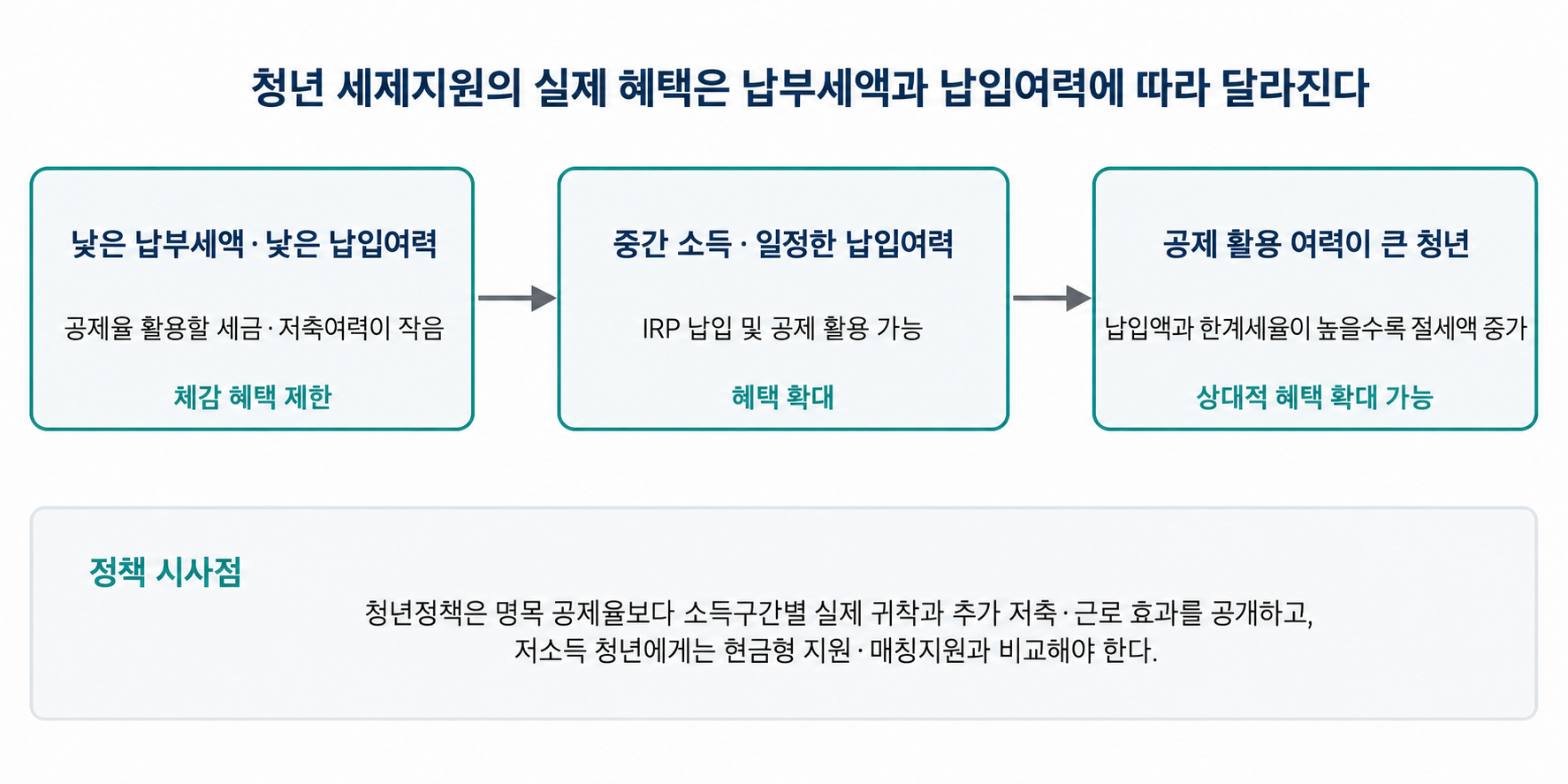
The government proposal raises the tax credit rate on IRP contributions for young people aged 15–34 to 15%. Under the current system, a 15% rate already applies to those with total salary income of 55 million won or less, so the additional benefit will mainly accrue to relatively higher-income young people who were previously subject to the 12% rate. Productive finance ISAs also allow a 10% income deduction on contributions, meaning that the tax-saving benefit may grow with both contribution capacity and taxable income (Ministry of Finance and Economy, 2026b).
Accordingly, youth support tax measures should first examine differences in actual ability to use them, rather than focusing only on nominal age eligibility. The government should disclose the share of young people unable to use the deductions and the reasons why, as well as the average tax savings by income bracket, so that one can determine whether the support reaches young people broadly or is concentrated on a particular group.
Figure 1. Incidence structure of youth tax support: differences in tax liability and saving capacity
Note: This is a conceptual transmission path; actual individual benefits vary depending on income, contribution amount, and deduction caps.
Source: Prepared based on Ministry of Finance and Economy (2026b) and the general operating structure of income deductions and tax credits.
◩ Youth policy should be evaluated by actual incidence across income brackets, not nominal credit rates
This is not an argument against youth support itself. It means that even within the same category of “young people,” those who pay little tax or lack the capacity to save may struggle to fully use deductions, whereas those with stable income and greater saving capacity can more easily use multiple benefits. The government should not present only the number of subscribers and total contributions; it should also disclose subscription rates by income bracket, average contribution amounts, actual tax savings, and the net additional amount of saving generated by the program.
◩ Asset formation is a broader question of economic opportunity than enrollment in a particular financial product
Young people’s asset formation is not determined by a single financial account. Stable jobs and wage growth, opportunities for entrepreneurship and investment, housing and mobility costs, and long-term access to asset markets all matter together. Expanding the monthly rent tax credit can help reduce current burdens, but in areas where supply is constrained, tax support alone cannot solve housing-cost problems (Ministry of Finance and Economy, 2026b).
A detailed evaluation of housing ownership and occupancy tax policy was addressed separately in Issue & Freedom No. 27. What matters in No. 28 is not to reanalyze real estate taxation, but to avoid viewing young people’s asset ladder too narrowly through tax support for financial products alone. If structural barriers to housing, labor mobility, and asset acquisition remain unchanged, simply increasing the benefits for specific savings products may reduce policy coherence (Center for Free Enterprise (CFE), 2026).
◩ Shift the goal of youth policy from subscription to tax-favored products to expanding available opportunities
For vulnerable groups, highly refundable support should come first. For young people more generally, lowering barriers to labor-market entry, startup regulation, and the cost of access to capital markets would provide broader long-term opportunities. Policy performance should be measured not by the number of IRP or ISA accounts, but by how much young people’s options to work, save, invest, and live independently have expanded.
3. SME Tax Policy: Support Growth, Not a Firm’s “Status”
◩ The tapered structure after SME graduation moves in the direction of easing the growth cliff
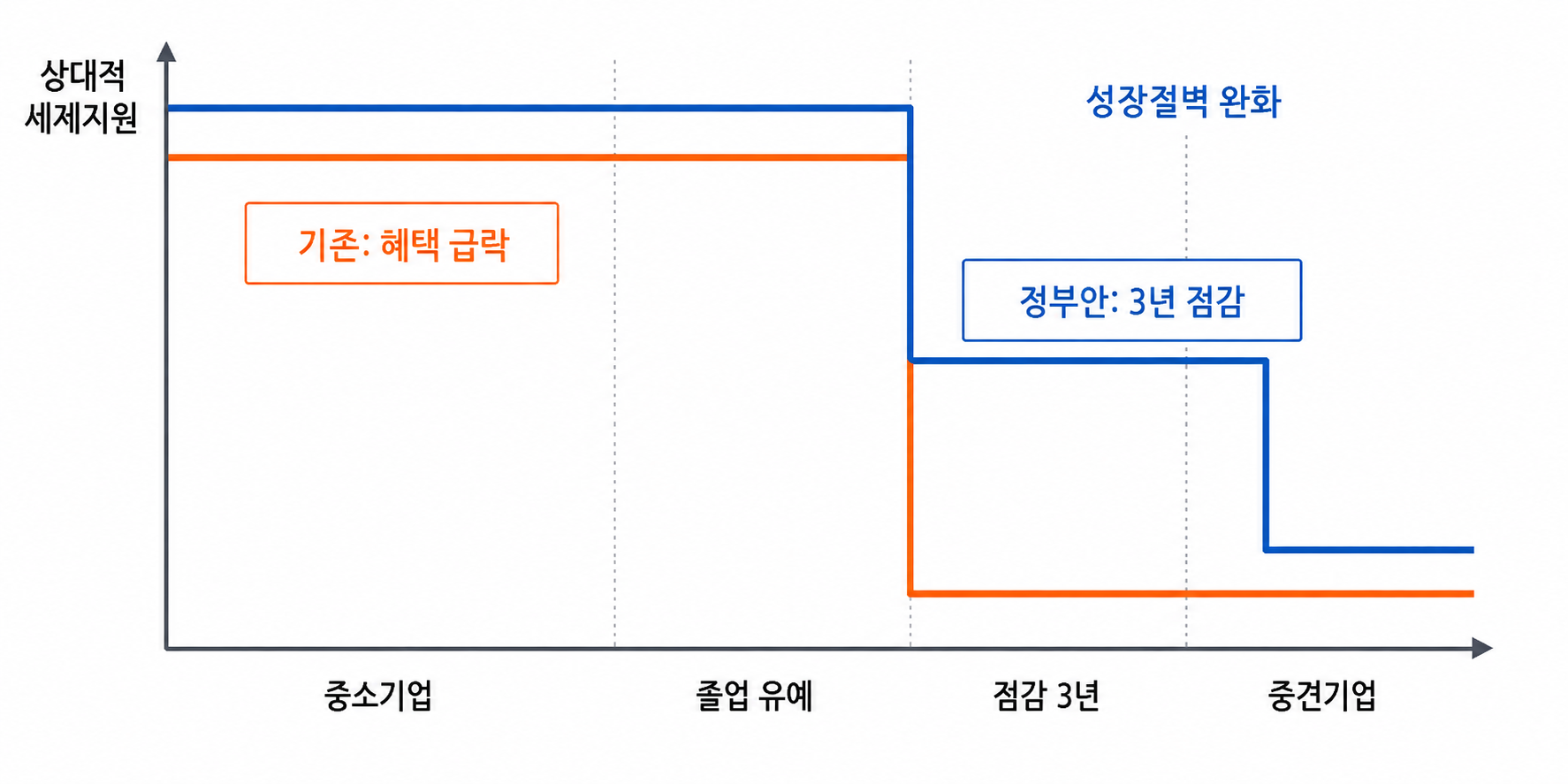
The government proposal changes the system under which firms eligible for the special SME tax reduction lost benefits immediately once the 5-year grace period (7 years for listed firms) ended after they exceeded SME thresholds. Under the new proposal, such firms would receive 50% of the mid-sized enterprise reduction rate for an additional 3 years. A tapered structure is also being introduced for tax credits on film and webtoon content production costs (Ministry of Finance and Economy, 2026b).
If multiple forms of support disappear at once the moment a firm grows, firms may be encouraged not to scale up or to split or adjust operations. The OECD has likewise noted that size-based tax support can help entry and growth but may also create incentives for firms to remain below the eligibility threshold (OECD, 2026b). In that respect, a tapered structure is preferable to simply expanding tax reductions because it lowers the implicit tax on growth.
◩ The next step is to support additional growth activity rather than SME status itself
A tapered structure mitigates the abrupt cliff, but the basic framework of support based on firm size remains intact. In the longer term, the focus should shift from benefits provided “because the firm is an SME” to additional productivity-enhancing activities such as new facilities, R&D, safety performance, workforce training, and entry into overseas markets. Firm size is not a policy objective; it is an outcome of growth.
◩ Accelerated depreciation for safety facilities is less distortionary than permanent tax reductions
The government proposal adds SME safety facilities to the scope of accelerated depreciation and allows the standard useful life to be adjusted within 50%. Compared with permanently exempting taxes, this measure is relatively temporary because it supports cash flow by recognizing costs earlier in the initial investment phase, and its application period is set to expire at the end of 2028. Even so, performance should be judged not by the amount spent on safety facilities but by how much investment actually increased because of the support and how much industrial accidents and fire risks declined (Ministry of Finance and Economy, 2026b).
◩ Venture support should reflect growth potential and market validation more than firm age
In venture investment tax support, easing the age requirement for eligible target firms from 7 years to 10 years may reflect the reality that scaling up technology firms takes longer. However, innovation and growth stage should not be judged by firm age alone. Criteria should also incorporate follow-on private investment, sales and employment growth, technological performance, and independent market validation (Ministry of Finance and Economy, 2026c).
Figure 2. The growth cliff in size-based tax support and the tapered structure
Note: This is a conceptual diagram illustrating the economic incentives created by the support structure, not actual tax rates or reduction amounts. Source: Prepared based on Ministry of Finance and Economy (2026b) and OECD (2026b).
◩ The tapered structure is a starting point for easing a system in which “not growing is advantageous”
Under the previous structure, support disappeared all at once when the grace period ended, potentially encouraging firms to remain below the threshold. The government proposal leaves part of the reduction in place for 3 years, providing an adjustment period. This approach can be applied to other size-based special provisions as well, but extending the tapering period alone cannot solve every problem.
◩ Overlapping firm-size provisions should be reduced and simplified around growth activities
When firm-size-based special provisions overlap across multiple taxes and support programs, lowering the cliff in one program may still leave new thresholds elsewhere in the overall support system. The government needs to disclose integrated data on effective tax rates and support amounts before and after SME graduation, and to simplify support by bundling together special provisions with the same objective and tapering them in a coordinated manner.
Ultimately, support should center on additional activities such as net investment, R&D, productivity, and safety performance rather than “status criteria” like sales, assets, or headcount. A system in which benefits shrink as firms grow is less growth-friendly than one in which benefits rise with the creation of new value and jobs.
◩ The success of reducing the growth cliff should also be verified through firm movement and productivity
After introducing the tapered structure, the government should regularly disclose the share of firms that exceed SME thresholds, changes in investment, employment, and productivity among graduating firms, and the distribution of sales and employment near the threshold. Policy success lies not in the number of firms receiving tax reductions, but in whether firms actually grow and move to the next stage.
4. Strategic Industry Tax Policy: Can the Government Choose the Winners of the Future?
◩ The domestic production tax credit has the advantage of linking support to actual production
The domestic production tax credit applies when qualified products that meet standards of importance, promise, and necessity are directly produced and sold domestically in six major fields: solar power, wind power, secondary batteries, semiconductors, critical materials, and AI robot components. The measure runs through the end of 2036, with the credit amount reduced gradually to 75%, 50%, and 25% over the final 3 years (Ministry of Finance and Economy, 2026b).
Compared with conventional profit-based tax reductions, the fact that benefits arise only when actual domestic production and sales occur, and that ceilings are tied to production cost and cumulative investment, is a mechanism intended to connect support with policy objectives. If there are clear social benefits not fully reflected in market prices—such as supply-chain stability or knowledge spillovers from advanced technologies—there is also a rationale for temporary support.
◩ But there are informational limits to the government’s long-term judgment of what is “promising”
The problem is who can determine, and how accurately, which technologies and products are strategically important and have future potential. The government proposal identifies six major fields in the law, but delegates substantial details—such as specific products, key processes, and standard credit amounts—to presidential decree. A product considered promising today may become a standard technology or be displaced by an alternative in a few years, while technologies currently outside the program may grow rapidly (Ministry of Finance and Economy, 2026b).
The OECD has pointed out that narrowly targeted investment tax incentives may reduce fiscal costs but can also increase administrative and compliance costs, distort markets, and create the risk of selecting particular technologies and firms as “winners.” Even where industrial support is needed, objective and technologically neutral criteria should be used as much as possible, and the validity of covered items should be regularly reassessed (OECD, 2026a).
◩ Productive finance, too, should not let taxes direct capital too narrowly
The productive finance ISA limits eligible investments to domestic listed stocks, domestic equity funds, the National Growth Fund, BDCs, and similar assets, combining tax exemption with income deductions for young people. The intent of supplying long-term capital to innovative domestic firms and capital markets is understandable. Yet once the tax code certifies particular products as “productive,” after-tax returns may exert more influence on asset allocation than risk and return themselves. Performance should be measured not by total inflows but by distinguishing funds shifted from other accounts from net new capital (Ministry of Finance and Economy, 2026b; 2026c).
Table 2. Questions needed to evaluate growth-support tax preferences
Criterion
Key question
Indicators to verify
Institutional mechanisms
Potential for growth
Would investment, production, and employment have occurred even without support?
Net additional investment, production, and employment relative to prior plans
Pre-established baseline · interim evaluation
Neutrality
Do the selection of specific products, firm sizes, or financial products distort competition?
Effective tax rates by industry and size, new entry
Minimized targeting · technological neutrality
Temporariness
Are the timing of termination and review clearly defined?
Annual costs and performance, residual effects after expiration
Sunset provisions · automatic termination
Transparency
Who receives how much, and what outcomes do they produce?
Distribution of benefits, reduction amounts, actual incidence
Non-identifiable disclosure of performance
Fiscal discipline
How is the revenue cost of a new special provision financed?
Amounts newly created, extended, or terminated; tax reduction ratio
Aggregate offsetting · PAYGO
Alternative means
Would regulatory reform or direct spending be more efficient?
Cost-effectiveness and administrative burden by instrument
Comparison with alternatives before adoption
Source: Prepared based on OECD (2026a) and National Assembly Budget Office (2026).
5. Tax Expenditures Are “Invisible Industrial Subsidies”
◩ National tax reductions of 80.5 trillion won: the cost of each special provision should be viewed like a budget item
Tax expenditures are fiscal instruments through which the government forgoes taxes it would otherwise collect for specific policy goals rather than making direct cash payments. According to the National Assembly Budget Office, national tax reductions are projected to rise from 39.7 trillion won in 2017 to 80.5 trillion won in 2026. Korea operates a national tax reduction ceiling and conducts preliminary feasibility reviews and in-depth evaluations of tax expenditures, but limitations have been identified in aggregate control and in linking evaluation results to program restructuring (National Assembly Budget Office, 2026).
As new special provisions for industry, youth, and finance continue to be added, the overall tax system becomes more complex even if each individual measure has a plausible rationale. Direct expenditures undergo annual budget review, but once tax preferences are embedded in the tax code, vested interests form and they become difficult to scale back. From the outset, new special provisions should disclose their revenue cost, distribution of benefits, alternative means, and termination conditions.
In particular, not all tax preferences should be evaluated the same way simply because they can all be described as “tax cuts.” A general rate reduction leaves the market to decide which industries and firms attract investment, whereas a special provision that favors only certain products, firm sizes, or financial products changes relative prices and effectively lets the government direct the allocation of resources. The more selective the provision, the greater the reason to scrutinize its costs and outcomes at the same level as a spending program.
◩ Performance should be measured not by total investment but by “investment increased because of the tax provision”
The core issue in investment tax policy is potential for growth. Even if a firm receiving a tax credit invests 100 billion won, if it would have invested 90 billion won without the support, then the investment newly created by the policy is closer to 10 billion won. The remaining 90 billion won is a benefit to the firm, but it cannot automatically be counted as a policy effect.
Figure 3. Evaluation structure for the growth potential of investment tax policy
Note: The figures shown are hypothetical and for conceptual illustration only. Source: Prepared based on OECD (2026a).
The OECD recommends that well-designed investment tax incentives should induce investment that would not have happened without support while minimizing subsidies to investments that were already profitable. Accordingly, the performance of the domestic production tax credit and venture or R&D tax preferences should be assessed not by total sales or total investment of recipient firms, but by net additional investment, production, employment, and reductions in supply-chain risk relative to pre-program plans (OECD, 2026a).
◩ A feedback system is needed: ex ante evaluation → interim review → automatic termination → external verification
The National Assembly Budget Office, in reviewing major-country practices such as the U.S. PAYGO rule, has noted the need to strengthen aggregate control over Korea’s tax expenditures and improve the feedback of evaluation results into policy adjustments. For new or expanded special provisions, the policy objective, baseline, required data, timing of interim evaluation, and termination conditions should all be set at the introduction stage (National Assembly Budget Office, 2026).
Even long-term special provisions such as the domestic production tax credit should not simply wait for their 2036 sunset. Qualified items and performance in terms of additional production and employment should be reassessed every 3 to 4 years, and if results are inadequate, the credit amount or eligible scope should be adjusted. Tax expenditures should be subject to the same level of accountability and external verification as budget programs.
6. Conclusion and Policy Recommendations: From Selective Support to a Stable and Predictable Tax System
The 2026 tax reform proposal contains changes worth preserving. Expanding the EITC makes meaningful refunds possible for low-income workers, while the tapered structure after graduation from SME status lowers the institutional cliff under which benefits suddenly disappear as firms grow. Measures like accelerated depreciation for safety facilities, which are tied to real investment and have a clear application deadline, are also more closely linked to policy goals than simple status-based tax reductions.
On the other hand, if tax benefits are finely differentiated according to young people’s asset formation, firm size, industry type, domestically produced products, and even financial products, the tax code can become an excessively detailed blueprint for industrial, youth, and financial policy. From the perspective of the Center for Free Enterprise (CFE), the necessary direction is not “abolishing support” but disciplining the means of support. Where there is clear market failure and verified potential for growth, temporary support may be used, but structural problems should be addressed through regulatory reform and improvements in the market environment.
◩ For low-income youth, prioritize refundability and effectiveness
For young people with little tax liability, compare whether the EITC, refundable tax credits, or matching support are more effective than income deductions. For youth IRPs and ISAs, average tax savings by income bracket and the additional saving effect should be disclosed.
◩ Support young people’s choices without making a particular financial product the “right answer”
Tax benefits should not make enrollment in a particular account a policy success in itself. Over the long term, youth policy should focus on expanding opportunities for labor income, entrepreneurship, and investment, and on lowering barriers to entering asset markets.
◩ Support growth and additional activity, not SME “status”
The tapered post-graduation structure should be extended to other size-based special provisions, while overlapping support is consolidated and the criteria for support are shifted toward additional activities such as new investment, R&D, safety performance, workforce training, and productivity gains.
◩ Limit strategic-industry tax preferences to clear market failures and objective criteria
Support should be concentrated where social benefits such as supply chains and knowledge spillovers are clear, and the criteria for selecting industries and products should be disclosed transparently. Technological neutrality and regular review procedures should be strengthened so that the entry of new technologies is not blocked.
◩ Apply the principles of growth potential, sunset, and automatic termination to all new tax expenditures
A baseline should be established before introduction, and net additional investment, employment, and production should be set as performance indicators. If results are not confirmed through interim evaluation and independent external verification, the measure should terminate automatically, and any extension should be reviewed as rigorously as a new program.
◩ Discipline the aggregate size of tax expenditures and prioritize structural reform
New special provisions should be linked either to the termination or reduction of underperforming provisions or to clear revenue-offset measures, while the structural problems facing youth and firms should be addressed through labor and capital markets, startup and business restructuring, and regulatory and competition policy. The tax system should maintain broad bases, low and simple rates, neutrality, and predictability as its basic principles.
Ultimately, the growth of young people and firms does not come from the number of special provisions. The government’s role is not to make a particular account, firm size, or industry the right answer, but to create conditions in which economic actors can freely work, invest, start businesses, and grow. Rather than designing those choices on their behalf, the tax system should provide a stable and predictable foundation.
◩ References
National Assembly Budget Office. 2026. “Current Status and Implications of Tax Expenditure Management Systems in Major Countries,” NABO Focus No. 159, May 21, 2026.
Ministry of Finance and Economy. 2026a. “2026 Tax Reform Proposal: Bullet-Point Version.” August 3, 2026.
Ministry of Finance and Economy. 2026b. “2026 Tax Reform Proposal: Detailed Version.” August 3, 2026.
Ministry of Finance and Economy. 2026c. “2026 Tax Reform Proposal: Q&A Materials.” August 3, 2026.
Center for Free Enterprise (CFE). 2026. “A Shift in Housing Tax Policy Toward Occupancy Could Make the Market More Rigid,” Issue & Freedom No. 27, August 5, 2026.
OECD. 2018. OECD Economic Surveys: Korea 2018. OECD Publishing, Paris.
OECD. 2026a. A Practical Guide to Investment Tax Incentives. OECD Publishing, Paris. DOI: 10.1787/427c66a9-en.
OECD. 2026b. “Corporate Income Taxation and Business Dynamism,” OECD Tax Policy Briefs, No. 2026/01. OECD Publishing, Paris. DOI: 10.1787/59a40a50-en.
Original title: 세금으로 청년과 기업의 성장을 설계할 수 없다.
Author: Center for Free Enterprise (CFE)
Date: 2026-08-12
Source: https://www.cfe.org/bbs/bbsDetail.php?cid=issue&pn=1&idx=29372