
Shifting Housing Taxes Toward Residence Could Further Stiffen the Market
-
Writer
CFE
-
◩ Key Summary
◆
It is reasonable to unify the standard from the number of homes owned to the value of homes, but if tax rates and the tax base are raised at the same time, the effect of simplification may be offset.
◆
If the long-term holding deduction is fully converted into a residency deduction, it may fail to adequately reflect diverse housing realities such as job relocation, caregiving, education, and rental arrangements, and may reduce residential mobility.
◆
If the reduction in the basic comprehensive real estate holding tax deduction, the increase in the fair market value ratio, and the adjustment of the tax credit cap and tax burden ceiling are layered together, the burden on some non-resident single-home owners could rise sharply.
◆ While it is reasonable to unify the standard from the number of homes owned to the value of homes, if tax rates and the fair market value ratio are also raised at the same time, the effect of simplifying the tax standard may be overshadowed by what is effectively a tax increase.
◆ If the long-term holding deduction is fully converted into a residency deduction, it may fail to fully reflect unavoidable non-residency circumstances such as job relocation, family care, education, and rental arrangements, and may reduce both housing and labor mobility.
◆ As the reduction in the basic comprehensive real estate holding tax deduction, expansion of the tax base, and increases in the tax credit cap and tax burden ceiling are layered together, the issue should be assessed not as isolated measures but in terms of their combined effect on the overall tax burden.
◆ Major foreign countries favor owner-occupied homes but also combine monetary caps, time-proportional deductions, recognition of long-term holding, and deferral of disposal. Korea likewise needs deductions that reflect both holding and residency, along with sufficient transitional measures.
1. Nature of the Reform Plan: Combining Rationalization Based on Property Value with a Stronger Residency Focus
In the 2026 tax reform proposal, the government presented the direction of real estate taxation as the “normalization of the tax burden on non-owner-occupied homes and homes above a certain value” and the “protection of owner-occupied single-home households.” It would shift the comprehensive real estate holding tax rate structure from one based on the number of homes to one based on home value, while redesigning the long-term deductions in capital gains tax and comprehensive real estate holding tax to focus more on the period of residence than the period of ownership. Because it also simultaneously revises special treatment for rental housing, temporary two-home ownership, and heavier capital gains taxation on multiple-home owners, this reform is closer to a package reform affecting choices regarding ownership, occupancy, rental, and sale of housing than to mere adjustments of individual taxes (Ministry of Finance and Economy, 2026a; 2026b).
The goal of protecting owner-occupied single-home households is itself understandable. It does not mean that homes used as actual living spaces should be treated in exactly the same way as homes held for investment or rental purposes. However, whether one resides in a home is not a complete criterion for showing a taxpayer’s income, tax-paying capacity, or the speculative nature of homeownership. Even among single-home owners with the same asset value and income, the level of deductions can vary greatly if one cannot directly reside in the home because of work, family caregiving, education, or business reasons.
Eliminating the criterion based on the number of homes is a positive step in that it alleviates the problem of applying a higher tax rate to several low-priced homes than to one high-priced home simply because more units are owned. However, the reform also pushes simultaneously for a reduction in the basic deduction, an increase in the fair market value ratio, some tax rate hikes, and an expansion of the tax burden ceiling. This reform should therefore be evaluated as a policy-inducing tax system combining the “rationalization of the number-of-homes criterion,” “greater burdens on non-resident and high-value homes,” and “inducement of owner occupancy.” What matters is not the rationale of each individual system but the combined effect on taxpayers and the housing market when multiple changes are applied at once (Ministry of Finance and Economy, 2026a).
2. Main Reform Measures and Issues
Main Elements of the 2026 Real Estate Tax Reform Proposal
Category
Current
Government Proposal
Key Issue
Long-term deduction for single-home owners
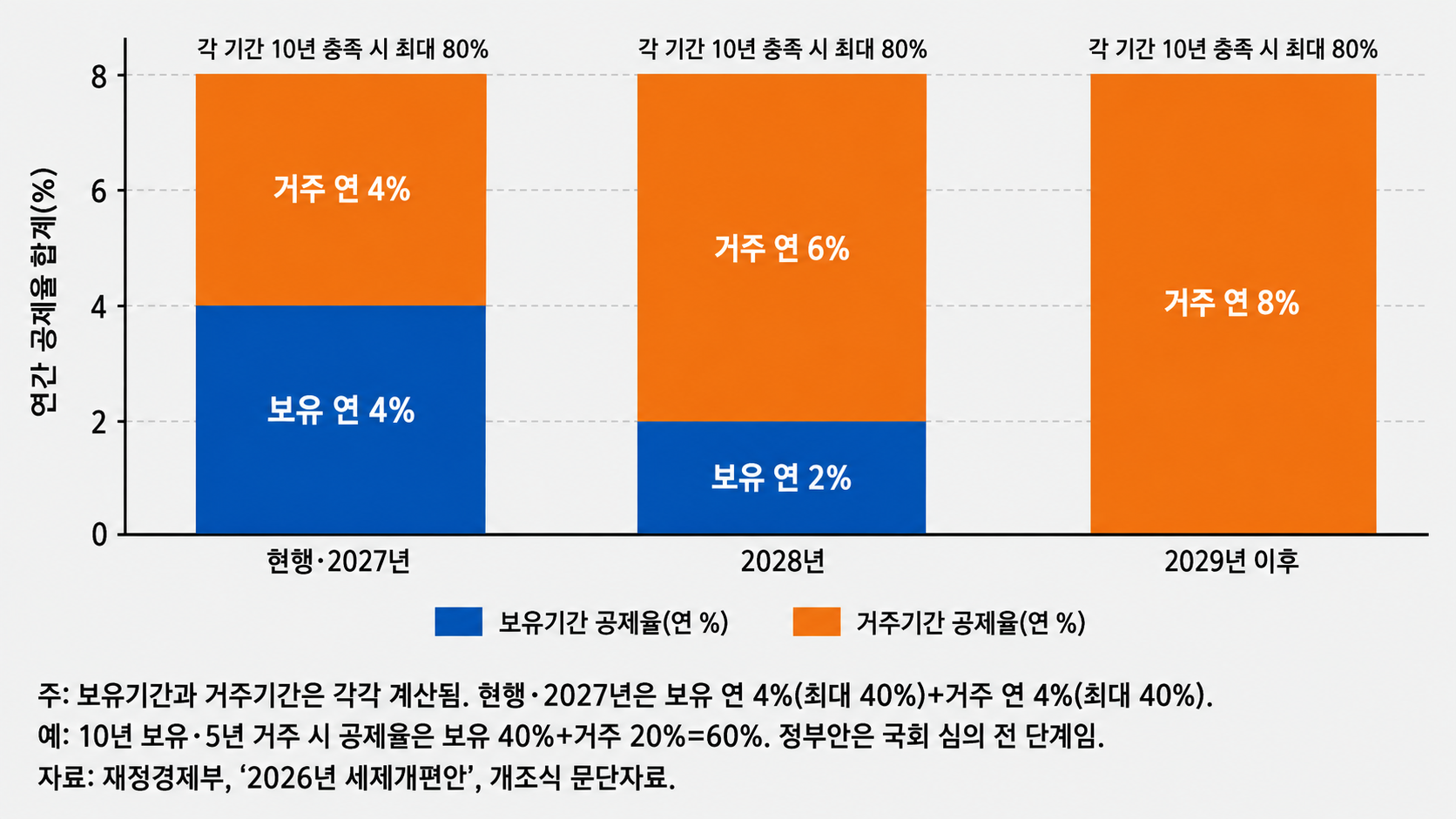
4% per year for holding + 4% per year for residence (up to 80%)
2028: 2% per year for holding + 6% per year for residence
2029 onward: 8% per year for residence
Reduced economic significance of the holding period
Cap on long-term deduction
No separate monetary cap
KRW 2 billion in 2028
KRW 1 billion from 2029 onward
Higher tax burden for high-value and long-term holders
Basic comprehensive real estate holding tax deduction
KRW 1.2 billion for one home per household
KRW 1.4 billion for resident owners
KRW 900 million for non-resident owners
Different treatment of homes of the same value based on residency status
Fair market value ratio
60% for housing
70% in 2027
80% from 2028 for owners of three or more homes, etc.
Gradual expansion of the tax base
Comprehensive real estate holding tax rate
Differentiated by number of homes
Unified by value from 2028
1.0% → 1.3% for the KRW 600 million–1.2 billion bracket
Elimination of the number-of-homes criterion is positive, but accompanied by a tax rate increase
Tax credit
·
Ceiling
Holding deduction, no monetary cap
Tax burden ceiling of 150%
Converted to residency deduction
KRW 8 million →
ceiling of KRW 6 million
Tax burden ceiling of 200%
Faster rise in tax burden
Temporary
2
homes
3 years in regulated areas
2 years
Constraints on normal home replacement
Apartment rental housing purchased for leasing
Exempt from heavier taxation
·
Preferential long-term deduction
Reduced in 2028, abolished from 2029 onward
Policy credibility and rental supply concerns
Source: Prepared based on Ministry of Finance and Economy (2026a; 2026b; 2026c). The government proposal is at the stage before National Assembly deliberation.
◩ The shift from the number of homes to a value-based standard is appropriate
Unifying comprehensive real estate holding tax rates based on total home value can alleviate the problem of punitive taxation simply because someone owns several low-priced homes in provincial areas or small rental units. The price of a single home varies greatly by region and location, so judging tax-paying capacity solely by the number of homes does not align with horizontal tax equity. Linking the tax standard not to the number of homes but to total asset value and ability to pay is also more consistent with tax neutrality.
A value-based standard also helps reduce distortions surrounding provincial homes and second homes. If heavier taxation on multiple homeowners is imposed simply because someone acquires one additional low-priced home in a provincial area, that may strengthen the preference for one expensive home in the Seoul metropolitan area and weaken demand for homes in local regions. The government’s move to expand special treatment for local second homes can also be seen as recognition of this issue. However, rather than adding exceptions only for certain regions or certain homes, it would improve consistency and predictability to simplify the multiple-home surtax itself based on property value (Ministry of Finance and Economy, 2026a; 2026b).
◩ However, the shift to a value-based standard should not become a channel for raising the tax burden
While shifting the tax standard toward property value, the government proposal also raises the tax rate for the KRW 600 million–1.2 billion tax base bracket from 1.0% to 1.3%, and increases the fair market value ratio from 60% to 70% for ordinary single-home owners and others, and to 80% from 2028 for owners of three or more homes and others. The tax burden ceiling is also adjusted from 150% of the previous year’s property tax burden to 200%. Rationalizing the standard and increasing the real tax burden are separate issues, so it is necessary to assess separately whether the positive effects of eliminating the number-of-homes criterion are being offset by increases in the tax base and tax rates (Ministry of Finance and Economy, 2026a; 2026b).
◩ The combined effect of the package matters more than individual measures
The basic comprehensive real estate holding tax deduction, fair market value ratio, tax rates, tax credits, and tax burden ceiling are all interconnected factors that determine the final tax amount. Even if a change in one factor appears small, when multiple measures overlap the tax burden can rise nonlinearly. In particular, non-resident single-home owners face a reduced basic deduction, a higher ratio reflecting the tax base, and at the same time a reduced deduction for the holding period. The government and the National Assembly should disclose not only the revenue effects of each measure but also changes in effective tax rates by home price, length of residence, and income group, along with case examples by taxpayer type (Ministry of Finance and Economy, 2026b; 2026c).
3. Problems Caused by Converting the Holding Deduction into a Residency Deduction
Note: The 4% and 4% in the graph are the current and 2027 annual deduction rates. The holding period and the residence period are calculated separately, and each must reach 10 years for the maximum 80% deduction, combining 40% for holding and 40% for residence. For example, if one held a home for 10 years and lived in it for 5 years, the deduction rate would be 60%, consisting of 40% for holding and 20% for residence. In 2028, this changes to 2% per year for holding and 6% per year for residence, and from 2029 onward it becomes 8% per year for residence. Source: Prepared based on Ministry of Finance and Economy (2026a; 2026c).
◩ Residency status is not a complete proxy for speculation or tax-paying capacity
There are cases in which people rent out their own home and live on a jeonse lease near their workplace, or cannot directly live in the home because of caring for parents, children’s education, overseas or regional assignments, reconstruction, or lease contracts. In such cases, non-residency may be not an investment choice but the result of labor, family, or housing circumstances. A non-owner-occupied home, if rented to another household, is also an asset providing housing services. If non-residency is immediately treated as speculative ownership and both the basic deduction and the long-term deduction are reduced, then normal life mobility and rental supply may also be disadvantaged.
◩ Expanding residency determinations also increases tax complexity and proof costs
The government proposal creates exceptions under which certain periods of non-residency—such as for schooling, work circumstances, registered rental housing, and redevelopment or reconstruction periods—are recognized as periods of residence. While these are devices intended to protect unavoidable circumstances, the more exceptions there are, the more taxpayers must prove with documents that their life circumstances meet legal requirements. Tax authorities must also distinguish actual residence from formal address changes, raising administrative costs and the possibility of disputes. If the aim is a simple tax system, then rather than greatly widening the gap based on residency status and then adding complex exceptions, a general rule that reflects both ownership and residency would be more appropriate (Ministry of Finance and Economy, 2026b).
◩ A legal tension arises between the purpose of a holding tax and residency-inducing taxation
Article 1 of the Comprehensive Real Estate Holding Tax Act states that the purpose of the tax is to improve the equity of the tax burden on real estate holding by imposing taxes on owners of high-value real estate, and to contribute to price stability and balanced development of local public finance. In principle, the tax base is also based on the total officially assessed value of the homes owned by the taxpayer. The basic nature of the comprehensive real estate holding tax is thus a holding tax targeting the value of property owned and the taxpayer’s ability to pay arising from that ownership, not the manner in which the home is used (Comprehensive Real Estate Holding Tax Act, Articles 1 and 8).
However, under the government proposal, even for a single home of the same value, a taxpayer who directly resides in it would receive a basic deduction of KRW 1.4 billion, while one who does not reside in it would receive KRW 900 million, and the long-term holding tax credit would also be converted into a credit based on the period of residence. It does not formally declare residency as a legal obligation, but it strongly induces owners in practice to move into their own homes through a large gap in tax burden. In this case, the comprehensive real estate holding tax shifts in character from a tax that adjusts equity in holding high-value real estate to a behavior-correcting tax that regulates the taxpayer’s form of residence. A conflict also arises between horizontal equity and tax neutrality because taxpayers with homes of the same value and the same tax-paying capacity are treated differently solely based on whether they reside there (Ministry of Finance and Economy, 2026a; 2026c).
Because the government proposal presupposes amendment of the Comprehensive Real Estate Holding Tax Act itself, it is difficult at this stage to immediately conclude that subordinate regulations would violate superior law. However, if the current purpose clause is left unchanged while non-residency is expanded into a core burden criterion, an issue of internal consistency arises between the purpose of the law and the actual function of taxation. Moreover, if essential requirements affecting tax burden—such as standards for determining actual residence, temporary non-residency, and exception periods—are broadly delegated to Presidential Decree, tension may also increase with the constitutional principle of no taxation without law, which requires tax elements to be clearly prescribed by statute so as to guarantee taxpayer predictability. In National Assembly deliberations, the core requirements and exceptions for owner-occupied housing should be specifically prescribed in the statute itself, with only technical details delegated to the Enforcement Decree (Constitution of the Republic of Korea, Articles 38 and 59; Constitutional Court, 1992).
◩ The long-term holding deduction also serves to adjust taxation of nominal gains
Price increases in housing accumulated over a long period include nominal gains resulting from inflation and changes in the value of money. In a structure where years of accumulated gains are taxed all at once upon transfer, the long-term holding deduction partly functions to mitigate taxation of nominal gains and the concentration effect of progressive tax rates. If only the residence period is recognized and the holding period is effectively excluded, the economic significance of long-term ownership is not adequately reflected (OECD, 2025).
The long-term holding deduction may have the effect of encouraging people to delay selling until a certain time. However, eliminating the deduction or replacing it with a residency requirement does not automatically increase transactions. If owners expect a larger tax burden when selling, they may instead delay disposal even further. To reduce the lock-in of listings, it is preferable not to exclude the holding-period deduction entirely but to simplify capital gains tax rates and deduction structures while reasonably adjusting nominal gains accumulated over a long period (OECD, 2025).
◩ Multiple burden-increasing measures are overlapping
For non-resident single-home owners, the basic deduction is reduced from KRW 1.2 billion to KRW 900 million, and the fair market value ratio rises from 60% to 70%. The long-term holding tax credit under the comprehensive real estate holding tax is converted into a residency credit and becomes subject to a monetary cap of KRW 8 million in 2027 and KRW 6 million from 2028 onward. If the tax burden ceiling rises from 150% to 200%, the speed at which these changes are reflected in actual tax amounts also increases. Looking at only one system at a time may make this seem like a gradual adjustment, but the key point is that multiple burden-enhancing measures may operate simultaneously on the same taxpayer (Ministry of Finance and Economy, 2026a; 2026b).
Housing is an illiquid asset, making it difficult to sell only part of it in order to pay taxes. Elderly or retired people with low income may have high asset values but insufficient cash flow to pay taxes. The government’s easing of the requirements for payment deferral is a necessary supplement, but deferral does not eliminate the tax burden; it merely postpones it until disposal or inheritance. Even where stronger property taxation is needed, consideration must also be given to the tax burden relative to income, installment payment and deferral, and the cash flow of long-term residents (Ministry of Finance and Economy, 2026a; 2026b; 2026c).
4. Expected Channels of Market Impact
◩ It is possible to see both increased transactions and reduced rental supply
If the tax burden on non-owner-occupied homes rises, some owners may choose to sell, and listings may increase in the short term. However, stronger holding taxes do not automatically guarantee more transactions. If the burden at the time of transfer is high or taxpayers expect the tax system to change again in the future, they may choose to continue holding rather than sell. Since housing prices, interest rates, transaction volumes, and capital gains tax burdens all operate simultaneously, it is difficult to engineer the volume of listings in the market through holding taxes alone (OECD, 2022; OECD, 2025).
◩ The cost of rental housing may not remain only with landlords
A substantial share of non-owner-occupied homes is supplied to the rental market. If the burden of comprehensive real estate holding tax and capital gains tax rises, the expected returns from rental business may decline, reducing new supply, or the tax burden may be reflected within possible limits in rents and security deposits. Conversely, if some rental homes enter the sales market, that could expand supply for owner-occupiers. Which effect is greater depends on rental demand and supply elasticity by region, so an approach that raises only the landlord’s tax burden in the name of protecting tenants should examine the actual incidence of the burden (OECD, 2022; OECD, 2025).
Note: The market impact is an analytical diagram organizing possible channels. In particular, in core areas such as Gangnam, actual move-in to one’s own home may simultaneously cause rental listings to be withdrawn and owner-occupancy demand to concentrate, and the size and direction of the effects may vary depending on local demand and supply conditions. Source: Prepared based on Ministry of Finance and Economy (2026a), OECD (2022; 2025).
◩ In core areas such as Gangnam, there is a paradoxical possibility of tighter rental supply and rising prices
The differentiation in the residency deduction and the basic comprehensive real estate holding tax deduction may produce results opposite to those intended in high-priced core areas such as Gangnam. If an owner who had rented out a home in Gangnam and lived on jeonse or monthly rent in another area moves into the home to reduce the tax burden, one Gangnam rental unit is withdrawn from the market. The rental unit the owner had previously occupied may re-enter the market, but because the region, school district, and housing quality differ, it cannot perfectly substitute for the Gangnam rental home. Where substitution between areas is limited, pressure from reduced Gangnam jeonse and monthly rental listings and rising rents may actually intensify (Ministry of Finance and Economy, 2026a; OECD, 2022).
If the residence period becomes the key criterion for comprehensive real estate holding tax and capital gains tax benefits, owners will also have an incentive to move into homes in core areas for a long time and delay selling. If owner-occupancy demand concentrates in Gangnam housing while both rental listings and homes for sale decline, the tax-system residency premium may be capitalized into housing prices, paradoxically pushing Gangnam home prices even higher. This shows that the simplistic assumption that increasing the burden on non-owner-occupied homes will immediately increase listings and stabilize prices does not sufficiently account for regional market structure. Because the magnitude of the effect may vary depending on market conditions, a regional impact assessment on rental supply and prices is needed before implementation (OECD, 2022; OECD, 2025).
◩ Temporary easing of capital gains tax distorts transaction timing
If the heavier capital gains tax rates on multiple-home owners are eased only in 2027 and 2028, taxpayers will determine their timing of sale according to the tax schedule rather than market conditions. Under the government proposal, in 2027 the surtax for owners of two homes is reduced to +5%p and for owners of three or more homes to +10%p; in 2028, +10%p and +15%p apply respectively; and in 2029 these revert to +20%p and +30%. To avoid a concentration of listings during a specific period and renewed lock-in after the program ends, the heavier taxation system itself should be reformed to a level that can be maintained over the long term (Ministry of Finance and Economy, 2026a; 2026b).
◩ Shortening the temporary two-home period also constrains normal moving
The disposal of an existing home is affected by factors beyond the taxpayer’s control, such as tenant contract periods, closing and move-in schedules, sluggish transactions, and delays in the completion of new homes. If the special period for temporary two-home ownership in regulated areas is shortened from 3 years to 2 years, the effect may be more to constrain normal home replacement and labor mobility than to suppress speculation. Especially in periods of low transaction volume, taxpayers may be unable to dispose of their previous home at a reasonable price within 2 years and thus suffer tax disadvantages (Ministry of Finance and Economy, 2026a; 2026b; 2026c).
◩ The reduction of special treatment for rental housing should be evaluated in terms of both policy credibility and supply effects
The phased abolition of the exemption from heavier capital gains taxation and preferential long-term deductions for apartment rental housing purchased in regulated areas is based on the logic of curbing excessive special treatment for rental housing. However, if the government retroactively changes the conditions for landlords who registered under earlier policy incentives and took on long-term rental obligations and rent regulations, policy credibility may be undermined. Even if benefits for newly registered properties are adjusted, sufficient transitional measures should be provided for existing contracts and fulfilled obligations, and evaluation should cover not only the fiscal cost of tax benefits but also actual rental duration, supply volume, and rent-stabilization effects (Ministry of Finance and Economy, 2026a; 2026b; 2026c).
5. Overseas Cases: Combining Residency Preference with Buffering Measures
The OECD explains that many member countries provide full or conditional exemptions for capital gains on principal residences. This is because owner-occupied housing has the characteristics of both a consumption good and an asset, and fully taxing gains arising in the course of moving can dampen residential mobility. Preferential treatment for owner-occupied housing is therefore not internationally unusual. However, major countries generally do not bifurcate taxation solely based on residency status; rather, they combine monetary caps, deductions proportional to the actual period of residence, recognition of long-term holding periods, and deferral of disposal after moving (OECD, 2022; OECD, 2025).
Comparison of Capital Gains Taxation on Principal Residences in Major Countries
Country
Main System
Standard
Implication
United States
Exclusion of capital gains on a principal residence
up to $250,000 for individuals and
$500,000 for married couples filing jointly
Owned and used for at least 2 years
out of the 5 years before sale
Combines a residency requirement with a clear monetary cap
United Kingdom
Private Residence Relief applied
in proportion to the actual period of main residence
The final 9 months are
treated as a period of residence
Handles residency and non-residency
proportionally rather than dichotomously
Germany
As a rule, gains from sale of real estate
within 10 years of acquisition are taxable
Exception if owner-occupied or occupied in the year of sale
and the two preceding years;
property held for over 10 years is also excluded from taxation
Recognizes both residency requirements
and long-term holding periods
Japan
Special deduction of up to JPY 30 million
for capital gains on a principal residence
Former residence remains eligible if disposed of
by the end of the year falling 3 years after moving out
Provides a sufficient grace period for sale after moving
Source: Prepared based on IRS (2025·2026), HMRC (2026), German Income Tax Act (EStG) §23, Japan National Tax Agency (NTA, 2025), OECD (2022; 2025).
Foreign cases cannot be applied to Korea exactly as they are, because levels of holding taxes, transaction taxes, and rental market structures differ by country. Even so, the common implication is clear. Even when owner-occupied homes are favored, taxpayers are not forced to dispose of their homes immediately when relocating for work or moving, and rigidity is reduced through recognition of long-term holding and proportional deductions. Korea’s reform plan should likewise be assessed less by the strengthening of the residency deduction itself than by whether stronger burdens and buffering measures are balanced against one another (OECD, 2022; OECD, 2025).
◩ Meaning of overseas cases
· Preferential treatment for owner-occupied homes is itself common internationally, but countries ensure taxpayer predictability by making monetary and time-based criteria clear.
· The United Kingdom grants relief in proportion to the actual period of residence and automatically recognizes the final 9 months, thereby protecting the time gap between moving and disposal.
· Germany, apart from the owner-occupancy exception, also recognizes a 10-year holding period, reflecting the view that homes held long term are less speculative.
· Japan allows former principal residences to qualify if disposed of within a certain period after moving out. Korea should likewise design recognition of the holding period together with the temporary two-home period and transitional measures for existing rental housing.
6. Conclusion and Policy Recommendations
The 2026 real estate tax reform proposal includes an advanced element in that it shifts the standard from the number of homes owned to the value of homes. Evaluating tax-paying capacity based on aggregate value rather than the number of homes can alleviate the previous punitive structure that was unfavorable to low-priced provincial homes and small rental units. The expansion of the basic deduction for owner-occupied single-home households and the supplementary easing of payment deferral for older taxpayers also reflect consideration of end-user burdens (Ministry of Finance and Economy, 2026a). However, if the long-term holding deduction is converted into a residency deduction, the basic deduction for non-resident single-home owners is reduced, and the fair market value ratio, tax rates, and tax burden ceiling are all raised at the same time, taxpayers may feel the strengthening of the burden more strongly than the rationalization of the tax standard. In core areas such as Gangnam, there is also the possibility that owners moving into their own homes will withdraw jeonse and monthly rental listings and concentrate owner-occupancy demand, thereby actually pushing up rents and home prices. If shortening the temporary two-home period, reducing special treatment for rental housing, and temporary easing of capital gains tax are combined, the normal replacement of homes, rental supply, and timing of sale may all become dependent on the tax schedule (Ministry of Finance and Economy, 2026a; 2026b; OECD, 2022).
Taxes should not become a means of telling citizens how long they must live in one home. In particular, if the comprehensive real estate holding tax—which is meant to adjust fairness in the holding of high-value real estate—is transformed into a tool that effectively mandates residency status, a conflict arises between the purpose of a holding tax and tax neutrality. The goal of housing taxation should not be to encourage a particular form of residence, but to create a simple and stable tax system proportionate to ability to pay. Through simplification based on home value, deductions reflecting both holding and residency, clear statutory requirements, and sufficient transitional measures, decisions on housing ownership, rental, sale, and residence should be made according to household needs and market price signals rather than tax benefits. The following are seven policy recommendations.
◩ Maintain unification based on value, but clarify the principles of a holding tax
Aggregate home value, rather than the number of homes, should be firmly established as the tax standard, and the medium- to long-term path of the fair market value ratio and tax rates should be clearly prescribed in law so that they are not altered from year to year for policy purposes. Consistent with the purpose clause and nature of the comprehensive real estate holding tax as a holding tax, residency status should be reflected only as a limited preferential factor, and rather than pushing through both the value-based shift and tax rate increases at once, the effect of simplifying the tax standard should first be evaluated.
◩ Apply both a holding deduction and a residency deduction
A longer actual residence period may be given greater preference, but a long holding period should also be recognized to some extent. Even if the current ratio of 4% for holding and 4% for residence is adjusted, the holding deduction should not be abolished entirely, and its function of adjusting nominal gains accumulated over a long period should be maintained.
◩ Reconsider the reduction in the basic deduction for non-resident single-home owners and clarify tax elements in statute
The gap between KRW 1.4 billion for resident owners and KRW 900 million for non-resident owners should be eased, and rather than forcing taxpayers to prove unavoidable non-residency through complex exceptions, it would be more appropriate to adjust the basic deduction gradually. The definition of owner-occupied housing, standards for actual residence, recognized periods, and core exceptions should be clearly prescribed in the Comprehensive Real Estate Holding Tax Act itself, while only technical details should be delegated to Presidential Decree, thereby ensuring the constitutional principle of no taxation without law and taxpayer predictability.
◩ Maintain the 3-year special period for temporary two-home ownership
Taking account of realities such as tenant contracts, sluggish transactions, and construction and move-in schedules, the current 3-year period should be maintained. In areas where transactions have sharply contracted or where unavoidable reasons are recognized, additional extensions should be allowed so that normal moving and housing replacement are not constrained by taxes.
◩ Turn the easing of heavier capital gains taxation into structural reform
Rather than temporary easing in 2027–2028, the heavier taxation based on the number of homes should be abolished or long-held homes should be excluded from the surtax, in order to reduce distortions in the timing of sales. Short-term speculative transactions may be taxed according to the holding period, but the method of imposing heavier taxation on even long-held homes solely based on the number of homes needs reconsideration.
◩ Protect policy credibility for existing rental housing
Benefits may be adjusted starting with newly registered properties, but for landlords who assumed long-term rental obligations under earlier policies, the originally promised tax conditions should in principle be honored. The performance of special treatment for rental housing should be evaluated not only by the amount of tax expenditure but also by supply duration, rent levels, and effects on tenants’ housing stability.
◩ Conduct ex post evaluations of the distribution of tax burdens and regional market effects
After the law takes effect, the government should regularly disclose not only effective comprehensive real estate holding tax rates by housing price bracket, age, income, and residency status, but also changes in jeonse and monthly rental listings, rents, actual move-ins, and sale prices in core areas such as Gangnam. If, contrary to expectations, tighter rental supply, concentration of demand in core areas, or a decline in rental supply emerges, an automatic mechanism should be prepared to review deductions, tax rates, and transitional measures.
◩ References
· Republic of Korea. Constitution of the Republic of Korea, Articles 38 and 59.
· Republic of Korea. Comprehensive Real Estate Holding Tax Act, Articles 1 and 8. [Effective Jan. 1, 2026.]
· Constitutional Court. Dec. 24, 1992. Decision 90Heon-Ba21 (principle of statutory taxation elements and clarity of taxation elements).
· Constitutional Court. May 30, 2024. Decision 2022Heon-Ba189 et al. (case concerning comprehensive real estate holding tax for tax year 2020).
· Ministry of Finance and Economy. 2026a. “2026 Tax Reform Proposal: Outline.” Aug. 3, 2026.
· Ministry of Finance and Economy. 2026b. “2026 Tax Reform Proposal: Detailed Version.” Aug. 3, 2026.
· Ministry of Finance and Economy. 2026c. “2026 Tax Reform Proposal: Q&A Materials.” Aug. 3, 2026.
· OECD. 2022. Housing Taxation in OECD Countries. OECD Tax Policy Studies, No. 29.
· OECD. 2025. Taxing Capital Gains: Country Experiences and Challenges. OECD Taxation Working Papers, No. 72.
· Internal Revenue Service. 2026. Publication 523: Selling Your Home; Topic No. 701, Sale of Your Home.
· HM Revenue & Customs. 2026. Private Residence Relief (HS283); Tax When You Sell Your Home.
· Bundesministerium der Justiz. Einkommensteuergesetz (EStG), §23 Private Veräußerungsgeschäfte.
· Japan National Tax Agency. 2025. No.3302 Special Case When You Sell Your Home; No.3314 When You Sell a Former Home You Previously Lived In.
Original title: 주택세제의 거주 중심 전환, 시장을 더 경직시킬 수 있다
Author: Center for Free Enterprise (CFE)
Date: 2026-08-04
Source: https://www.cfe.org/bbs/bbsDetail.php?cid=issue&pn=1&idx=29347