
Worsening Economy... Will the Government Jail Businesspeople?
-
Writer
Jong-un Park
-
 Regulations such as the enforcement decree of the Aggravated Punishment Act for Specific Economic Crimes, the forced wage hikes, and the forced cap on working hours must be abolished
A new chapter is opening in the IT era ... “If the old era wins in this clash of eras, the new era cannot bloom”
Indicators showing that the economic situation has been steadily worsening in recent times continue to emerge. Sales in the vast market where we export our products and services to 7 billion global citizens are clearly showing a continuing downward trend.
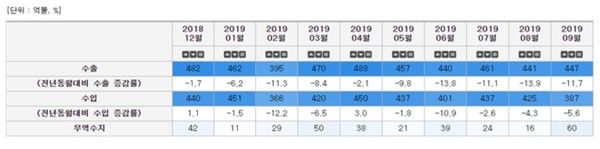
According to the Korea International Trade Association’s trade statistics system, exports deteriorated continuously from 15.8% ($573.7 billion) in 2017 to 5.4% ($604.9 billion) in 2018, and to -9.8% in 2019 (through September). The monthly trend in 2019 is even more serious. Export performance has continued on a downhill path compared with the previous year.
Source: Ministry of Trade, Industry and Energy
A closer look at the sectors that declined in 2019 shows especially notable drops in semiconductors at -25.3%, flat panel displays and sensors at -15.5%, petroleum products at -11.0%, and synthetic resins at -12.5%.
By country, China stands out with a decline of -18.1%. This is mainly due to difficult international economic conditions such as the U.S.-China tariff war and semiconductor oversupply. Nevertheless, because Korea’s advanced manufacturing and capital-intensive industries, which lead the Korean economy from the front, are facing difficulties, the impact on the Korean economy is correspondingly large.
By company, comparing sales performance in the third quarter of last year with the third quarter of 2019, Samsung Electronics was down -56.2%, SK Hynix -93%, POSCO -32%, LG Chem -33.9%, and Korean Air -46.5%. Even when all KOSPI-listed companies are combined, the figure was -35%. Of course, this does not mean these major companies are now facing bankruptcy. But if this deterioration in performance continues, there is no telling what situation may result. We must prepare in advance.
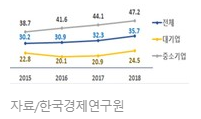
Perhaps an even better indicator of reality than the retreat in sales growth rates is the share of firms with an interest coverage ratio below 1.0. The fact that this share is steadily growing is another problem. According to the Korea Economic Research Institute (KERI), in 2018, 47.2% of small and medium-sized enterprises—nearly half—could not cover even their interest expenses with operating profit, and 24.5% of large enterprises were in the same state.
Small and medium-sized enterprises account for 99.9% of our economy and 89.8% of employment. In the case of SMEs, they are suffering in particular from the government’s income-led growth policy, which has forced wage increases and forced caps on working hours. As a result, this government coercion is driving many SMEs and small business owners toward closure, pushing workers into unemployment, and forcing incomes downward. Everyone is becoming worse off together.
This mood must be reversed. Above all, that reversal must come from the efforts of entrepreneurs. But the government’s misguided policies and regulations, which are holding back businesspeople trying to serve consumers in the market, must also be changed as soon as possible.
Large corporations are working desperately to break through today’s difficult international economic conditions. Yet the current government still treats businesspeople with hostility and is recklessly rolling out all kinds of regulatory policies. It has even done the shocking thing of trying to strip entrepreneurs of management control by mobilizing the National Pension Service, which is not even government budget money. This is why some in the business community say that the sudden death of Korean Air Chairman Yangho Cho from stress-related illness was not unrelated to this climate.
In the case of entrepreneurs, after they commit a crime and are punished, the government quietly created an enforcement decree by presidential order—without going through the legislative amendment process—so that they cannot return to their companies. Under this enforcement decree, even Samsung Electronics Vice Chairman Jae-yong Lee and Lotte Group Chairman Dongbin Shin, in line with the government’s wishes, would have to step away from the front lines of corporate activity. These regulations should be abolished, and entrepreneurs should be encouraged so that they can take the lead on the trade front.
In the case of SMEs, the aforementioned forced wage hikes and forced caps on working hours must be abolished as soon as possible. Wages should be determined in the market, and if workers so desire, working hours should not be bound by a rigid cap.
The IT era is now opening a new chapter. IT-based new industries such as Uber, Tada, and Airbnb must not be held back by old non-IT industries such as taxis and hotels. If the old era wins in this clash of eras, the new era cannot bloom.
Jongwoon Park, current affairs columnist
Original title: 악화된 경제상황 ...정부가 기업인 가둘텐가
Author: Jong-un Park
Date: 2019-11-15
Source: https://www.cfe.org/bbs/bbsDetail.php?cid=press&pn=24&idx=22055