
[Market Economy Guide] When Do People Open Their Wallets?
-
Writer
Sung-no Choi
-
 The first ice cream you eat on a hot day is the most satisfying.
By the third or fourth one, you won’t buy it no matter how cheap it is~
In the blazing summer sun, when you walk on heat-radiating ground, sweat pours down like rain and your mouth becomes parched. At a moment when you desperately crave a sip of cold water or a chunk of ice more than ever, what would you do if you saw an ice cream shop right in front of you?
Desire and Subjective Satisfaction
If you like ice cream, you would walk into the shop without hesitation and buy one. It is so hot and you are so thirsty that you would probably be willing to pay even 5,000 won for it. The pleasure of cold, sweet happiness beginning at the tip of your tongue and filling your whole mouth would surely be worth more than 2,000 won in satisfaction. What if you bought another ice cream after that? It would still taste good, but it would be hard to feel the same thrilling joy as when you took the first bite. At that point, the satisfaction would be just a little above the 2,000 won price. What about a third one? You might want one more, yet at the same time think maybe you should stop. Still, you would be willing to pay 2,000 won for it. There is no need to think twice about the fourth one. By then, you have already had enough and relieved your heat and thirst. Even if the ice cream cost 500 won, you would not particularly want it, so you would close your wallet and leave the shop.
Alfred Marshall’s Principle
Even when it is the very same ice cream, the desire to eat more of it gradually declines because the utility the consumer derives from the ice cream decreases. Utility is the degree of satisfaction one feels from buying and eating ice cream. In other words, it is “the ability of a good to satisfy human wants, or the degree of subjective satisfaction obtained from consuming it.”
Utility is important because it is a matter of “subjective value.” It is difficult for people to feel the same value under the same conditions. No matter how unbearably hot a summer day may be, some people may not find cool ice cream satisfying, and some may want ice cream but be unable to have it. The number of ice creams people eat also differs from person to person. Some may eat just one and want no more, while others may easily finish five and still want more. On this point, the British economist Alfred Marshall wrote in his Principles of Economics, “The pleasure which the same sum of one shilling affords to different persons is different.”
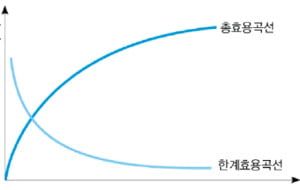
No matter how pleasant something is to hear, if you hear it more than three times, it begins to sound tiresome. As the same words are repeated, the emotional impact you felt the first time gradually fades. In this way, the subjective utility people feel always has a limit. Think again of the ice cream example. The first ice cream gave satisfaction worth more than 2,000 won. The second gave satisfaction slightly greater than 2,000 won, and the third gave satisfaction worth exactly its price, 2,000 won. But the fourth ice cream’s satisfaction fell below even 500 won. That is why by the third one you begin to wonder whether to buy another, and by the fourth there is no need to think at all—you simply snap your wallet shut.
This kind of step-by-step change in utility is called “marginal utility.” An interesting thing happens with marginal utility: as the number of units of a good consumed increases, it steadily declines. When the satisfaction gained from each additional ice cream keeps falling, utility decreases, and marginal utility falls as well. This is precisely what is called the “law of diminishing marginal utility.” In the course of our daily lives, as we consume various goods, we are already constantly encountering this law.
Marginal Utility and the Price of Goods
People pay a price only when the satisfaction they expect exceeds the price they must pay. Conversely, if the satisfaction is lower than the price, they do not pay it. In other words, consumption takes place only when there is still enough “utility” left for the individual.
That is why marginal utility is very important for analyzing consumer behavior and understanding how product prices are formed. Consumers continue purchasing goods as long as they gain satisfaction—that is, utility—greater than the cost they must pay. But at some point, when the price of the good becomes higher than the utility they expect, they stop consuming it. Just as they did not buy the fourth ice cream because it failed to provide satisfaction worth its 2,000 won price, consumers do not want to buy goods that fall short of their own utility. Ultimately, therefore, the price of a good comes to match each consumer’s marginal utility.
● Please remember
People pay a price only when the satisfaction they expect exceeds the price they must pay. Conversely, if the satisfaction is lower than the price, they do not pay it. In other words, consumption takes place only when there is still enough “utility” left for the individual.
Sung-no Choi, President of the Center for Free Enterprise (CFE)
Original title: [시장경제 길라잡이] 사람은 언제 지갑을 열까?
Author: Sung-no Choi
Date: 2019-08-26
Source: https://www.cfe.org/bbs/bbsDetail.php?cid=column&pn=12&idx=20453