
The Serious Accidents Punishment Act Fuels Anxiety by Branding People “Potential Criminals” and Needs Major Easing
-
Writer
CFE
-
 The Serious Accidents Punishment Act, which fuels anxiety by branding business owners as “potential criminals,” needs major easing
▪ It introduces imprisonment—even a statutory minimum sentence—not found in the UK’s Corporate Manslaughter Act, its original model, raising concerns about violating the constitutional principle of proportionality
▪ For prime contractors dealing with dozens or hundreds of subcontractors, preventing every serious industrial accident is practically impossible
▪ As workplaces with fewer than 50 employees also become subject to the law from 2024, calls to “please ease the law” are growing amid snowballing administrative, staffing, and facility burdens
■ Introduction
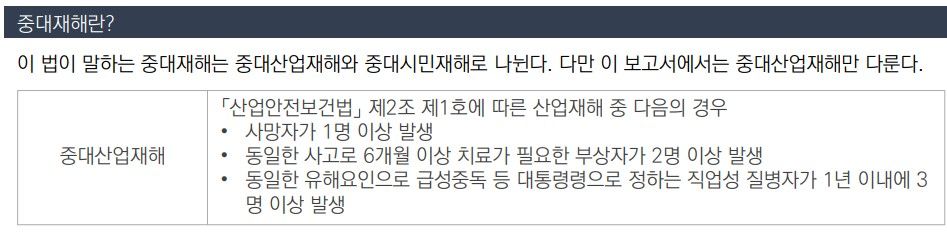
The Serious Accidents Punishment Act (hereinafter, the “Serious Accidents Punishment Act”) is a law introduced to impose civil and criminal liability on employers, responsible management personnel, and corporations when they fail to fulfill their duty to secure safety and health in connection with serious accidents involving workers and others at workplaces. The law was designed to reduce repeated industrial accidents and encourage businesses to establish sufficient preventive measures in advance. It was first proposed in 2017 by former lawmaker Hoechan Noh and was passed during the 21st National Assembly.
The Serious Accidents Punishment Act is a law that has prompted broad concern and calls for revision across the business community, regardless of company size. Critics argue that in workplace environments where it is virtually impossible to predict and prevent every accident perfectly, holding business owners and managers responsible for all serious accidents effectively treats them as “potential criminals.” In addition, the Act has continually been criticized for having not only ambiguous targets and scope of punishment compared with similar overseas legislation, but also excessively severe penalties. There is also strong dissatisfaction over the compliance costs required under the Act.
■ Main Contents
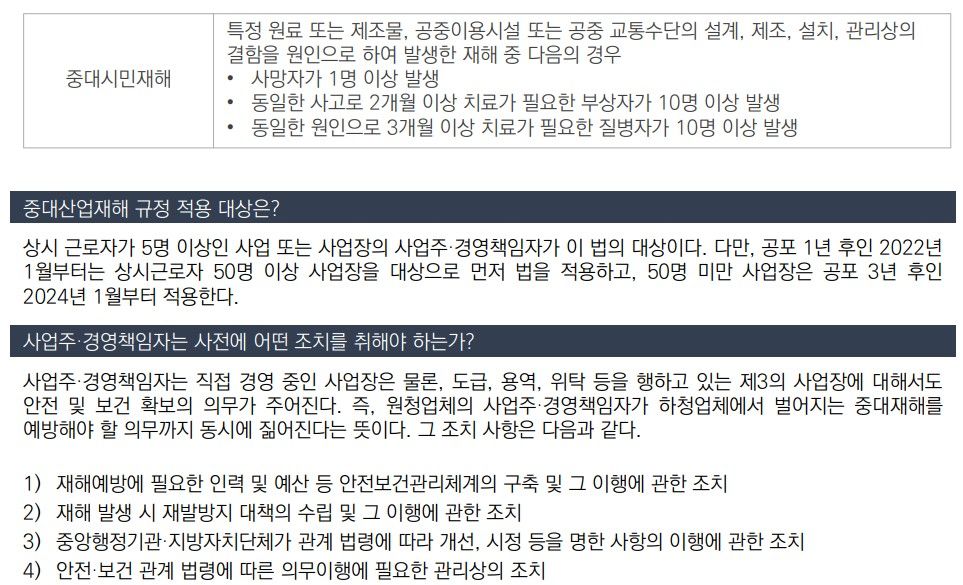
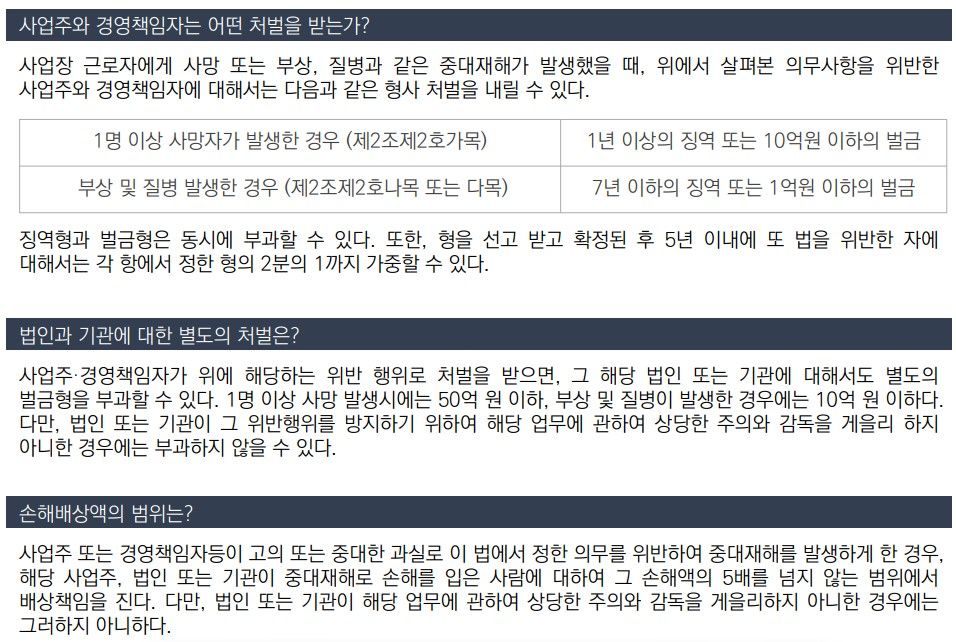
The Serious Accidents Punishment Act is a relatively concise special law consisting of 4 chapters and 16 articles. Although the Occupational Safety and Health Act, fully revised in January 2020, had already specified duties to prevent serious accidents, a broad social consensus emerged that serious accidents were still not being adequately addressed, leading to the enactment of a special law reflecting stronger punishment provisions. The law contains the definition and types of serious accidents, the subjects of protection and punishment, and the level of sanctions. The key provisions are as follows.
■ Revision Process and Legislative Status
Compared with the original bill, this law went through a process in which some provisions were moderated, including the punishment clauses and the scope of covered companies. This was the result of strong opposition from the business community, as well as concerns about “over-legislation” voiced not only by the then-opposition People Power Party but also within the ruling Democratic Party of Korea.
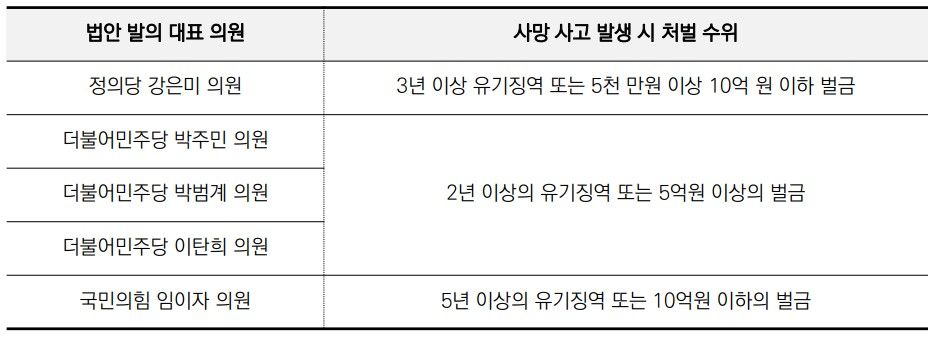
The most controversial issue in the legislative discussions was how severely business owners and responsible management personnel should be held liable in cases involving a worker’s death. Comparing the penalties for employers and responsible management personnel in fatal serious accidents between the originally proposed bills and the final enacted law shows that the member-proposed bills contained harsher punishments.
The Act passed the plenary session on January 8, 2021. Of the 266 members present, 164 voted in favor, while 44 and 58 voted against and abstained, respectively. Most lawmakers from the Democratic Party of Korea voted in favor, while lawmakers from the People Power Party were split between opposition and abstention. Meanwhile, Justice Party lawmakers, who had maintained their position in favor of the original version as the punishment provisions were partially softened, cast abstention votes, effectively signaling opposition to the law.
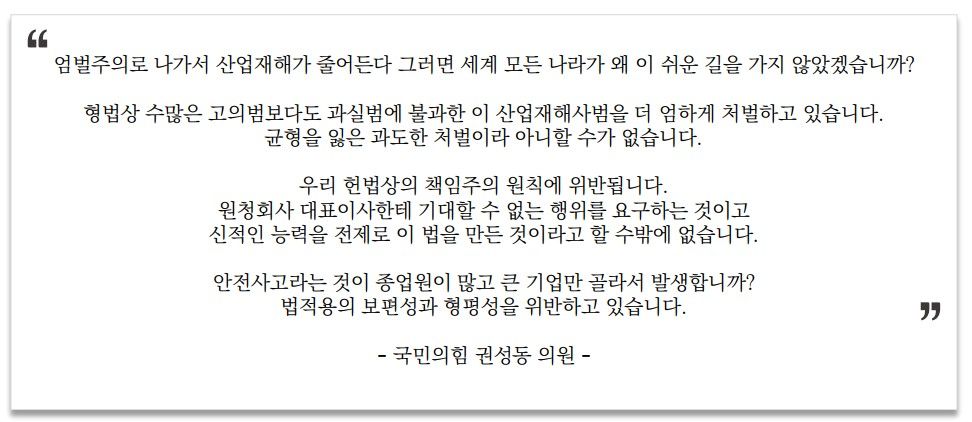
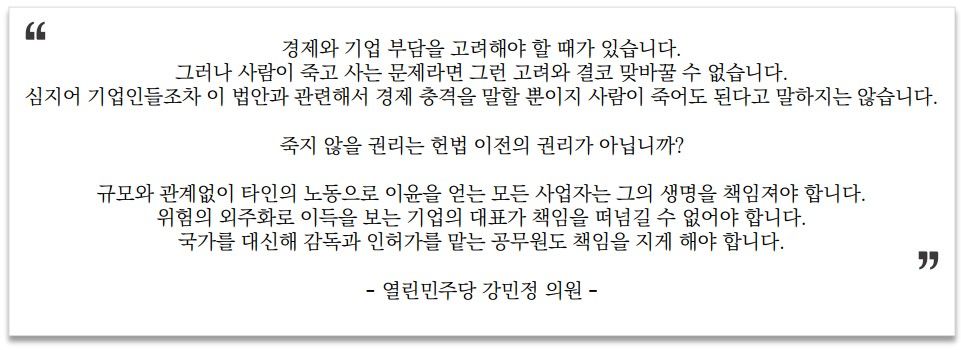
Lawmakers who took part in the plenary debate generally expressed negative views of the law. Their opposition fell into two groups. Lawmakers mainly from the People Power Party argued that the law relied only on excessive punishment and “penal populism,” and raised concerns about its negative impact on the business community and its lack of effectiveness. On the other hand, some lawmakers lamented that the punishment provisions had been excessively watered down compared with the original bill promoted by the Justice Party, thereby reducing the law’s expected effect. Some of their arguments are as follows.
■ Evaluation of the Bill
1. Introduction of punishment and imprisonment for business owners and responsible management personnel, absent even from the UK’s Corporate Manslaughter Act, the original model
Major countries around the world commonly operate laws that punish business owners and responsible management personnel when industrial accidents occur, and in Korea this role is played by the Occupational Safety and Health Act. However, countries known to have a separate special law applicable only in cases of “serious accidents” are limited to the UK, Canada, and Australia.
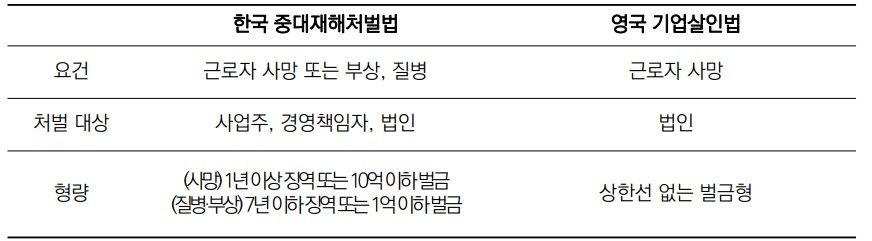
Among them, the UK’s Corporate Manslaughter and Corporate Homicide Act 2007 was the most important reference in the process of introducing the Serious Accidents Punishment Act and is regarded as its original model. In reality, however, the UK’s Corporate Manslaughter Act and Korea’s Serious Accidents Punishment Act differ greatly in character, targets of punishment, and severity. In conclusion, the Serious Accidents Punishment Act contains excessively punitive provisions. A comparison by item is as follows.
In the UK, for accidents other than death, not the Corporate Manslaughter Act but the Health and Safety at Work Act—a general law corresponding to Korea’s Occupational Safety and Health Act—is applied. In cases of worker death, only the corporation (company) bears criminal liability; business owners and responsible management personnel are not held criminally liable for negligence. Accordingly, only fines may be imposed. However, because there is no upper limit on fines, punitive fines are possible.
Meanwhile, the United States, Germany, Japan, and France do not have a separate special law for serious accidents like Korea’s Serious Accidents Punishment Act. In the United States, liability for accidents is separately imposed on corporations and employers under the Occupational Safety and Health Act, while in France it is handled under the Labor Code. Germany and Japan have no separate punishment provisions beyond the Criminal Act.
2. Statutory minimum imprisonment, hard to find in overseas cases, may violate the principle against excessive restriction
As noted above, the Serious Accidents Punishment Act provides that when a fatal serious accident involving a worker occurs, the business owner or responsible management personnel may be punished by imprisonment for at least one year or by a fine of up to KRW 1 billion. The key point here is that it sets one year or more—that is, one year—as the statutory minimum. This is where criticism arises that the Act may violate the constitutional principle against excessive restriction.
In general, the responsibility of business owners and responsible management personnel for fatal serious accidents occurring at workplaces falls under negligence. Put simply, cases in which a business owner or responsible management personnel intentionally causes a worker’s death are extremely rare. Yet under Korea’s Criminal Act, statutory minimum prison terms are generally applied to intentional crimes. For example, murder is punishable by imprisonment for at least five years, and statutory minimum sentences also exist for intentional arson and assault resulting in death. These are mostly serious crimes.
Meanwhile, the offense of occupational negligence resulting in death or injury under the Criminal Act (Article 268), which is similar in purpose to the Serious Accidents Punishment Act, is punishable by imprisonment without prison labor for not more than five years or by a fine of not more than KRW 20 million. This is a statutory maximum, not a statutory minimum.
Korea is the only country to impose a statutory minimum prison sentence on business owners and responsible management personnel in cases of serious accidents. In March 2021, the business community officially requested revision of the law, stating that “criminally punishing business owners and responsible management personnel—who bear supervisory responsibility based on negligence—more heavily than the actual violator simply because they oversee corporate management is inconsistent with Korea’s criminal law system.”
3. It is excessive to impose the “same responsibility” on prime contractors as on subcontractors
With respect to the “duty to secure safety and health in contracting, service, consignment, and similar relationships” prescribed in Article 5 of the Serious Accidents Punishment Act, companies likely to fall under the category of prime contractors have complained of excessive burdens.
Their argument is that while prime contractors that effectively direct and operate a workplace may bear some responsibility for certain serious accidents, the extent of that responsibility cannot be the same as that of the business owners and responsible management personnel of subcontractors, who hold the most direct management and operational authority. In particular, when a subcontractor’s worker is a specially employed worker, there are limits on the prime contractor’s ability to directly supervise that worker. In addition, there is concern that subcontractors, which themselves have a duty to prevent serious accidents, may use this law as a basis to shift responsibility onto prime contractors.
A review of similar overseas legislation also shows no cases in which prime contractors are assigned the same responsibility as subcontractors. Rather, liability is recognized proportionately according to the contractual relationship between the prime contractor and subcontractor.
4. The smaller the company, the greater the cost burden
The Serious Accidents Punishment Act first took effect one year after promulgation for workplaces with 50 or more employees, and from January 2024, it additionally applies to workplaces with fewer than 50 employees.
The problem is that the administrative and financial burden of complying with the obligations prescribed by the Act is substantial, making compliance more difficult for smaller businesses. Under the Enforcement Decree of the Serious Accidents Punishment Act, companies must establish a dedicated department to oversee and manage safety and health affairs, and must secure the personnel, facilities, and equipment necessary for accident prevention and safety and health. They must also assign specialized personnel such as safety managers and health managers required under the Occupational Safety and Health Act.
According to the “Survey on the Serious Accidents Punishment Act and Safety Management Conditions among SMEs” released by the Korea Federation of SMEs in July 2023, 40.8% of the 250 responding workplaces with fewer than 50 employees said it would be impossible or difficult to comply with the obligations under the Act from 2024. Meanwhile, 58.9% said that implementation of the law should be postponed for at least two more years.
Original title: '잠재적 범죄자' 낙인 불안 조장하는 중대재해처벌법, 대폭 완화 필요
Author: Ju-jin Yoon
Date: 2023-09-06
Source: https://www.cfe.org/bbs/bbsDetail.php?cid=bill&pn=2&idx=26003